
About Dwain Chambers
Born 1978. Dwain Chambers is a British rugby league player, sprinter and american football player.
Biography Early life and career Chambers was born in Islington, and raised in Finsbury Park, London. Running was a part of his family life: his older sister Christine won the senior 100 metres Finals at the English Schools Championships in 1986 and 1987 and competed in the European Athletics Junior Championships. As a schoolboy he was coached by Selwyn Philbert who devoted himself to the young sprinter. Chambers first athletic success came at the 1994 English Schools' Athletic Association Championships, where he won the boys' intermediate 100 m race with a time of 10.64 seconds. International medals followed at the 1995 European Junior Championships, at which he won the 100 m and the 4 × 100 metres relay. He defended these titles at the 1997 European Junior Championships, and set a then world junior record in the 100 m with a time of 10.06 s. He achieved a new personal best in September at the 1998 IAAF World Cup with a run of 10.03 s for third place and won a relay gold medal. At the 1998 Commonwealth Games he was a 100 m semi finalist and set a games record as part of the 4 × 100 m relay team. His ability attracted the attention of former sprinter and Commonwealth Games gold medallist Mike McFarlane, who became his coach. In spite of this, Chambers remained some distance behind his North American counterparts in terms of times.
Seville World Championships to Sydney Olympics In his first major outing on the world stage, Chambers attained a new personal best at the 1999 World Championships in Seville, registering a time of 9.97 s for third place in the 100 m final. This made the 21-year-old the youngest ever World Championships 100 m medallist. The British sprint team Chambers, Gardener, Campbell and Marlon Devonish performed well in the 4 × 100 metres relay event as runners-up in a time of 37.73 s behind the US team led by Greene. World record holder Maurice Greene was hitting his peak, winning three gold medals in Seville. However, at 21 years old, Chambers had achieved more than Greene had at that age: Greene's best was 10.08 s in 1996 and he had never reached a major final.
With the 2000 Sydney Olympics approaching, Chambers studied the technique of other sprinters. In an interview with BBC journalist Tom Fordyce, Chambers commented on the stamina Greene and Surin had gained from running in the 200 metres event and Jason Gardener's improved acceleration through running the 60 metres event. He experimented with distances at the beginning of 2000, sprinting over 50, 60 and 200 m in various competitions. He set a personal best of 6.55 s in the 60 m event in Ghent in February. A late rejuvenation at the British Olympic trials guaranteed his selection as he snatched first place with 10.11 s (just one hundredth of a second ahead of Darren Campbell). Victory against in-form world record holder Maurice Greene in Gateshead raised Chambers' confidence and he stated his aim to take home a medal from the Games.
The 2000 Sydney Olympics saw Chambers come close to the podium. He easily qualified through the heat stages and achieved a season's best of 10.08 s in the 100 m final finishing fourth behind Greene, Ato Boldon and Obadele Thompson. Chambers was the best European 100 m performer, but after disqualification in the relay heats he left the games without a medal. At the Amateur Athletics Association (AAA) trials in Birmingham his run of 10.01 s was the fastest ever wind-legal time recorded in Britain by a British sprinter. Chambers ran with consistency in the summer of 2001: he won at the Seville Grand Prix in 10.01 s and finished third in ten seconds flat at the Athletissima meet. In the run up to the 2001 IAAF Edmonton World Championships Chambers compared his own performances to the British record holder: "I am very consistent in the 10.00s this year, and that bodes well for the Worlds. If you are running as fast as Linford Christie in his prime, it gives you a lot of confidence."
Chambers also competed over 200 m and a personal best run of 20.31 s earned him selection in both sprints for the World Championships. In an interview with Tom Fordyce, Chambers stated that Maurice Greene's strong presence and mind games undermined the competition both physically and mentally. "You have to get out in front of him and hold on for dear life" he said of the world record holder. This was not enough for a medal in a strong race which featured five sprinters running under ten seconds and saw Greene defend his title. Chambers was later upgraded to fourth place after silver medallist Tim Montgomery tested positive for banned substances. A hamstring injury in the final ruled him out of the 200 m event. Chambers ended his season at the 2001 Goodwill Games in Brisbane, and finished in first place in the absence of an injured Greene, who commentated on his European rival's victory.
2002 European champion Chambers' coach Mike McFarlane struggled with the workload of full-time training. Frustrated by the distance between himself and the top sprinters, Chambers decided to relocate to California to work with Ukrainian coach Remi Korchemny and nutritionist Victor Conte. After parting ways with American sprinter Tim Montgomery, Conte looked to Chambers to fill the athlete's berth. In the run up to the year's major events, Chambers was in fine form and recorded a 200 m personal best of 20.27 s in Athens on 10 June 2002. Montgomery, impressed by Chambers' training regime, tipped the Briton to win the gold at the forthcoming 2002 Commonwealth Games in Manchester, England.
I'm not taking anything away from Dwain. He was better prepared than me and fully deserved the victory. He's getting better and better. I can't be mad with myself – he ran so well. then equalled Linford Christie's record of 10.04 s at European Cup, Victories over Maurice Greene followed at Oslo's IAAF Golden League meeting and in Sheffield with a wind-assisted 9.95 s. He was the favourite for the 2002 Commonwealth Games, but Chambers faced stiff competition from British newcomer Mark Lewis-Francis who was finishing fractions of a second behind him. but he suffered a cramp mid-race and ended up in last place. The English sprinters had the three slowest times in the final, with Lewis-Francis also beset by injury.
After Commonwealth disappointment on home turf, Chambers won gold medals in the 100 m and 4 × 100 m relay at the 2002 European Championships in Munich, setting a championship record of 9.96 s. Chambers recorded a time of 9.94 s at the Weltklasse Zürich meeting, again beating world record holder Greene. He finished the season by equalling Linford Christie's European record at the 2002 IAAF Grand Prix Final. His run of 9.87 s with a maximum allowable wind of +2.0 m/s left him second to Tim Montgomery, who set a world record of 9.78 s. Chambers received the 2002 European Athlete of the Year trophy for his achievements on the track that year.
2003 World championships Chambers began the 2003 season with a grandiose statement – namely that he would lower the 100 m record to 9.65 s. After recovering from a minor injury he suffered in January, Despite claims he could also beat the 60 m indoor record, his form was poor and he failed to pass the heats at the 2003 British Grand Prix, finishing fourth in a time of 6.68 s. He was beaten by Mark Lewis-Francis by a hundredth of a second at the trials for the IAAF World Indoor Championships, narrowly missing out on selection with a time of 6.59 s.
Chambers announced that he was to part with trainer Mike McFarlane in favour of a permanent relationship with Ukrainian coach Remi Korchemny. The sprinter started the 100 m season modestly, finishing third and fourth in Modesto and Eugene, respectively. Chambers beat Montgomery in Glasgow in June, running a stadium record of 10.15 s into a headwind, and qualified for the World Championships by winning the AAA trials.
His season's best came under unusual circumstances at the British Grand Prix – due to a system malfunction he was initially timed by hand at dead on ten seconds, which was amended to 9.96 s after video evidence was consulted. Chambers squandered his anchoring lead in the 4 × 100 m relay, allowing Joshua J. Johnson of the United States team to beat him to the finish line.
Doping ban A sample for an out-of-competition drugs test that Chambers had provided in Germany on 1 August 2003 was re-examined in October and subsequently tested positive for banned substances. The United States Anti-Doping Agency (USADA) were investigating the Bay Area Laboratory Co-operative (BALCO); the workplace of both Chambers' coach Remi Korchemny, and nutritionist Victor Conte. Both men faced charges of distributing illegal drugs to athletes in the United States. The BALCO Scandal uncovered drug use in a wide range of sportsmen and women, including sprinters Marion Jones and Tim Montgomery.
After further investigation, it was revealed on 22 October 2003 that Chambers had tested positive for the banned steroid THG. The disciplinary hearing on 24 February 2004 resulted in a two-year ban from athletics, backdated to begin on 7 November 2003. Chambers denied that he had any knowledge that the substance he was taking was banned and claimed he was deceived by Conte over its true use. By Chambers' own admission in 2008, in a letter by his supplier Conte to British anti-doping chief John Scott, THG was not the only substance he had used during his career. In his confession he admitted to the use of epitestosterone cream, EPO, HGH, insulin lispro, modafinil and liothyronine.
Banned from competition, Chambers sought alternative commercial outlets for his athletic prowess. He had an unsuccessful American football try-out with the San Francisco 49ers, hoping to emulate Renaldo Nehemiah. He drifted on to the celebrity circuit, appearing on British reality television series Hell's Kitchen in May 2004. However, Chambers had little interest in the show and soon chose to leave. He appeared in neither sporting events nor television programmes for 18 months. After further disclosure (that took away his European 100 m gold medal and invalidated his European record of 9.87 s), Chambers was cleared to compete on 10 June 2006, although his return was dependent on an agreement to repay prize money he won while using banned substances. He returned to competition on 11 June 2006 at the British Grand Prix and took third in 10.07 s, behind Asafa Powell who equalled his own world record. Chambers stated that his training regime with Bolt had helped him make a strong opening performance despite a long absence from competition. The result placed Chambers at the top of the British rankings and was the second fastest time by a European sprinter in 2006.
Ironically, with the exception of the 9.87 s he clocked to equal Linford Christie's British record in Paris in 2002, Chambers was a consistently quicker athlete before he moved to San Francisco that year and became entangled in the drugs net spun by Victor Conte, and the Bay Area Lab Co-operative. He was part of the gold medal-winning British 4 × 100 m team, but Darren Campbell, who was angry about losing his 2002 and 2003 relay medals due to Chambers' ban, refused to join the team in a celebratory lap. After the competition, Chambers again expressed an interest in switching to American football, and completed a week-long NFL Europa training camp in Cologne that November.
American Football Chambers signed for BAFA National Leagues side Farnham Knights in 2005, After attending a series of NFL Europe training camps, he gained a contract with German NFL Europa side Hamburg Sea Devils in March 2007. Following news that Chambers was receiving new, legal nutritional supplements from Victor Conte, the Hamburg Sea Devils confirmed that Chambers would undergo a vigorous drug testing regime.
When asked whether a clean athlete was likely to beat one using drugs in an Olympic final: "It's possible, but the person that's taken drugs has to be having a real bad day. That's what I believe". Chambers claimed there would always be athletes using performance-enhancing drugs because drug testers did not keep pace with advances in science and that athletes who took drugs had an immense advantage over those who remained clean. Chambers was roundly condemned for his comments in the interview by both the press and his former colleagues in the athletics world, including Sir Steve Redgrave, Mo Farah, and Sebastian Coe.
Chambers' American football career was brought to a standstill when a stress fracture injury on his right foot ruled him out for the season. The situation worsened further when the NFL closed the European league on 29 June 2007 leaving Chambers jobless. He returned as a TV personality on reality television show Cirque de Celebrité in October but was unpopular with the public and subsequently voted off.
Athletics again and rugby league Following the collapse of the NFL Europa franchise, Chambers made a second return to athletics in early 2008. Competing in the 60 m indoor final at the Birmingham Games in February 2008, he finished with a time of 6.60 s, setting a new meeting record. UK Athletics stated that committee was "unanimous in its desire not to select Dwain" but were forced to by the selection criteria, saying they would have preferred to send younger athletes eligible for the Olympics.
At the World Indoor Championships 60 metres final, Chambers won a silver medal and recorded a new personal best of 6.54 s to take second behind Olusoji Fasuba. The performance did not sway opinion: Chambers continued to encounter extensive criticism within athletics. Promoters did not invite him to key athletics events, Eddie Kulukundis – who had supported Chambers earlier in his career – refused to sponsor the sprinter, and the British Olympic Association (BOA), prevented him from competing in the 2008 Summer Olympics in Beijing. To return to the track Chambers had to rely on the money he received from his partner, Leonie Daley, a civil servant whom he met at the Miss Jamaica UK competition. The couple now had a child, a boy named Skye who was born in September 2005. He amassed a selection of cuttings about his fall from grace and the BALCO Scandal in order to show his son the risks of drug abuse.
Chambers tried to fashion himself as a living example of the dangers of drugs, sporting a T-shirt in Valencia with an anti-drugs slogan of "Just Say No!". He also expressed regret about previous comments suggesting that drug use was necessary to reach the upper echelons of athletics and set about presenting himself as a changed, clean athlete – devoid of the bravado that had marked his earlier career. Chambers' reinvention was met with a mixed reaction and the acceptance of a proven drug user on the track was not palatable to some. Dame Kelly Holmes, and parts of the British press called for Chambers to retire from the Great Britain athletics team.
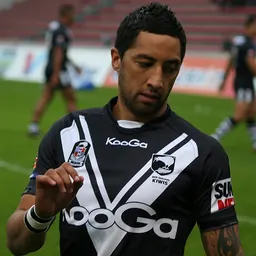
Chambers' return to athletics took an unusual turn when he confirmed in March 2008 that he had joined English rugby league team Castleford Tigers on trial; a move which surprised and angered in equal measure given the fact he had never played the sport before. The Rugby Football League did not object to the move, in spite of his drug-damaged reputation, but stated much improvement was needed prior to any appearance for Castleford in the Super League competition. At a rugby press conference, Chambers expressed a desire to compete in the Beijing Olympics, casting doubt on his dedication to his new career. Chambers officially registered as a player with the Rugby Football League, and Martin Offiah declared that he was prepared to mentor Chambers. He completed training with the Castleford Tigers first-team squad and made his début in a reserve game against York City Knights, but Castleford announced that they would not be offering him a contract.
High Court challenge
In May 2008 Chambers announced that he was challenging his Olympic ban at the High Court of Justice. Chambers returned to sprinting in June and, in his first 100 m race since August 2006, he won the Papaflessia meet with a time of 10.26 s. He achieved the "A" Standard for the 2008 Beijing Olympics in June and won the British Olympic trials in ten seconds flat in July. Public opinion on an Olympic appearance remained split.
His performance at the Olympic trials was in vain as Mr. Justice Mackay upheld the BOA ban in the High Court of Justice and stated that a right to work was not sufficient reason to remove it. The BOA chairman, Lord Moynihan, was satisfied with the outcome, stating that those abusing drugs did not deserve to represent Great Britain at the Olympics. However, he lamented that a sprinter of Chambers' calibre had in effect excluded himself from the competition.
It is a matter of regret that Dwain Chambers, an athlete with such undoubted talent…should by his own actions put himself out of the running to shine on the Olympic stage in Beijing. but he had no intention to retire and set an appearance in the 2012 London Olympics as his main goal, aiming to prove he could perform without the use of drugs. Lord Moynihan objected to this, saying it would sully the reputation of both the Great Britain athletics team and the London Olympics. In late 2008 Chambers signed a book deal, covering his athletics career and drug usage, and stated his desire to become a sprint coach when his track career was finished. He had his second child, a boy named Rocco, that November.
Charles van Commenee's appointment as head coach of UK Athletics brought a change of approach towards Chambers as both the new coach and Niels De Vos welcomed him back to compete internationally. The pair judged that he had served his sentence – van Commenee was especially complimentary, stating: "He is a likeable guy and a damned fine athlete". That month Chambers appeared at a "Tackling Doping in Sport" conference and told of the damage drugs had caused to his career, health, and finances. The Olympic ban remained in place, however, and London 2012 chairman Sebastian Coe said: "I am clear cut on the Chambers case – I don't think there is room for drugs cheats in sport". He intensively studied the technique of Usain Bolt to improve his own times, seeing Bolt as the new generation's Maurice Greene. Though he was still banned from Euromeetings-organised events, he set a new personal best of 6.52 s in the 60 m at the Birmingham Indoor Grand Prix, then became the UK Indoor Champion, equalling Mike Rodgers' world leading time of 6.51 s. At the 2009 European Indoor Championships he broke Ronald Pognon's European 60 m record with a 6.42 s run in the semi-finals, then won the gold medal with a time of 6.46 s in the final. British head coach van Commenee stated that Chambers had undergone vigorous testing and that his performance sent "a message that you can win and break European records in the proper way."
The record-breaking performance brought him an invite from the Berlin IAAF Golden League meet, although organising group Euromeetings condemned the move. Revelations in Chambers' autobiography Race Against Me brought further controversy as the book had in-depth accounts of his past drug abuse and claimed drug use remained rife in athletics, estimating that half the American Olympic athletes in Beijing had used illegal substances. Chambers signed a statement with UK Sport, verifying that he believed the information to be true, which brought a close to the organisation's inquiries into his drug use. An IAAF investigation concluded that the book demanded no further action on their part. Olympic gold medallist and anti-drugs campaigner Ed Moses gave his support, saying that Chambers admissions provided a useful insight, but that athletes and administrators remained in denial about the high levels of doping in athletics.
Invites to Golden League meets never materialised, but he continued to run at smaller events. He ran a European leading time of 10.06 seconds at Papaflessia in Greece, and won the 100 m and 200 m races at the 2009 European Team Championships. He was the fastest entrant at the national championships but 2008 runner-up Simeon Williamson won the final by some distance. The result took Chambers by surprise and he said that limited opportunities to race had made him complacent. He later withdrew from the 200 m race citing exhaustion.
At the World Championships Chambers finished sixth in 100 m final with a season's best of 10.00 seconds. He was the only sprinter from outside the Americas in the final and was some distance behind Bolt who ran a world record of 9.58 seconds. However, he was pleased with his performance and said he was happy just to be involved in the fastest 100 m race ever. He pulled out of the 200 m with a calf injury and called an end to his season.
World indoor champion
The following year, he began by focusing on the 2010 IAAF World Indoor Championships, and he won the 60 m at the UK trials in 6.50 seconds (a time only he had bettered in the previous two seasons). His closest competitor, Ivory Williams, received a ban for marijuana usage, leaving Chambers as a strong favourite. He was the fastest in all rounds of World 60 m competition, and surged ahead of Mike Rodgers in the final to win his first world title with a time of 6.48 seconds. Banned from the 2010 Commonwealth Games, he set his sights on making the team for the 2010 European Athletics Championships.
At the start of the outdoor season he had wins in Maringá in Brazil and at the Cezmi Or Memorial. He beat Christophe Lemaitre to win the 100 m at the 2010 European Team Championships, helping Great Britain to second place in the tournament and recording 9.99 seconds – the first sub-10 time by a European athlete in almost four years. Lemaitre and Chambers were seen as the only gold medal contenders for the 100 m final at the European Athletics Championships, but the event defied expectations in terms of times and placings. The Frenchman won in 10.11 seconds into a headwind while a tight finish between the four following athletes (all 10.18) saw Chambers finish fifth.
2011–2012: World and Olympic semi-finalist The start of his 2011 season saw him take a fourth consecutive national title over 60 m with a European-leading time. At the 2011 European Athletics Indoor Championships the following month he was beaten to the line by Obikwelu, although he was pleased with the silver medal as he had changed his training to focus towards the 100 m for that season. Four straight wins on the Brazilian Athletics Tour came at the beginning of his outdoor season in May, including a season's best of 10.01 seconds, and he took his fifth national title at the British trials. At the 2011 World Championships he reached the 100 m semi-finals but fell foul of the IAAF's new false start rule: he twitched in his blocks and was immediately disqualified.
He won his fifth national title in the 60 m in 2012 with a season's best of 6.58 m. A third consecutive podium finish came at the 2012 IAAF World Indoor Championships, where he pipped Trell Kimmons to the bronze medal. Chambers was given the chance to return to the Olympic stage after the Court of Arbitration for Sport (CAS) decided in favour of the World Anti-Doping Agency over the validity of British Olympic Association's (BOA) Olympic ban by-law. CAS agreed that the law was non-compliant with the World Anti-Doping Code, to which the BOA was signatory due to its connection with the International Olympic Committee. Chambers ran a 150 m-straight best of 15.27 seconds at the Great City Games in May then won the 100 m Olympic trial race, holding off emerging teenager Adam Gemili. His absence from the major track circuit came to an end with a run at the Diamond League London Grand Prix, although he did not achieve the Olympic "A" standard time there.
Chambers was named in the British squad for the 2012 London Olympics after the selectors took into account his trials win and his times from the previous year. Given the abrupt turnaround in his fortunes, he said: "For me representing my country in an Olympics is a privilege that should never be taken for granted. To be given the opportunity to do so in my home town has been a dream that at times has seemed very distant and is now a reality." He returned to the British relay team at the 2012 European Athletics Championships after a six-year absence but a botched baton change saw the team disqualified. At the Olympics he won his 100 metres heat in a season's best of 10.02 seconds, with a legal 2.0 m/s following wind, in his first Olympic race in twelve years. He was drawn in the same semi-final as Usain Bolt but Chambers' run of 10.05 seconds for fourth meant he did not make the final. His Olympics came to an end in the 4 × 100 metres relay heats as the British team made an illegal baton exchange.
Later career Chambers began his 2013 season with a 60 m win in Glasgow with a run of 6.58 seconds. A back injury affected his preparations for the 2013 European Indoor Championships, where he was eliminated in the heats. Outdoors, he won his fourth consecutive British Championship title, running 10.04. A month later at the World Championships in Moscow, he ran 10.14 in his heat to reach the semi-finals, where he was eliminated running 10.15. He ended the year with second-place finishes at the Rieti Challenge and Great North City Games. Chambers won his final medal in international competition at the 2014 IAAF World Relays in May, anchoring a team of Kilty, Harry Aikines-Aryeetey and James Ellington to a bronze. He won a fifth straight national title at the 2014 British Athletics Championships. Initially selected for the relay at the 2014 Commonwealth Games, he pulled out to focus on what would be his final international appearance at the 2014 European Championships in August. Chambers missed out on a final individual medal by 0.02 seconds, finishing fourth in the 100 m final in 10.24, while his teammates Dasaolu and Aikines-Aryeetey reached the podium.
Chambers attended just two meets in 2015. He had a more active 2016, winning his heat and semi-final in the 60 m at the British Indoor Championships but only managed seventh in the final. At the outdoor national championships in June, he made the final of the 100 m in which he ran a heavily wind assisted (+3.0 m/s) 10.11, which once again saw him finish seventh. In 2017, Chambers came third at the national indoor championships in 6.62 but was not selected for the 2017 European Indoor Championships. He could only reach the national semi-finals outdoors in July in the 100 m,
In December 2018, at the age of 40 Chambers returned at a low-key meet in London. He progressed from his heat, but was disqualified after a false start in the semi-final. In February 2020, Chambers once again returned to the British Indoor Championships. He finished last in his semi-final after coming through the heats. He went on to compete at the UK Indoor Championships in February 2024, reaching the semi-finals. He ran at two events in 2025, finishing the 60 metres in under seven seconds in both.
He is also a public speaker and gave his first TedX in October 2023.
Statistics
Chambers' performances at tournaments in the 100 metres event make him one of the fastest European sprinters in the history of recorded athletics. His personal best of 9.97 s set at the 1999 Seville World Championships places him, as of 2025, in the top 20 fastest Europeans in the 100 m Chambers' annulled 9.87 s finish at the Paris Grand Prix in 2002 would have made him the joint fastest British 100 m sprinter with Christie and the joint second fastest European in the event. and, as of 2025, is the ninth-fastest Briton of all time over 100 m.
His personal best of 6.42 in the 60 metres set in 2009 was a European record for over a decade, with Marcell Jacobs beating that by one hundredth of a second in 2022. As of 2025, it remains the second fastest mark by a European, and within the top ten fastest globally.
Personal bests Excludes times nullified due to Chambers' positive drugs tests and subsequent ban – All information taken from IAAF profile.
International competition record †Amended from fifth after Tim Montgomery tested positive for banned substances Excludes results nullified due to Chambers' positive drugs tests and subsequent ban.
Don’t just read it —
keep it.
Full-length biographies made to live with: read them, listen on the way to work, watch them tonight.
- E-book
- Audio
- Video
Instant download · yours to keep · every purchase keeps this site free
Important facts
People in Dwain Chambers's life
Named in this biography and alive at the same time





Related people
Same field, nearest in time



Contemporaries
People whose lives overlapped Dwain Chambers's



Frequently asked questions
Who is Dwain Chambers?
English sprint athlete
When was Dwain Chambers born?
Dwain Chambers was born on 5 April 1978 in London.
What is Dwain Chambers's occupation?
Dwain Chambers is a rugby league player, sprinter and american football player.
What nationality is Dwain Chambers?
Dwain Chambers is British.
Sources & further reading
Cite this page
APA: Biography.guide. (2026). Dwain Chambers. https://biography.guide/dwain-chambers/
MLA: "Dwain Chambers." Biography.guide, https://biography.guide/dwain-chambers/.
Chicago: "Dwain Chambers." Biography.guide. https://biography.guide/dwain-chambers/.
Data last updated: 2026-09-20 · Spot an error? Report a correction.
Page generated 2026-09-27 05:21 UTC