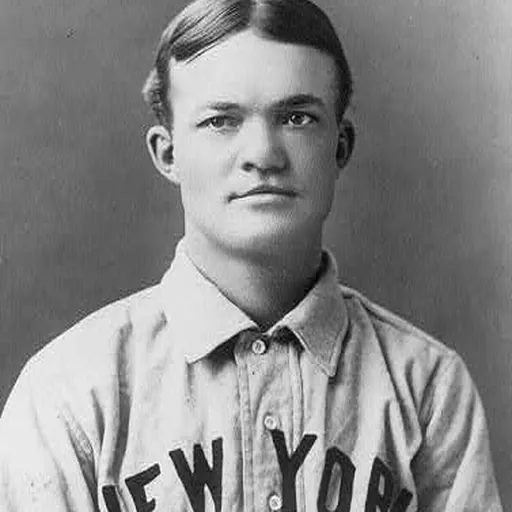
About Dummy Taylor
Lived 1875 – 1958 (aged 83). Dummy Taylor was an American baseball player.
Luther Haden "Dummy" Taylor (February 21, 1875 – August 22, 1958) was an American right-handed pitcher in Major League Baseball from 1900 to 1908 who was deaf. He played for the New York Giants and Cleveland Bronchos and was one of the key pitchers on the Giants' National League championship teams of 1904 and 1905.
In 1901, his first full season in the major leagues, Taylor led the National League by pitching in 45 games and ranked second in the league with 37 complete games. In 1904, he won 21 games for the Giants, and in 1906 his 2.20 earned run average was the lowest on a pitching staff that included Baseball Hall of Famers Christy Mathewson (2.97), and "Iron Man" Joe McGinnity (2.25).
Taylor was the only successful deaf pitcher in Major League Baseball and was regarded, along with Dummy Hoy, as a role model and hero for hearing impaired Americans in the early 20th century. In the 1900s, Taylor was reported to be the highest paid deaf person in the United States. He was also known as the comedian of the Giants teams, waving a lit lantern when an umpire refused to call a game due to darkness and coaching at third base in rubber boots when an umpire refused to call a game due to rain.
In 2000, author Darryl Brock wrote the historical novel Havana Heat about Taylor's experience in professional baseball. The book won the Dave Moore Award in 2000 as the "most important baseball book" published that year.
Early years Taylor was born in Oskaloosa, Kansas in 1875. He was the son of Arnold B. Taylor, a farmer, and his wife, Emaline (Chapman) Taylor. At the time of the 1880 United States census, Taylor was living in rural Jefferson County, Kansas with his parents, two older brothers, and two older sisters. However, at age four, Taylor was not listed as being "deaf and dumb" or otherwise disabled in the family's U.S. Census record. By age 10, Taylor was living at the Kansas School for the Deaf in Olathe, Kansas. He was listed in the 1885 Kansas State Census as a pupil at the Deaf and Dumb Institute.
Taylor continued to live at the Kansas School for the Deaf through his high school years. He was a pitcher for the school baseball team and also participated in boxing. Interviewed in 1942, Taylor recalled he had dreams as a boy of becoming a great boxer, but his parents objected. At the time of the 1895 Kansas State Census, Taylor was living in Olathe.
Semi-pro and minor league baseball After leaving the Kansas School for the Deaf, Taylor began playing semi-pro baseball with a team in Nevada, Missouri. He then played at Lincoln, Illinois, and with minor league teams in Wabash, Crawfordsville, Danville and Terre Haute, Indiana. In 1897, he played for a minor league team in Mattoon, Illinois. He played for the Shreveport Tigers of the Southern League in 1898 and 1899.
Major League Baseball First stint with Giants In August 1900, Taylor was called up to the major leagues to play for the New York Giants. He made his major league debut on August 28, 1900. In his first game for the Giants, five Boston players tried to take advantage of Taylor's deafness by trying to steal third base. Interviewed in 1942, Taylor recalled with pride, "I nailed each one. I walked over to (Herman) Long, the last man caught, and let him know by signs I could hear him stealing."
In his second season in the major leagues, Taylor was a workhorse for the 1901 Giants. He led the National League with 43 games started and by appearing in a total of 45 games. He also ranked second in the league with 37 complete games, innings pitched, and 1,518 batters faced. With the absence of run support, Taylor finished the season with a win–loss record of 18–27. His 27 losses in 1901 is tied for the second most given up by any pitcher in Major League Baseball during the 20th century (trailing Vic Willis's 29 losses in 1905).
Cleveland Bronchos In March 1902, Taylor signed for more money with the Cleveland Bronchos of the American League. Bowerman sat in the stands while Taylor was pitching and negotiated the terms of Taylor's return to the Giants by signing. Taylor recalled:
John McGraw recalled an occasion when he, too, was cursed out by Taylor: "In sign language, Dummy consigned me to the hottest place he could think of—and he didn't mean St. Louis."
Later years After his retirement from baseball, Taylor returned to Olathe and the Kansas State School For the Deaf, where he worked as a teacher and coach. He also served as an umpire from 1915 to 1920, working games for the House of David and Union Giants. At the time of the 1915 Kansas State Census, he was living in Olathe with his wife, Della M. (Ramsey) Taylor. At the time of the 1920 United States census, Taylor was living at the Kansas School for the Deaf where he was employed as the physical instructor.
Taylor subsequently moved to Iowa where he worked as a coach at the Iowa School for the Deaf. At the time of the 1925 Iowa State Census, he was living at the Iowa School for the Deaf in Lewis Township, Pottawattamie County, Iowa.
In 1927, several newspapers reported Taylor had died. Taylor issued a statement from his home in Iowa, emphatically denying he was dead. Taylor's statement resulted in headlines in papers across North America such as, "'Dummy' Taylor Denies being Dead." It turned out Taylor had been confused with another deaf baseball pitcher, Lyman "Dummy" Taylor.
At the time of the 1930 United States census, Taylor was still living at the Iowa School for the Deaf. His occupation was listed as a coach, and he was listed as living with his wife, Della M. Taylor, a teacher at the school.
Taylor later was employed at the Illinois School for the Deaf in Jacksonville, Illinois. When he was interviewed in 1942 for a feature story in The Sporting News, Taylor was employed as a coach and "house father" at the Illinois School for the Deaf. Taylor married for the third time to Lina Belle Davis from Little Rock, Arkansas in August 1941.
In August 1958, Taylor died at Our Savior's Hospital in Jacksonville, Illinois. He was buried with his first wife, Della, at Prairie City Cemetery in Baldwin City, Kansas.
He was the last surviving member of the 1905 World Champion New York Giants.
Cultural references Taylor is used as the narrator and hero of Darryl Brock's fictional account of his later life, Havana Heat.
Don’t just read it —
keep it.
Full-length biographies made to live with: read them, listen on the way to work, watch them tonight.
- E-book
- Audio
- Video
Instant download · yours to keep · every purchase keeps this site free
Important facts
People in Dummy Taylor's life
Named in this biography and alive at the same time




Related people
Same field, nearest in time


Contemporaries
People whose lives overlapped Dummy Taylor's

Frequently asked questions
Who was Dummy Taylor?
Major League Baseball pitcher (1875-1958)
When was Dummy Taylor born?
Dummy Taylor was born on 21 February 1875 in Oskaloosa.
When did Dummy Taylor die?
Dummy Taylor died on 22 August 1958 in Jacksonville.
What was Dummy Taylor's occupation?
Dummy Taylor was a baseball player.
What nationality was Dummy Taylor?
Dummy Taylor was American.
Sources & further reading
Cite this page
APA: Biography.guide. (2026). Dummy Taylor. https://biography.guide/dummy-taylor-baseball-player/
MLA: "Dummy Taylor." Biography.guide, https://biography.guide/dummy-taylor-baseball-player/.
Chicago: "Dummy Taylor." Biography.guide. https://biography.guide/dummy-taylor-baseball-player/.
Data last updated: 2026-09-20 · Spot an error? Report a correction.
Page generated 2026-09-27 05:09 UTC