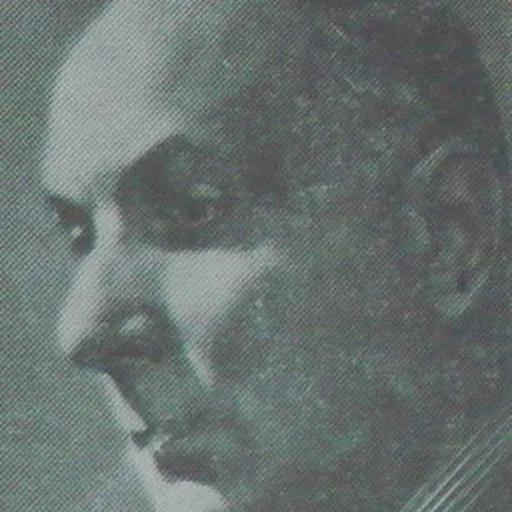
About Duiliu Marcu
Lived 1885 – 1966 (aged 80). Duiliu Marcu was a Romanian architect.
Duiliu Marcu (25 March 1885 – 9 March 1966) was a Romanian architect, one of the most well known and prolific of the interwar period. With a career spanning from 1912 to 1966, he is said to have designed 150 public and private projects across Romania, his work reflecting the evolution of local architecture in the first half of the 20th century from French Renaissance, though Neo-Romanian to modernism. Though also designing private villas and apartments, he designed some of the major interwar public buildings in the country, including the Timișoara Theatre, the Elisabeth Palace in Bucharest for the royal family, and the Victory Palace, which now houses the office of the Prime Minister.
Biography Born in 1885 in Calafat, a small town on the Danube (now on the border with Bulgaria), Marcu came from a modest family. In 1900 he enrolled in the new Carol I High School in Craiova, where he was awarded special prizes in drawing. In 1905, he decided to attend the School of Architecture in Bucharest, but after only a year he left for Paris, where he studied at the famous École des Beaux-Arts in Paris, graduating in 1912.
Almost immediately he gained prestigious commissions, and by the mid 1930s he was practically the government’s preferred architect.
In his biography which he published in 1960, he divides his career into three phases, which overlap : "works of classical conception", that is academic and eclectic architecture, which stretches from 1912 to 1925; “traditional architectural works”, that is Neo-Romanian architecture between 1920 and 1930; and “works of modern Romanian architecture”, between 1925 and 1960, the year of publication of the work (though he ceased designing in 1945).
After World War II, he continued his teaching and pedagogical activities, having already been Professor of "city aesthetics" at the Higher School of State Sciences in Bucharest (1923-1927) and substitute teacher at the Higher School of Architecture in Bucharest (now the Ion Mincu Architecture University) from 1927, which in 1929 became a professorship, which he held until 1957. Instead of only applying the details of other architects, he made his own study trips, his research focuses especially on the Brancoveanu style, peasant houses in his native region, Oltenia, as well as on the monasteries in Moldova, which explains the presence of Byzantine as well as regional influences in his Neo-Romanian works.
He is best known for designing some of the largest government building projects in Bucharest in the 1930s, employing stylised classical forms influenced by Italian rationalist architecture of the period. They include the CFR (State Railways) Palace, the Military Academy, and finally the huge Victory Palace. Theater of Timișoara, 1923–1928 (façade 1934-36). Dr. Anton Dobrovici House, 40 Lascăr Catargiu Street, 1922–1925 Union Square, Oradea, (layout, lamps, fences), 1926 Romanian Pavilion, Barcelona Expo, 1929 (demolished) Elisabeta Palace, designed 1930, built 1936–1937 Bușilă House, 1 Rabat Street, 1932-1933 Nestor Block, Calei Victoriei, Bucharest, 1932–1934 and 1937–1939 (destroyed by the 1977 Vrancea earthquake) Villa Olga Ștefănescu, Sinaia, 1934 Luca Bădescu House, 1 Muzeul Zambaccian Street, 1934 Three Apartment buildings, 17, 18, 20, Știrbei Vodă Street, 1935-1937 Royal Railway Stations, Băneasa, Bucharest, and Sinaia, 1938 CFR Palace, Gara de Nord, Bucharest, 1934–1937 , Calea Victoriei, Bucharest, 1934–1941 Athenee Palace Hotel, Calea Victoriei Bucharest, 1935–1937 (renovation alteration of the facades) Military Academy, 68-72 Șoseaua Panduri, Bucharest, 1937–1939 (now the Carol I National Defence University) Victory Palace, Piața Victoriei Bucharest, 1937–1944–1952 (now housing the office of the Prime Minister.)
Gallery
Don’t just read it —
keep it.
Full-length biographies made to live with: read them, listen on the way to work, watch them tonight.
- E-book
- Audio
- Video
Instant download · yours to keep · every purchase keeps this site free
Important facts
People in Duiliu Marcu's life
Named in this biography and alive at the same time

Related people
Same field, nearest in time


Contemporaries
People whose lives overlapped Duiliu Marcu's


Frequently asked questions
Who was Duiliu Marcu?
Romanian architect
When was Duiliu Marcu born?
Duiliu Marcu was born on 25 March 1885 in Calafat.
When did Duiliu Marcu die?
Duiliu Marcu died on 9 March 1966 in Bucharest.
What was Duiliu Marcu's occupation?
Duiliu Marcu was an architect.
What nationality was Duiliu Marcu?
Duiliu Marcu was Romanian.
Sources & further reading
Cite this page
APA: Biography.guide. (2026). Duiliu Marcu. https://biography.guide/duiliu-marcu/
MLA: "Duiliu Marcu." Biography.guide, https://biography.guide/duiliu-marcu/.
Chicago: "Duiliu Marcu." Biography.guide. https://biography.guide/duiliu-marcu/.
Data last updated: 2026-09-23 · Spot an error? Report a correction.
Portrait: Wikimedia Commons · author & licence
Page generated 2026-09-27 05:05 UTC