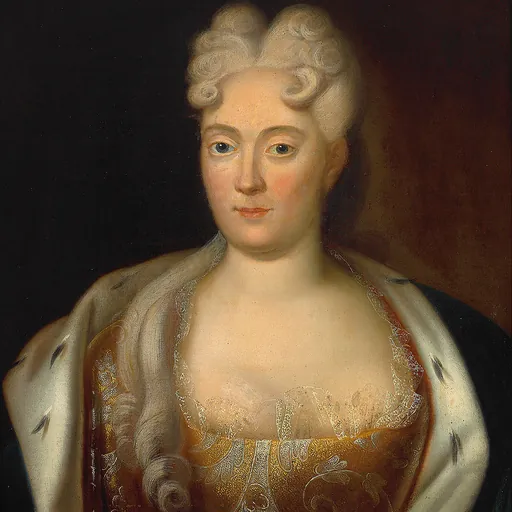
About Duchess Sibylle of Saxe-Lauenburg
Lived 1675 – 1733 (aged 58). Duchess Sibylle of Saxe-Lauenburg was a German politician.
Sibylle of Saxe-Lauenburg (Franziska Sibylle Auguste; 21 January 1675 – 10 July 1733) was Margravine of Baden-Baden. Born a Duchess of Saxe-Lauenburg, she was the wife of Louis William, Margrave of Baden-Baden, a famous Imperial general who was known as the . She was the consort of the ruler of Baden-Baden (1690–1707) and regent (1707–1727) during the minority of her son Louis George.
Regent
Sibylle's husband Louis William died aged 51 in January 1707, of a war injury. He was succeeded by their eldest surviving son Louis George, who from his birth in 1702 had been Hereditary Prince of Baden-Baden.
As Louis George was aged five at the time, Sibylle was created the Regent of Baden-Baden in the name of her son. Sibylle has been credited with the reconstruction of Baden-Baden, a state which had been greatly ravaged by the French during their various wars, prior to Louis George's birth. She held a tight rein on the state's finances and by the time of Louis George's majority in 1727, Baden-Baden was once again flourishing In the end, Johanna acquiesced to her mother's preference and agreed to marry Louis d'Orléans. There was a proxy ceremony held at the Schloss Rastatt before she was married in person on 13 July 1724 to Louis, the grandson of Louis XIV of France. Chosen for, among other reasons, her family's Catholicism, she brought a comparatively small dowry of 80,000 livres to the House of Orléans.
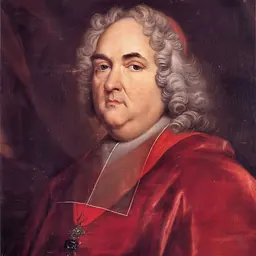
Retirement and death Louis George reached his majority on 22 October 1727 at the age of 25. Sibylle thus retired from state administration to Ettlingen Palace in Ettlingen. Having retired, she made pilgrimages and under the influence of the Cardinal Damian Hugo Philipp von Schönborn, she led a very religious life and visited several monasteries. In her dowager years, she also carried out various improvements which were finished in the year of her death.
Sibylle, born a Duchess of Saxe-Lauenburg, Margravine of Baden-Baden and Regent of Baden-Baden died at the Schloss Ettlingen on 10 July 1733 at the age of 58. As instructed in her will she was buried at the Schloss Rastatt with little pomp.
Architectural legacy
Siyblle had an active interest in architecture as well as property management. While living in Ostrov with her husband in the first years of their marriage, the two carried out improvements to the ('white castle'). Their chosen architect was .
Sibylle's most significant legacy was Schloss Rastatt, which became the main residence of the rulers of Baden-Baden when Rastatt was promoted to city status in 1700. The residence in Rastatt is the oldest baroque residence in the German Upper Rhine area and was built according to the example of the French Palace of Versailles.
She also carried out various other projects:
1707 : Renovations begin at the Schloss Rastatt; 1710 : Construction on the Schloss Favorite begins; 1713 : Construction on the Valentin Church, Karlsruhe begins; 1714 : Reconstruction in Rastatt begins; 1715 : Construction on the Einsiedeln Chapel begins; 1717 : Construction on the Home Office, Offenburg begins; 1717 : Construction on the Fremersberg hunting lodge begins; 1718 : Hermitage Museum in the Park of Schloss Favorite is built; 1719 : Holy Cross Church (Castle Church) in Rastatt is built; 1721 : Loretokapelle is built; 1721 : Extension of the Jagdschloss (hunting lodge) in (see Beiertheim-Bulach); 1722 : Pagodenburg is built in the gardens of Rastatt; 1723 : Extensions on the Schloss Bruchsal 1724 : Hermitage in Waghäusel is built; 1724 : Redesigning of the Schloss Kislau; 1724 : Various projects at Scheibenhardt; 1728 : Expansion of Ettlingen Palace; 1731 : Chapel in Ettlingen Palace; 1730 : Reconstruction of the nave of the church of St. Martin in Ettlingen.
Ancestry
Don’t just read it —
keep it.
Full-length biographies made to live with: read them, listen on the way to work, watch them tonight.
- E-book
- Audio
- Video
Instant download · yours to keep · every purchase keeps this site free
Important facts
Family & relationships
People in Duchess Sibylle of Saxe-Lauenburg's life
Named in this biography and alive at the same time
Related people
Same field, nearest in time



Contemporaries
People whose lives overlapped Duchess Sibylle of Saxe-Lauenburg's





Frequently asked questions
Who was Duchess Sibylle of Saxe-Lauenburg?
German princess (1675-1733)
When was Duchess Sibylle of Saxe-Lauenburg born?
Duchess Sibylle of Saxe-Lauenburg was born on 21 January 1675 in Ratzeburg.
When did Duchess Sibylle of Saxe-Lauenburg die?
Duchess Sibylle of Saxe-Lauenburg died on 10 July 1733 in Ettlingen.
What was Duchess Sibylle of Saxe-Lauenburg's occupation?
Duchess Sibylle of Saxe-Lauenburg was a politician.
What nationality was Duchess Sibylle of Saxe-Lauenburg?
Duchess Sibylle of Saxe-Lauenburg was German.
Sources & further reading
· Wikipedia: Duchess Sibylle of Saxe-Lauenburg
· DBpedia: Sibylle of Saxe-Lauenburg
Cite this page
APA: Biography.guide. (2026). Duchess Sibylle of Saxe-Lauenburg. https://biography.guide/duchess-sibylle-of-saxe-lauenburg/
MLA: "Duchess Sibylle of Saxe-Lauenburg." Biography.guide, https://biography.guide/duchess-sibylle-of-saxe-lauenburg/.
Chicago: "Duchess Sibylle of Saxe-Lauenburg." Biography.guide. https://biography.guide/duchess-sibylle-of-saxe-lauenburg/.
Data last updated: 2026-09-24 · Spot an error? Report a correction.
Portrait: Wikimedia Commons · author & licence
Page generated 2026-10-03 09:35 UTC