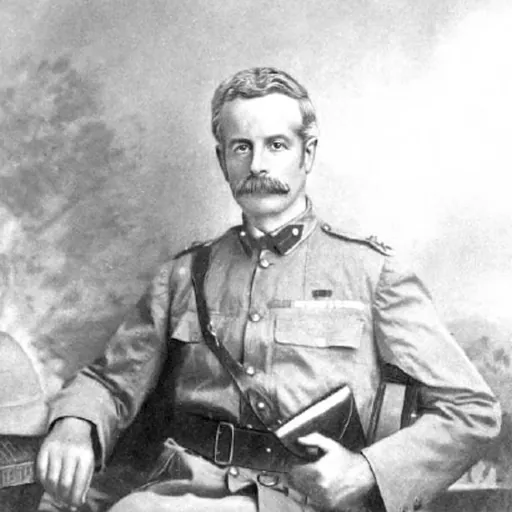
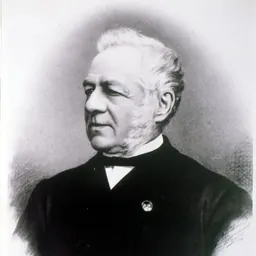
Douglas Cochrane, 12th Earl of Dundonald
British politician and general
About Douglas Cochrane, 12th Earl of Dundonald
Lived 1852 – 1935 (aged 82). Douglas Cochrane, 12th Earl of Dundonald was a British military personnel and politician.
Lieutenant-General Douglas Mackinnon Baillie Hamilton Cochrane, 12th Earl of Dundonald, (29 October 1852 – 12 April 1935), styled Lord Cochrane between 1860 and 1885, was a British Army officer and politician.
Early life Cochrane was the second but eldest surviving son of Thomas Cochrane, 11th Earl of Dundonald, by Louisa Harriet Mackinnon, daughter of William Alexander Mackinnon. Thomas Cochrane, 1st Baron Cochrane of Cults, was his younger brother. He was educated at Eton College.
Military career
Cochrane was commissioned into the Life Guards in July 1870, and was promoted to lieutenant the following year and captain in 1878. He then served in the Nile Expedition,
In April 1902, it was announced that Lord Dundonald would be appointed General Officer Commanding the Militia of Canada, the senior military officer in Canada. He left Liverpool on 15 July, and arrived in Quebec and Ottawa later the same month to take up his position. He and his family stayed at Crichton Lodge in Rockcliffe, Ottawa, Ian McAllister of Morton College, Oxford was appointed as his private secretary whilst in charge. During his time at Canada, he authored a scheme for the reorganisation of the Canadian militia on entirely new lines, which was adopted, he also wrote a drill and training book, directed towards Cavalry and infantry, additionally, he revamped the cadet corps structure and established several other associations aimed at enhancing the militia. He was also able to change the dress codes of many Scottish regiments to align more with their culture. He served in Canada for two years until he was dismissed by the dominion cabinet due to his outburst at a dinner in Montreal, described as "utterances at a banquet" in newspaper articles and officially termed "Indiscretion and insubordination" by the cabinet. In defence of his critics, Dundonald asserted that communication between him and the minister of the militia had been corrupted which left Canada defenceless.
In 1904, two military issued books; 'Infantry Training Canada 1904' & 'cavalry training 1904' were written by Douglas and published by the London War office.
In 1910, Douglas, after being appointed colonel of the 2nd Life Guards in April 1907, was appointed the first 'gold stick in waiting' for King George V, and on arrival of Theodore Roosevelt, he was the king's 'aide de camp'.
He later served in the First World War as chairman of the Admiralty Committee on Smoke Screens in 1915.
In 1921, he became a 'special ambassador' to the Peruvian Centenary.
Inventions A list of his inventions that were patented;
- 'Pocket-stove', (Patented 25 August 1896)
- 'Carriage and Traction Arrangement for a Machine or Quick Firing Gun', (Patented 18 August 1896)
- 'An Improvement in Nosebags for Horses', (Patented 7 September 1896)
- 'Improvements in Horse Traction Arrangements for Vehicles', (Patented 1 May 1897)
- 'Improvements in Ambulances and other Vehicles, especially adapted for Camel Traction', (patented 3 September 1897)
- 'Ammunition holder for machine guns', (Patented 19 July, I898)
- 'Bicycle saddle'; A Yielding Seat applicable in lieu of Saddle, (Patented 6 September, I898)
- 'Apparatus for Mechanical Patrontilførlsen by Guardian'; cartridge supply, (Patented 2 February 1899)
- 'Improvements in the Coupling and Traction of Bicycles', (Patented 18 February 1899)
- 'Tea or Coffee pot'; which was later manufactured as a teapot by the Wedgwood company, and marketed as the "SYP" (Simple Yet Perfect). Later, in 1911 a licence to manufacture 'S.Y.P. teapots and coffee pots' was applied for with James Dixon & Sons. (Patented 16 July 1901)
Personal life
In 1878, the British government paid a grant to Douglas of the sum of £5000 (equivalent to ~£530,238.00 in June 2026) as backpay for this grandfather's services in the Napoleonic wars; "in respect of the distinguished services of his grandfather, the late Lord dundonald."
Lord Dundonald married Winifred Bamford-Hesketh, daughter of Robert Bamford-Hesketh, in 1878. For many years, the family lived at Gwrych Castle in North Wales, the seat of the Bamford-Hesketh family. The Countess of Dundonald did not accompany her husband to Canada. They had two sons and three daughters:
Lady Grizel Winifred Louisa Cochrane (1880–1976), who married Lt.-Col. Hon. Ralph Gerard Alexander Hamilton, Master of Belhaven (1883–1918), only son of Alexander Hamilton, 10th Lord Belhaven and Stenton, in 1904. He was killed during the Battle of Amiens.
He owned live stock, it is not known where they were located, but an article from 1900 mentions that he owned pigs.
His wife died in January 1924. Lord Dundonald died at his home in Wimbledon in April 1935, aged 82, and was succeeded in the earldom by his eldest son, Thomas.
In 1926, he published an autobiographical book of his military career titled called 'My Army Life'.
He is buried in Achnaba Churchyard, Ardchattan near Benderloch, Lorne, Argyll and Bute. As his eldest son died unmarried and without issue, he was succeeded by his nephew, Ian Douglas Leonard Cochrane as the 14th Earl of Dundonald.
Honours and legacy Lord Dundonald was appointed a Commander of the Royal Victorian Order (CVO) in December 1901, and in June 1907 knighted as a Knight Commander (KCVO) of the order.
Dundonald Park, in Centretown, Ottawa, is named after him.
Don’t just read it —
keep it.
Full-length biographies made to live with: read them, listen on the way to work, watch them tonight.
- E-book
- Audio
- Video
Instant download · yours to keep · every purchase keeps this site free
Important facts
Family & relationships
People in Douglas Cochrane, 12th Earl of Dundonald's life
Named in this biography and alive at the same time
Related people
Same field, nearest in time
Contemporaries
People whose lives overlapped Douglas Cochrane, 12th Earl of Dundonald's
Frequently asked questions
Who was Douglas Cochrane, 12th Earl of Dundonald?
British politician and general (1852-1935)
When was Douglas Cochrane, 12th Earl of Dundonald born?
Douglas Cochrane, 12th Earl of Dundonald was born on 29 October 1852 in Banff.
When did Douglas Cochrane, 12th Earl of Dundonald die?
Douglas Cochrane, 12th Earl of Dundonald died on 12 April 1935 in Wimbledon.
What was Douglas Cochrane, 12th Earl of Dundonald's occupation?
Douglas Cochrane, 12th Earl of Dundonald was a military personnel and politician.
What nationality was Douglas Cochrane, 12th Earl of Dundonald?
Douglas Cochrane, 12th Earl of Dundonald was British.
Sources & further reading
· Wikipedia: Douglas Cochrane, 12th Earl of Dundonald
· DBpedia: Douglas Cochrane, 12th Earl of Dundonald
Cite this page
APA: Biography.guide. (2026). Douglas Cochrane, 12th Earl of Dundonald. https://biography.guide/douglas-cochrane-12th-earl-of-dundonald/
MLA: "Douglas Cochrane, 12th Earl of Dundonald." Biography.guide, https://biography.guide/douglas-cochrane-12th-earl-of-dundonald/.
Chicago: "Douglas Cochrane, 12th Earl of Dundonald." Biography.guide. https://biography.guide/douglas-cochrane-12th-earl-of-dundonald/.
Data last updated: 2026-09-28 · Spot an error? Report a correction.
Portrait: Wikimedia Commons · author & licence
Page generated 2026-10-04 12:59 UTC