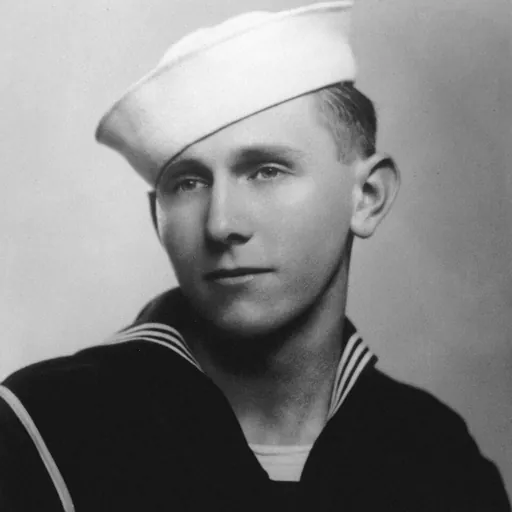
About Douglas Albert Munro
Lived 1919 – 1942 (aged 22). Douglas Albert Munro was an American military personnel.
Douglas Albert Munro (October 11, 1919 – September 27, 1942) was a United States Coast Guardsman who was posthumously decorated with the Medal of Honor for an act of "extraordinary heroism" during World War II. He is the only person to have received the medal for actions performed during service in the Coast Guard.
Munro was born in Canada to an American father and a British mother, and his family moved to the United States when he was a child. He was raised in South Cle Elum, Washington, and attended Central Washington College of Education before volunteering for military service shortly before the United States entered World War II. Munro and his shipmate Raymond Evans were known as the Gold Dust Twins, so-called because they were inseparable.
During the Guadalcanal campaign, Munro was assigned to Naval Operating Base Cactus at Lunga Point, where small boat operations were coordinated. At the Second Battle of the Matanikau in September 1942, he led the extrication of a force of Marines whose position had been overrun by Japanese forces. He died of a gunshot wound at age 22 while using the Higgins boat that he was piloting to shield a landing craft filled with Marines from Japanese fire.
Several ships, buildings, and monuments have been dedicated to Munro, and a street in his hometown is named after him. The anniversary of his death is annually observed in Cle Elum and at Coast Guard Training Center Cape May. His grave has been designated a historical site by Washington state. He is the namesake of the Douglas A. Munro Coast Guard Headquarters Building, Munro Hall at the U.S. Coast Guard Academy, the "Douglas Munro March", the Navy League's Douglas A. Munro Award, the Coast Guard Foundation's Douglas Munro Scholarship Fund, and the Veterans of Foreign Wars' Douglas Munro–Robert H. Brooks Post. He is the only non-Marine to have his name enshrined on the Wall of Heroes of the National Museum of the Marine Corps.
Early life and education
Family Munro's father, James Munro, was born in Sacramento, California as James Wilkins. By age eight he had moved to Canada; his divorced mother remarried a Canadian citizen whose surname he took. Munro's mother, Edith Fairey, was born in Liverpool, England, and—in childhood—relocated with her family to Canada. From 1953 to 1957 Francis Fairey sat in the House of Commons of Canada representing Victoria, British Columbia, as a member of the Liberal Party.
In 1939, with the threat of war growing, Munro decided to withdraw from college and enlist in the military.
Munro underwent entrance processing in Seattle, where he met and became friends with Ray Evans. Munro would spend the rest of his Coast Guard career with Evans, and the pair became known to shipmates as "the Gold Dust Twins".
Career
Munro's first shipboard posting was aboard the Coast Guard cutter USCGC Spencer.
Munro and Evans underwent recruit training at Coast Guard Air Station Port Angeles. They were then assigned to the Treasury-class cutter USCGC Spencer, serving aboard the vessel until 1941.
Guadalcanal campaign In mid-1941, with tension with Japan on the rise, the U.S. government began emergency mobilization, and transferred the Coast Guard from the Department of the Treasury to the Department of the Navy. Munro and Evans volunteered for reassignment to the attack transport USS Hunter Liggett, which was being outfitted and manned by the Coast Guard as part of preparations for War Plan Orange.
By mid-1942, Hunter Liggett had been assigned to Transport Division 17, tasked with supporting the Guadalcanal campaign. Established on August 9 by Coast Guard Commander Dwight Dexter, NOB Cactus is the only known instance of a naval operating base primarily led by Coast Guard personnel. Munro volunteered for assignment at Lunga Point; Dexter was his favorite officer.
According to U.S. Marine Master Sergeant James Hurlbut, Munro and Evans lived at the base in an approximately hut "they had made from packing boxes and scrap material", which he also described as "quite a swank establishment for Guadalcanal".
On September 20, 1942, Munro volunteered to lead a small boat search-and-rescue mission seeking to recover the crew of a Navy airplane that had been forced down off Savo Island. During the operation, Munro's craft came under intense fire from Japanese shore positions, though he was able to maneuver the boat back to base with only minor injuries to his crew. The downed aircrew was ultimately found and rescued by a flying boat. Preceded by a beach-clearing ship-to-shore bombardment from the destroyer , the amphibious force landed and began moving inland towards its objective.
The U.S. Marine Corps landing force came under attack in a Japanese counteroffensive and quickly found itself encircled on a hill. With the Marines in danger of being overrun, Monssen opened fire on the Japanese positions with her caliber guns, managing to clear a narrow corridor to the beach. Using Monssens signal lamp, Puller ordered the Marines to fight their way to the shore.
At Lunga Point, the landing craft were instructed to return and extract the besieged Marines.
To date, Munro is the only member of the U.S. Coast Guard to have received the Medal of Honor.
Munro's remains were recovered from Guadalcanal in 1947 and were reinterred at Laurel Hill Memorial Park in Cle Elum in 1948, his family having declined a full military burial at the Arlington National Cemetery. In 1954, the City of Cle Elum expanded Munro's gravesite with the installation of two decommissioned Mk22 naval deck guns to either side of the tombstone.
Personal life Munro had a sister, Patricia, who attempted to enlist in the Coast Guard Women's Reserve following her brother's death but was rejected as she was underweight.
At the time of Munro's death, according to a shipmate, he had a girlfriend. Munro also had a maternal cousin serving in the Royal Canadian Navy who was among those killed in the sinking of HMCS Guysborough when she was torpedoed by U-868 in 1945.
Three Coast Guard facilities are named in honor of Munro: Munro Hall at the United States Coast Guard Academy, Munro Hall at United States Coast Guard Training Center Cape May, and the Douglas A. Munro Coast Guard Headquarters Building in Washington, D.C. The act to designate the Coast Guard headquarters in tribute to Munro was introduced by Eleanor Holmes Norton, the Delegate of the District of Columbia to the United States, and co-sponsored by United States Congressmen Duncan Hunter, John Garamendi, and Lou Barletta.
Several monuments have also been erected to Munro, including a bronze statue at Coast Guard Training Center Cape May (Douglas Munro by Carey Boone Nelson), a larger-than-life bust at the Douglas A. Munro Coast Guard Headquarters (Douglas Munro by John Tuomisto-Bell and Tyson Snow), a black marble pillar etched with Munro's visage at the Coast Guard Academy, a memorial marker at the Point Cruz Yacht Club in Honiara in the Solomon Islands, and a monument in Crystal River, Florida. In 2006, Munro was added to the Wall of Heroes of the National Museum of the Marine Corps, becoming the only non-Marine represented on it.
In Cle Elum, Washington, Munro is commemorated by Douglas Munro Boulevard.
Observances At Coast Guard Training Center Cape May, recruit classes are annually assembled at the statue Douglas Munro on the anniversary of Munro's death, during which three-volleys are fired.
Cooley flagpole at the Douglas Munro Burial Site For several decades, Munro's boyhood friend Mike Cooley raised and lowered the United States flag at Munro's gravesite, daily walking three miles from his home to the cemetery. According to Cooley's daughter, for over 30 years he never missed a day, even when he was ill with pneumonia. Upon his death in 1999, a lighted flagpole dedicated to Cooley was installed to allow the U.S. colors to be displayed continuously at Munro's grave without the need to be lowered at dusk. Cooley was cremated and his ashes interred at the Douglas Munro Burial Site with the remains of the Munro family.
Since the dedication of the new flagpole, an annual military ceremony has been held at the gravesite on the anniversary of Munro's death.
Other alt=Image of the 1989 painting Douglas A. Munro Covers the Withdrawal of the 7th Marines at Guadalcanal Douglas A. Munro Covers the Withdrawal of the 7th Marines at Guadalcanal, (1989) by Bernard D'Andrea
In 1989 the Coast Guard commissioned the painting Douglas A. Munro Covers the Withdrawal of the 7th Marines at Guadalcanal from Bernard D'Andrea.
The Veterans of Foreign Wars post in Cle Elum is named the Douglas Munro-Robert H. Brooks VFW Post 1373, and the Anacostia chapter of the Surface Navy Association is officially named the Douglas Munro Chapter. The Douglas A. Munro Award, established in 1971 and sponsored by the Navy League of the United States, is annually presented to an enlisted Coast Guardsman "who has demonstrated outstanding leadership and professional competence to the extent of their rank and rate". The "Douglas Munro March", composed by Lewis J. Buckley, was debuted by the United States Coast Guard Band on September 26, 1982, at Constitution Hall in Washington, D.C.
Several members of Munro's extended family have been named Douglas as a familial tribute to Munro.
Ratings
Awards and decorations
Don’t just read it —
keep it.
Full-length biographies made to live with: read them, listen on the way to work, watch them tonight.
- E-book
- Audio
- Video
Instant download · yours to keep · every purchase keeps this site free
Important facts
People in Douglas Albert Munro's life
Named in this biography and alive at the same time





Related people
Same field, nearest in time



Contemporaries
People whose lives overlapped Douglas Albert Munro's




Frequently asked questions
Who was Douglas Albert Munro?
Coast Guard Medal of Honor recipient (1919–1942)
When was Douglas Albert Munro born?
Douglas Albert Munro was born on 11 October 1919 in Vancouver.
When did Douglas Albert Munro die?
Douglas Albert Munro died on 27 September 1942 in Guadalcanal.
What was Douglas Albert Munro's occupation?
Douglas Albert Munro was a military personnel.
What nationality was Douglas Albert Munro?
Douglas Albert Munro was American.
Sources & further reading
· Wikipedia: Douglas Albert Munro
· DBpedia: Douglas Albert Munro
Cite this page
APA: Biography.guide. (2026). Douglas Albert Munro. https://biography.guide/douglas-albert-munro/
MLA: "Douglas Albert Munro." Biography.guide, https://biography.guide/douglas-albert-munro/.
Chicago: "Douglas Albert Munro." Biography.guide. https://biography.guide/douglas-albert-munro/.
Data last updated: 2026-09-23 · Spot an error? Report a correction.
Portrait: Wikimedia Commons · author & licence
Page generated 2026-09-27 05:07 UTC