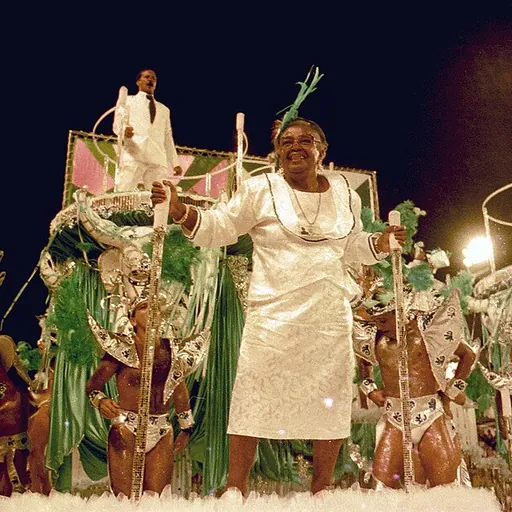
Dona Zica
Brazilian samba dancer
About Dona Zica
Lived 1913 – 2003 (aged 89). Dona Zica was a Brazilian sambista, known for Estação Primeira de Mangueira.
Euzébia Silva de Oliveira, better known as Dona Zica (6 February 1913 – 22 January 2003), was a Brazilian samba dancer at the Mangueira Samba school in Rio de Janeiro, who went on to play an important role in the Mangueira favela.
Early life Dona Zica was born in Piedade in the north of Rio de Janeiro on 6 February 1913. Her father died when she was one year old. She moved with her family to Mangueira as a child, where she became one of the first members of the Mangueira Samba school, participating in its first parade, in 1928, when she was 15. She first married at the age 19, to Carlos Dias do Nascimento, a footballer, and they had six children, one of whom was adopted. Dona Zica was widowed after 20 years of marriage. Having previously worked as a cloth weaver, she then worked as a dishwasher, a kitchen assistant and, finally, a cook at a club known as the Clube Bola Preta.
Marriage to "Cartola" in October 1964, Zica married the samba dancer, composer and songwriter, Cartola (Agenor de Oliveira), one of the founders of the Mangueira School. They had lived together for a decade before marrying and Zica was responsible for persuading Cartola to return to the Mangueira favela, to overcome his alcoholism, and to start composing again. A photo of the couple leaning out of a window appears on the cover of his second album. One of Cartola's most beautiful compositions, the samba, "We two", was composed for their wedding, and Zica inspired several more of his songs, performing in one or two on Cartola's records. D. Zica - Tempero, Amor E Arte is a book of Dona Zica's recipes that includes stories from her life. It was written by her granddaughter, Nilcemar Nogueira, and by Sergio Cabral. The book was published a few days after Dona Zica's death.
Death Dona Zica died on 22 January 2003 in Mangueira. About a thousand people attended the funeral ceremony. The burial took place at the São Francisco Xavier Cemetery, in the north of Rio de Janeiro, to the sound of Exaltação à Mangueira the anthem of the association of which she had been a member since its foundation on 28 April 1928.
Don’t just read it —
keep it.
Full-length biographies made to live with: read them, listen on the way to work, watch them tonight.
- E-book
- Audio
- Video
Instant download · yours to keep · every purchase keeps this site free
Important facts
Family & relationships
People in Dona Zica's life
Named in this biography and alive at the same time

Related people
Same field, nearest in time

Contemporaries
People whose lives overlapped Dona Zica's





Frequently asked questions
Who was Dona Zica?
Brazilian samba dancer
When was Dona Zica born?
Dona Zica was born on 6 February 1913 in Rio de Janeiro.
When did Dona Zica die?
Dona Zica died on 22 January 2003 in Rio de Janeiro.
What was Dona Zica's occupation?
Dona Zica was a sambista.
What was Dona Zica known for?
Dona Zica was known for Estação Primeira de Mangueira.
What nationality was Dona Zica?
Dona Zica was Brazilian.
Sources & further reading
Cite this page
APA: Biography.guide. (2026). Dona Zica. https://biography.guide/dona-zica/
MLA: "Dona Zica." Biography.guide, https://biography.guide/dona-zica/.
Chicago: "Dona Zica." Biography.guide. https://biography.guide/dona-zica/.
Data last updated: 2026-09-23 · Spot an error? Report a correction.
Portrait: Wikimedia Commons · author & licence
Page generated 2026-09-27 05:08 UTC