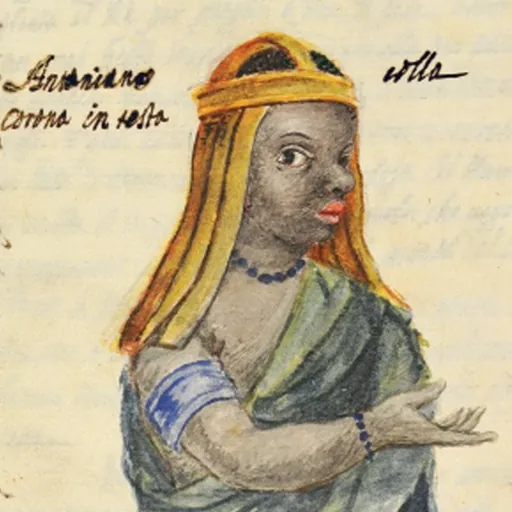
About Dona Beatriz Kimpa Vita
Lived 1684 – 1706 (aged 21–22). Dona Beatriz Kimpa Vita was a politician, prophet, religious leader and spiritual leader.
Dona Beatriz Kimpa Vita, also known as Kimpa Mvita, Cimpa Vita or Tsimpa Vita (1684 – 2 July 1706), was a Kongolese prophetess and leader of her own Christian movement, Antonianism; this movement taught that Jesus and other early Christian figures were from the Kongo Kingdom.
The name "Dona" indicates that she was born into a family of high Kongolese nobility; she was later given the name "Beatriz" after the Catholic saint. Her teaching grew out of the traditions of the Catholic Church in Kongo, and caused her to upbraid the Catholic priests for not believing as she did.
Dona Beatriz believed the teachings of St. Anthony and used this claim to attempt to restore the ideal of Kongo as a unified Christian kingdom. Kimpa Vita is seen as an antislavery figure and as anticipating African democracy movements. While the role of Kimpa Vita is widely overlooked, the years of her movement are some of the best documented in Kongo's history.
Early life Beatriz Kimpa Vita, also referred to as Beatrice of Congo, was born near Mount Kibangu in Angola, Kongo Kingdom, around 1684. She was born into a family of the Kongo nobility, probably of the class called Mwana Kongo, and her father was a regional commander of the King's army. This noble status permitted Kimpa Vita to study as an nganda marinda, a form of religious medium. Kimpa Vita was baptized Dona Beatriz at her father's behest, following the Catholic beliefs of the Kings. Some modern scholars believe that she was connected to King António I, because of his Kikongo name, Vita a Nkanga.
At the time of her birth, Kongo was torn by civil war. These wars had started shortly after the death of António I at the Battle of Mbwila in 1665, and had resulted in the abandonment of the ancient capital of São Salvador (present-day Mbanza Kongo) in 1678 and the division of the country by rival pretenders to the throne.
Call to mission Beatriz went to live among colonists sent out by King Pedro IV, one of several rival rulers of Kongo, to reoccupy the ancient and now abandoned capital of São Salvador. There was a great deal of religious fervor among these colonists who were tired of the endless civil wars in the country, and many had become followers of an old prophet, Appolonia Mafuta.
During a supernatural illness in 1704, Kimpa Vita claimed to have received visions of God while on the verge of death, wherein she was given divine commandment to preach to King Pedro IV, resurrecting her. She proclaimed that Jesus was a Kongo and that there will be slavery if they trusted the Portuguese. While in this state, she learned that Kongo must reunite under a new king, for the civil wars that had plagued Kongo since the battle of Mbwila in 1665 had angered Christ. She was ordered to unite the Congo under one king. Following the practices of Catholic monks, she forwent all her earthly possessions and set out on her mission to preach to King Pedro IV.
During her time in São Salvador, Kimpa Vita would grow to doubt the validity of her movement and her possession by Saint Anthony, as she became pregnant by a man named João Barro, despite her teachings of chastity. Kimpa Vita believed that this sin had stripped her of virtue and is what led to her eventual downfall. Kimpa Vita kept the pregnancy a secret from her followers and soon returned to her hometown with the child.
Beatriz sent out missionaries of her movement to other provinces. They were not successful in the coastal province of Soyo, where the Prince expelled them, but they were much more successful in the dissident southern part of Soyo and Mbamba Lovata, which lay south of Soyo. There they won converts, especially among partisans of the old queen Suzana de Nóbrega. Manuel Makasa, one of these partisans also became an Antonian and moved to São Salvador.
Religious tenets
Much of her teaching is known from the Salve Antoniana, a prayer she adapted from the Catholic prayer Salve Regina (Hail Holy Queen) into an anthem of the movement. Among other things, the Salve Antoniana taught that God was only concerned with believers' intentions, not with sacraments or good works, and that Saint Anthony was the greatest one - in fact, a "second God".
Kimpa Vita's teachings stated that Kongolese Catholicism was the true form of Catholicism and that the teachings and practices of white and Capuchin Catholics were incorrect and elitist. She believed that black people originated from the skin of a fig tree, and thus many followers of the Antonine Movement wore cloth spun from the bark of these trees. The execution was carried out at the temporary capital of Evululu by forces loyal to Pedro IV. She was tried under Kongo law as a witch and a heretic, with the consent and counsel of the Capuchin friars Bernardo da Gallo and Lorenzo da Lucca. Kimpa Vita's son, whom she wished to name António, was spared by Lorenzo da Lucca. Lorenzo denied her requested name, instead naming the child Jerónimo. Custody of Jerónimo was given to the church's officials.
The Anthonian prophetic movement outlasted her death. Her followers continued to believe that she was still alive, and it was only when Pedro IV's forces took São Salvador in 1709 that the political force of her movement was broken, and most of her former noble adherents renounced their beliefs and rejoined the Catholic church.
Some hint of the strength of her teaching may be glimpsed by the fact that eighteenth-century Kongo religious art often shows Jesus as an African, and that Saint Anthony, known as "Toni Malau", is very prominent in it. More recently, some see present-day Kimbanguism, Matswanism and (Tokoism) as its successors. Traditions circulating in Mbanza Kongo (formerly São Salvador) in 2002 also place great significance in the role of Beatriz' mother as an inspiration for the 20th century prophet Simon Kimbangu and also as playing a role in its continuation, and in fact, her mother was present in the aftermath of her death.
Statue Historian Scholastique Dianzinga has praised the statue commemorating Kimpa Vita for expanding the representation of women on African public monuments.
Don’t just read it —
keep it.
Full-length biographies made to live with: read them, listen on the way to work, watch them tonight.
- E-book
- Audio
- Video
Instant download · yours to keep · every purchase keeps this site free
Important facts
Related people
Same field, nearest in time




Contemporaries
People whose lives overlapped Dona Beatriz Kimpa Vita's


Frequently asked questions
Who was Dona Beatriz Kimpa Vita?
Kongo Empire guérisseuse (1684-1706)
When was Dona Beatriz Kimpa Vita born?
Dona Beatriz Kimpa Vita was born in 1684.
When did Dona Beatriz Kimpa Vita die?
Dona Beatriz Kimpa Vita died on 2 July 1706 in Evululu.
What was Dona Beatriz Kimpa Vita's occupation?
Dona Beatriz Kimpa Vita was a politician, prophet, religious leader and spiritual leader.
What nationality was Dona Beatriz Kimpa Vita?
Dona Beatriz Kimpa Vita's recorded nationality: Kingdom of Kongo.
Sources & further reading
· Wikipedia: Dona Beatriz Kimpa Vita
Cite this page
APA: Biography.guide. (2026). Dona Beatriz Kimpa Vita. https://biography.guide/dona-beatriz-kimpa-vita/
MLA: "Dona Beatriz Kimpa Vita." Biography.guide, https://biography.guide/dona-beatriz-kimpa-vita/.
Chicago: "Dona Beatriz Kimpa Vita." Biography.guide. https://biography.guide/dona-beatriz-kimpa-vita/.
Data last updated: 2026-09-20 · Spot an error? Report a correction.
Portrait: Wikimedia Commons · author & licence
Page generated 2026-09-27 04:58 UTC