
About Domenico di Bartolo
Lived 1400 – 1445. Domenico di Bartolo was a painter.
Domenico di Bartolo (birth name Domenico Ghezzi), born in Asciano, Siena, was a Sienese painter of the early Renaissance period. In the Lives of the Most Excellent Painters, Sculptors, and Architects, Giorgio Vasari says that Domenico was the nephew of Taddeo di Bartolo. Influenced by the new Florentine style of painting, Domenico di Bartolo was the only Sienese painter of his time to receive commissions from clients in Florence. In Siena, he was employed by Lorenzo di Pietro (known as Vecchietta), to help execute the fresco The Care of the Sick, in the Pilgrim's Hall of the Hospital of Santa Maria della Scala.
Domenico is first recorded in 1420 when he and several other Sienese artists, is documented as part of a project to paint in Siena Cathedral. He is first recorded as a master in 1428, in a list of the painters' guild (ruolo dei pittori). In 1433 he also painted the Virgin and Child Surrounded by Saints. Renaissance Scholar Bruce Cole refers to Domenico's Madonna of Humility with Angels as "one of the loveliest works of the early Sienese Quattrocento". Another situation that can attest to Jacopo and Domenico's professional relationship comes from the written record that after Jacopo was elected to be the overseeing operator of the Cathedral of Siena's works, Domenico di Bartolo secured himself works to paint in the sacristy. Scholars such as Bruce Cole commend Domenico's Madonna of Humility, because it is unlike any Sienese painting of its time. This is for several technical and stylistic reasons, all of which give insight into Domenico di Bartolo's keen eye for adaptation and observation from fellow artists. In particular, much of the art critiques give recognition to Domenico's painting because of its strong sculptural references, many of which align with Jacopo della Quercia's style.
The composition of the painting is centred with a very volumetrically and triangularly depicted Madonna. Behind her are five angels, who form a semicircle that gives further movement and depth into the painted space. Referring back to several of the Madonna panels by Masaccio that have survived until today, a similarity between them and Domenico's Madonna is that the large figures created dominating geometrical forms that give the overall image a strong sense of sculptural stability and gravity. Hence, colour, geometric orientation, costumes, and faces all come together to suggest that Domenico would have received his early apprentice training from someone in Siena with strong Florentine influences. Two possible candidates that Bruce Cole introduces are Paolo di Giovanni Fei or Taddeo di Bartolo. Masaccio was commended for his refined skills in imitating nature, recreating lifelike movements in his subjects, as well as his consistent success in creating a convincing three-dimensionality to his paintings. Domenico's observations of Masaccio's painting would have proved to be an educational experience as he later is seen to utilize a type of artistic technique called circular-arc composition within the Madonna of Humility.
In the painting, the Virgin is also depicted in a way that had been popularized in Siena by Gentile da Fabriano: an Italian painter who was best known for his international gothic painting style. Other artists who depicted the Virgin in a similar manner during this time were Giovanni di Paolo for his Branchini Madonna of 1427 and Andrea di Bartolo for his Madonna of Humility. Foreshortened halos and Virgin's crown were rare during the time that Domenico di Bartolo's painting was executed, and can only be found in the Pisa altarpiece executed by Masaccio. There, too, is an illustration of the baby with fingers in his mouth, which strongly recalls back to Masaccio's Pisa altarpiece, which illustrates the Christ child eating grapes. Domenico's Madonna of Humility successfully models lights and darks within the flesh tones, and this too is done in the style of Masaccio. However, renowned British art historian John Pope-Hennessy states in his articles that Domenico di Bartolo cannot be a fully Masacciesque painter. Whilst painters like Filippo Lippi or Andrea di Giusto depict their figures to stand up in a stiff manner, those of Domenico di Bartolo possess a certain "Gothic flexibility". Giorgio Vasari notes that sometime in his career, Domenico di Bartolo painted altarpieces for Florentine churches, which confirms such appraisals and evaluations that Domenico was competent enough to analyze and infer from the Florence aspects of Renaissance art. Yet, many Sienese and general Renaissance art critics consider Domenico to still be a Sienese painter, with acquired Florentine tastes, and not a progressive Florentine painter. His work of the Madonna of Humility is ultimately considered Sienese, and many art historians conclude that at this time Domenico himself was a young artist who was attracted and eagerly open to new ideas, but perhaps had not yet assimilated such ideas to a profound meaning. He himself was not unfamiliar with the art world during his time, and was known to favour canonized artistic images from the Sienese Trecento, and therefore influenced the subsequent production of many Sienese artworks. In Domenico's Madonna of Humility, the common salutation on the painting – "Ave Maria"- is replaced by the term "Ave Stella Maris", which means "Hail Star of the Sea". Although this ancient attribute originated early on in Christian etymology for the name Mary, there is no existing record of an author before Bernardino who had written so intricately about the term's meaning. Brandi comments of the architecture of the fresco panel, for although it is not entirely correct in perspective, it can be successfully viewed from below. As mentioned previously, it is clear that some form of a partnership had existed prior to Jacopo della Quercia's election, because of the efficient timing in which Domenico had been summoned to complete artworks for the cathedral. As observed by art historian Carl Strehlke, the pointed shortening of the upper edges and the low viewpoint of the Virgin's abdomen are all indications that the painting's composition had originally possessed different dimensions. The hospital is conveniently located across both the Siena Cathedral and the Opera del Duomo, Each fresco that was to be produced would display some kind of attribution to the hospital's philanthropic work. Domenico was but a minor artist to contribute to the artistic works within the building. The project to decorate the Pilgrim's hall was first proposed by Giovanni di Francesco Buzzichelli (1434–1444). Giovanni is the one who summoned both Vecchietta and Domenico di Bartolo to carry out the project. Both of them successfully renovated the hall in a way that depicts the realities of lively daily existence. As mentioned by Strehlke, no documentation of a commission for this hospital wall is known to exist. He also observes that although the frescoes done by Domenico di Bartolo (as well as Vecchietta) that have managed to survive until today present a unified pictorial scene, details such as changes in the framing and challenges with the architecture of the hospital show that adaptations were made during the execution of the artworks. It is unclear what position Domenico occupied in the hospital's decoration, and there are no records that he served at the planner or director of the project.
Care of The Sick
Domenico's first of his six frescoes is named the "Care of The Sick", which is signed by Domenico with Latin inscription and dated to 1440. The fresco shows, with impressive detail, the interior layout of the hospital ward. Doctors and nurses are depicted assisting the patients, as well as carrying out other generous deeds. The fresco also depicts in the centre foreground the washing of the patient's feet, directly inferring to the well-known image of Christ washing the feet of his disciples. Throughout the whole painting, Domenico vividly brings out the colour of the costume and its well-crafted décor. Because of such imitation of a real location, Domenico is said to have followed the works of Vecchietta, where both artists pave the way into a whole new area of descriptive realism to the world of Sienese art. Other painters at the time such as Gentile da Fabriano and Pisanello might have depicted landscapes to be realistic or naturalistic, but they were consistently known to create images that came out of fantasy and creativity. It was therefore new to the art world for both Domenico and Vecchietta to produce images that seem to imitate a specific location. The frescoes by Domenico are also one of the first works done in Sienese art that includes visual clues for its viewers.
Education and Betrothal of the Foundlings
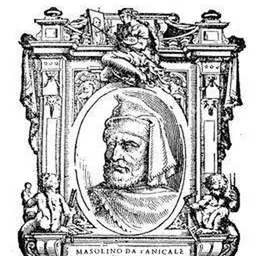
The second most recognized fresco produced by Domenico was named Education and Betrothal of the Foundlings. The entire basis of which the painting is orientated upon depends almost entirely on the architectural formation. The painting depicts foundlings being betrothed under a detailed, elaborate building with grand arches. Because of the dominating architectural layout, the figures within the fresco are all formed and placed to be in a mathematically accurate spatial construction, in which all of the orthogonals join together at the single "vanishing" point on the painting's horizon. What makes this fresco peculiar for its time is its measurable, mathematically expressed space, which is a quality that was rarely produced in Sienese painting during the first half of the Quattrocento. Without a doubt, Domenico's decision to depict one of his frescos with such measured accuracy must have been influenced by realists of Florentine painting such as Masaccio, Masolino da Panicale and Filippo Lippi. Still, Bruce Cole writes about this fresco as one that stays eccentric and stylistically distant to Domenico's Sienese ancestors and Florentine contemporaries. Cole writes that the fresco is a "peculiar blend of realism and fantasy, of immediacy and distance". Because of this, the overall effect of the picture counteracts its realistic layout. Some of the most minute details in the Education and Betrothal of the Foundlings can be found in the floor tiles, rugs, decorated robes and floor-to-ceiling mouldings.
The last fresco
Domenico was unable to finish all six frescoes in time. Domenico began to have complications in his relationship with the hospital after he was unable to deliver a completed sixth fresco. In addition to this, the hospital had also commissioned Domenico to produce a Madonna della Misericordia, which he was also unable to finish. Strehlke presents documents that prove that Domenico was put on probation and his payroll was reduced. Strehlke suggests that a strong reason for Domenico being unable to finish his work was due to illness, of which he died shortly after falling sick.
Final years Di Bartolo's last ever (dated) commission was the fresco of the Coronation of the Virgin in the Cancelleria di Biccherna, for the Palazzo Pubblico of Siena. He began to paint four angel heads, but his work was interrupted by his death in 1445. Soon after, the fresco was completed by another Sienese artist Sano di Pietro.
Don’t just read it —
keep it.
Full-length biographies made to live with: read them, listen on the way to work, watch them tonight.
- E-book
- Audio
- Video
Instant download · yours to keep · every purchase keeps this site free
Important facts
People in Domenico di Bartolo's life
Named in this biography and alive at the same time




Related people
Same field, nearest in time

Contemporaries
People whose lives overlapped Domenico di Bartolo's



Frequently asked questions
Who was Domenico di Bartolo?
Italian painter (c.1400-c.1445)
When was Domenico di Bartolo born?
Domenico di Bartolo was born in 1400 in Asciano.
When did Domenico di Bartolo die?
Domenico di Bartolo died in 1445 in Siena.
What was Domenico di Bartolo's occupation?
Domenico di Bartolo was a painter.
Sources & further reading
· Wikipedia: Domenico di Bartolo
· DBpedia: Domenico di Bartolo
Cite this page
APA: Biography.guide. (2026). Domenico di Bartolo. https://biography.guide/domenico-di-bartolo/
MLA: "Domenico di Bartolo." Biography.guide, https://biography.guide/domenico-di-bartolo/.
Chicago: "Domenico di Bartolo." Biography.guide. https://biography.guide/domenico-di-bartolo/.
Data last updated: 2026-09-20 · Spot an error? Report a correction.
Page generated 2026-09-27 05:31 UTC