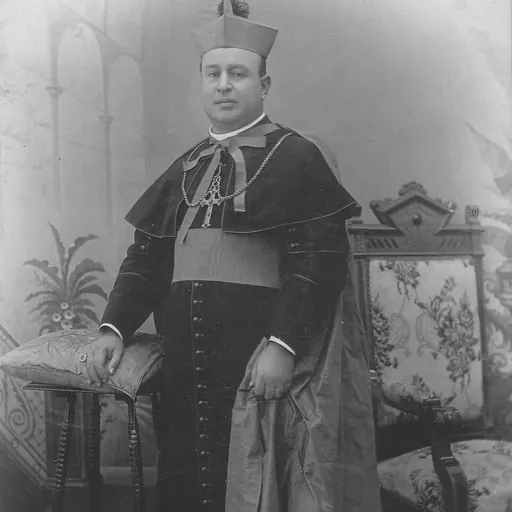
About Dom Ambrose Agius
Lived 1856 – 1911 (aged 55). Dom Ambrose Agius was a Maltese catholic priest, diplomat and catholic bishop.
Ambrose Agius (born Tancredi Alfred Agius; 17 September 1856 – 13 December 1911) was a Maltese archbishop of the Catholic Church.
A member of the Benedictine Order, Agius was appointed the apostolic delegate to the Philippines by Pope Pius X in 1904. In 1907, Agius was delegated to canonically crown the image of Our Lady of La Naval de Manila. He founded the first Benedictine monastery in Malta and consecrated the first Filipino bishop of the Catholic Church.
Early life Agius was born on 17 September 1856, in the Egyptian city of Alexandria (then part of the Ottoman Empire), the second son and third child of a Maltese merchant named Tancredi Agius and his wife, Saveria Sammut. Tancredi's children were:
Edward Agius: 1849–1924 Giulia Agius: 1854–1932 Tancredi Alfred: 1856–1911 Edgar Agius: 1864–1935 Robert Agius: 1868–1874
Agius was baptized as Tancredi Alfred Agius at Saint Catherine's Cathedral in Alexandria on 5 November 1856. He returned with his family to Malta during his early years. Agius attended the college operated by the monks of the Abbey of Saint Augustine in Ramsgate, Kent, England, where he was an outstanding student. After completing his studies in 1872, he felt called to join the abbey's monastic community. At his first profession of monastic vows, he was given the religious name Ambrose. On 12 October 1873, he professed his perpetual vows and was then sent by his abbot to Rome to complete his studies in philosophy and theology.
Catholic priesthood
Agius was ordained into the Catholic priesthood on 16 October 1881 at Subiaco Abbey.
He became deeply immersed in Maltese culture as he traveled extensively during his early years.
In May 1881, Agius was instructed by the Holy See to open the first Benedictine monastery in Malta. In December 1881, Agius, along with a group of Benedictine monks, settled in Nigret, Żurrieq. Under his supervision, a canonical religious community was established and a novitiate open to international candidates was set up; it was dedicated to the Immaculate Conception.
In 1884, the monastery was closed due to Italian-Maltese political turmoil, and Agius returned to Ramsgate to continue his mission. In 1893, he was appointed secretary to the procurator of the Subiaco Congregation by Pope Leo XIII.
Appointment to the Philippines The interior of the Manila Cathedral, where the body of Agius was interred in the underground crypt until 1945.
On 24 August 1904, Pope Pius X appointed Agius as the apostolic delegate to the Philippines. He was appointed titular archbishop of Palmyra on 3 September 1904, and received his episcopal consecration on 18 September 1904, at Sant'Ambrogio della Massima in Rome by the cardinal secretary of state, Rafael Merry del Val.
Agius convoked the 1907 Provincial Council of Manila with the other bishops of the nation at Manila Cathedral, re-dedicating the Philippines to the Immaculate Conception. This later became the country's official patroness under the pontificate of Pope Pius XII in September 1942.
As Filipinos were previously barred from priestly ordination and from joining religious orders under Spanish colonial rule, Agius ordained the first Filipino bishop in the Roman Catholic Church, Jorge Barlin Imperial, on 29 June 1906.
Death and burial In November 1911, Pope Pius appointed Agius as the new papal legate to the United States. While preparing to travel to Rome, he died of an acute attack of peritonitis on 13 December at 55 years of age. On 15 December 1911, Agius was given a solemn requiem Mass and was buried in the underground crypt of the Manila Cathedral. The tomb survived the destruction of the cathedral during the Battle of Manila in 1945. His remains were later set into a smaller casket and moved to a new grave inside the Abbey of Our Lady of Montserrat in Manila. The inscription translates as:
Memorial plaque in Saint Augustine's Church in Ramsgate, England. A memorial plaque was added to those for the monks of Ramsgate Abbey in St Augustine's Church, Ramsgate, with an inscription that translates as:
Names and titles Agius was baptized as Tancredi Alfred Agius but was called "Alfredo" by his Italian-speaking parents and "Alfred" while at school in Ramsgate, according to a 1871 census. After taking his perpetual vows, Agius became known as Dom Ambrose, but he was commonly referred to as "Padre Ambrosio", "Padre Ambo", or "Father Dom" by the Filipino and Maltese faithful who knew him.
Don’t just read it —
keep it.
Full-length biographies made to live with: read them, listen on the way to work, watch them tonight.
- E-book
- Audio
- Video
Instant download · yours to keep · every purchase keeps this site free
Important facts
People in Dom Ambrose Agius's life
Named in this biography and alive at the same time

Related people
Same field, nearest in time

Contemporaries
People whose lives overlapped Dom Ambrose Agius's




Frequently asked questions
Who was Dom Ambrose Agius?
Maltese priest and diplomat (1856-1911)
When was Dom Ambrose Agius born?
Dom Ambrose Agius was born on 17 September 1856 in Alexandria.
When did Dom Ambrose Agius die?
Dom Ambrose Agius died on 12 December 1911 in Manila.
What was Dom Ambrose Agius's occupation?
Dom Ambrose Agius was a catholic priest, diplomat and catholic bishop.
What nationality was Dom Ambrose Agius?
Dom Ambrose Agius was Maltese.
Sources & further reading
· Wikipedia: Dom Ambrose Agius
Cite this page
APA: Biography.guide. (2026). Dom Ambrose Agius. https://biography.guide/dom-ambrose-agius/
MLA: "Dom Ambrose Agius." Biography.guide, https://biography.guide/dom-ambrose-agius/.
Chicago: "Dom Ambrose Agius." Biography.guide. https://biography.guide/dom-ambrose-agius/.
Data last updated: 2026-09-22 · Spot an error? Report a correction.
Portrait: Wikimedia Commons · author & licence
Page generated 2026-09-27 05:04 UTC