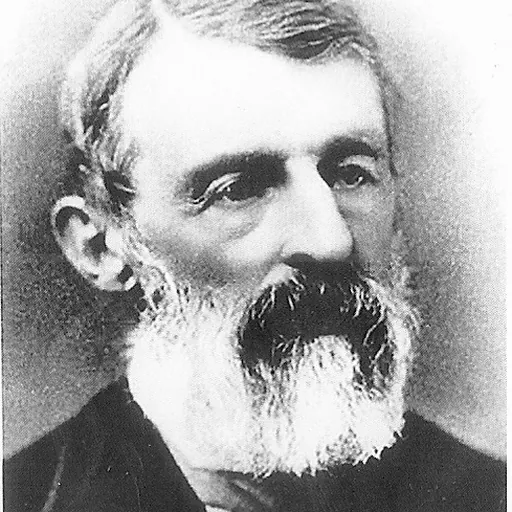
About Doc Adams
Lived 1814 – 1899 (aged 84). Doc Adams was an American baseball player, physician, politician and national Association of Base Ball Players, known for Baseball and Shortstop.
Daniel Lucius "Doc" Adams (November 1, 1814 – January 3, 1899) was an American baseball player and executive who is regarded by historians as an important figure in the sport's early years. For most of his career he was a member of the New York Knickerbockers. He first played for the New York Base Ball Club in 1840 and started his Knickerbockers career five years later, continuing to play for the club into his forties and to take part in inter-squad practice games and matches against opposing teams. Researchers have called Adams the creator of the shortstop position, which he used to field short throws from outfielders. In addition to his playing career, Adams manufactured baseballs and oversaw bat production; he also occasionally acted as an umpire.
From 1847 to 1861, the Knickerbockers selected Adams as their president six times, and as a vice president, treasurer, or director in six other years. As president of the club, Adams was an advocate of rule changes in baseball that resulted in nine-man teams and nine-inning games. When the National Association of Base Ball Players (NABBP) was formed in 1858, he led the rules and regulations committee of the new organization. In his role, Adams ruled that the fields' bases should be apart, the modern distance, and supported the elimination of the "bound rule", which allowed for balls caught after one bounce to be recorded as outs. He resigned from his positions with the Knickerbockers and NABBP in 1862. Adams' contributions in creating baseball's rules went largely unrecognized for decades after his 1899 death, but in 1980 a letter about him appeared in The New York Times; by 1993, researcher John Thorn had written about Adams' role. Other historians have given him credit for helping to develop the sport, and Thorn has called Adams "first among the Fathers of Baseball".
A graduate of Yale University and Harvard Medical School, Adams began working in the medical field in the late 1830s, and practiced in New York City during his time as a member of the Knickerbockers. In 1865, he left medicine and later became a bank president and member of the Connecticut legislature. He and his wife had five children.
Early life Born in Mont Vernon, New Hampshire, on November 1, 1814, Adams was the fourth of Daniel and Nancy Adams' five children. The elder Daniel Adams was a physician and author; he wrote a math textbook that was widely used in the United States in the early- to mid-1800s. After being schooled at Kimball Union Academy in New Hampshire from 1826 to 1828 and Amherst, Massachusetts' Mount Pleasant Classical Institution, Adams attended three colleges from 1831 to 1838. He studied at Amherst College for two years, then transferred to Yale University, where he acquired a bachelor's degree upon his graduation in 1835. Nancy Adams, Daniel's sister, indicated in a letter penned in the early 1830s that he began playing with "bats and balls" by this time.
Adams continued his studies at Harvard Medical School through 1838, obtaining an MD. Following his time in college, he joined his father's medical practice. The pair worked in Mont Vernon, before the younger Adams relocated twice, first to Boston and then to New York City. Adams also worked for the New York Dispensaries, which provided medical care to poor residents. His field of employment gave rise to his nickname of "Doc", which was given as "Dock" at the time.
Playing career According to baseball historian John Thorn, 1839 is the year Adams became a baseball player. In an 1896 interview in The Sporting News, Adams said that "soon after going to New York I began to play base ball just for exercise, with a number of other young medical men." Starting in 1840, he was a player with the New York Base Ball Club. In the first five years the Knickerbockers played, the team fielded anywhere from eight to eleven players. The only infielders were the players covering each of the bases; if there were more than eight players, extra outfielders were sometimes used. The outfielders had difficulty throwing baseballs into the infield, because of the balls' light weight. Adams' shortstop position, at which he started playing in about 1849 or 1850, was used to field throws from the outfielders and throw to the three infielders. With the advent of higher-quality baseballs, Adams moved toward the infield, since the distance the balls could travel increased. Prior to the invention of the shortstop, large gaps existed in the defensive positioning of infields; defensive players tended to stand by bases, leaving empty space in between them for batters. The shortstop filled one of the two gaps.
Adams hit left-handed; he said that his batted balls occasionally went into a river by the Elysian Fields, the ground in Hoboken, New Jersey, where the Knickerbockers practiced and played. Adams had a long on-field career with the Knickerbockers; he remained a player with the team until 1859. He did not limit his play to shortstop; he fielded at every position except pitcher. Little is known about the relative performance of early baseball players, and the game was largely recreational, as opposed to competitive. Thorn speculates that Adams may have been "the best player of the 1840s", citing his lengthy playing career as evidence.
Equipment maker and umpire In addition to playing the game, Adams was involved in the production of early baseball equipment. He personally manufactured baseballs for a period of time, supplying many New York City-based clubs. Adams found that when the ball was more tightly stitched, it traveled further when batted or thrown. According to author Peter Morris, Adams' ball-manufacturing efforts helped to keep the Knickerbockers in operation during their first few years, as they would otherwise have had difficulty finding balls. In later years Adams gathered rubber from old galoshes for the insides of baseballs. A tanner then used horsehide to create the balls.
Number of players and game length Duncan Curry and Adams were on opposite sides of the Knickerbockers' debates on roster size and game length. A supporter of nine-man baseball teams, Adams favored a measure in 1856 which allowed for players from outside the Knickerbockers to join their intrasquad games when 17 or fewer team members appeared. No rules existed at the time regarding team size, but official games between clubs were typically played with nine men per club. The proposal was defeated by a 13–11 vote, in favor of a rule forbidding non-club members to play if there were 14 players (seven per team).
A two-man committee was created with the aim of working with the Eagle and Washington clubs to resolve the debate over how many players to field in official games. Duncan F. Curry and William F. Ladd were chosen as the committee members, but Ladd withdrew and Adams was named as a substitute. His partner on the committee, Curry, had led the opposition to nine-man teams. Adams and Curry also differed on another issue: the length of games. At the time, a baseball game lasted until one of the teams had 21 runs; that team was awarded the victory. The "Laws" included regulations governing bat and ball sizes, and a ban on betting by players and umpires. Fellow Knickerbocker William H. Grenelle copied Adams' work onto blue pages, and modifications and notations were made as the convention progressed. Among other changes, part of the rule Adams had written on game length was crossed out; the number nine was replaced with seven, before the motion that settled the issue was introduced. He contributed to the creation of the Ridgefield Land Improvement Association, and to a committee overseeing construction of a town house. In 1871, he accepted a job with the Ridgefield Savings Bank (later renamed the Fairfield County Bank) as the company's first president. After working there until 1879, Adams took a break from his duties; during this time, he helped found Ridgefield's library and served as its treasurer. In 1884, he returned to the Ridgefield National Bank and remained president there until mid-1886. Adams and his family relocated to a house in New Haven, Connecticut, in 1888. and claims that Abner Doubleday invented baseball in 1839, which are considered flawed by modern researchers, were reported by the media. The New York Times published an article on Adams on September 23, 2015. Mont Vernon holds an annual baseball game in honor of Adams, which incorporates the rules of his era, as a part of the town's Lamson Farm Day.
Various historians have given Adams recognition as an important figure from the early years of baseball. Thorn has written that he "may be counted as first among the Fathers of Baseball." O'Maxfield said of Adams: "Without [him], we wouldn't have the game we know and love as baseball today."
While Adams' contributions had received notice from historians, Associated Press writer Andrew Dalton called such reports "somewhat speculative" in nature before 2016. That year, the 1857 "Laws of Base Ball" authored by Adams were sold at an auction. The documents were included in a batch of historical papers that brought $12,000 in a 1999 sale. Adams' authorship of the papers was unknown at the time, but was confirmed after the owner brought the documents to the attention of an auction house in 2015. An anonymous buyer purchased the "Laws of Base Ball" in April 2016 for $3.26 million, the most a series of baseball documents had ever sold for.
Don’t just read it —
keep it.
Full-length biographies made to live with: read them, listen on the way to work, watch them tonight.
- E-book
- Audio
- Video
Instant download · yours to keep · every purchase keeps this site free
Important facts
People in Doc Adams's life
Named in this biography and alive at the same time




Related people
Same field, nearest in time



Contemporaries
People whose lives overlapped Doc Adams's



Frequently asked questions
Who was Doc Adams?
Baseball player and executive (1814–1899)
When was Doc Adams born?
Doc Adams was born on 1 November 1814 in Mont Vernon.
When did Doc Adams die?
Doc Adams died on 3 January 1899 in New Haven.
What was Doc Adams's occupation?
Doc Adams was a baseball player, physician, politician and national Association of Base Ball Players.
What was Doc Adams known for?
Doc Adams was known for Baseball and Shortstop.
What nationality was Doc Adams?
Doc Adams was American.
Sources & further reading
Cite this page
APA: Biography.guide. (2026). Doc Adams. https://biography.guide/doc-adams/
MLA: "Doc Adams." Biography.guide, https://biography.guide/doc-adams/.
Chicago: "Doc Adams." Biography.guide. https://biography.guide/doc-adams/.
Data last updated: 2026-09-24 · Spot an error? Report a correction.
Portrait: Wikimedia Commons · author & licence
Page generated 2026-09-27 05:09 UTC