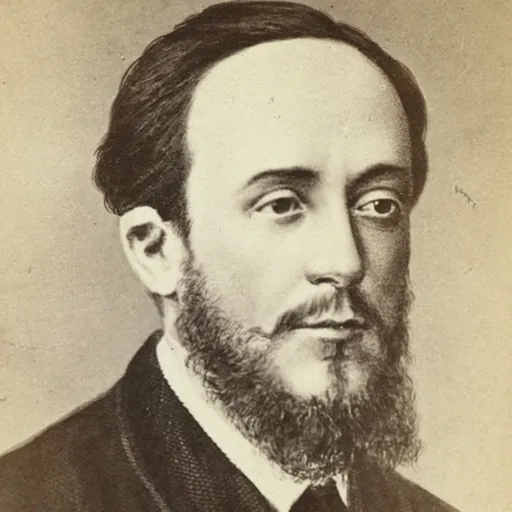
About Dmitry Pisarev
Lived 1840 – 1868 (aged 27). Dmitry Pisarev was a Russian essayist, journalist, writer, literary critic and literary historian, known for Bazarovism and Nietzscheanism.
Dmitry Ivanovich Pisarev ( – ) was a Russian literary critic and philosopher who was a central figure of Russian nihilism. He is noted as a forerunner of Nietzschean philosophy, and for the impact his advocacy of liberation movements and natural science had on Russian history.
A critique of his philosophy became the subject of Fyodor Dostoevsky's celebrated novel Crime and Punishment. Indeed, Pisarev's philosophy embraces the nihilist aims of negation and value-destruction; in freeing oneself from all human and moral authority, the nihilist becomes ennobled above the common masses and free to act according to sheer personal preference and usefulness. These new types, as Pisarev termed them, were to be pioneers of what he saw as the most necessary step for human development, namely the reset and destruction of the existing mode of thought. Among his most famous locutions is: "What can be smashed must be smashed. Whatever withstands the blow is fit to survive; what flies into pieces is rubbish. In any case, strike out right and left, no harm can come of it."
Pisarev wrote most of his works while imprisoned. He was arrested for political crimes the year after graduating university and drowned only two years after his release, aged 27. It is unknown whether his death was accidental or suicide as he had also suffered severe mental health issues throughout his life. His works had a deep influence throughout Russia on revolutionaries such as Lenin, anti-nihilists such as Dostoevsky, and scientists such as the Nobel Prize winner Ivan Pavlov.
Biography
Dmitry Pisarev was born in Znamenskoye in the west of the Russian Empire, into a family of the landed aristocracy. He graduated from a gymnasium in Saint Petersburg in 1856, and in the same year began studying history and philology at Saint Petersburg Imperial University. He began writing as a literary critic for a women's liberal journal called Rassavet in 1858 while he was still a student. From 1859 to 1860 he suffered a severe mental breakdown and attempted suicide at least twice. He was committed to a mental asylum for four months after which he resumed his work and studies. As a critic, he came into contact with the writings of radicals such as Nikolay Dobrolyubov and Nikolay Chernyshevsky, as well as their mentors and followers. He became enthralled with this modern wave of literature, stating that it "forced me out of my confined cell into the fresh air." He graduated in 1861, the same year as serfdom was abolished and the first major student demonstrations were held in Saint Petersburg, by which time he had thoroughly adopted the nihilist outlook and abandoned his Orthodox Christian faith.
After graduation he worked as editor for various publications. He was arrested in 1862 for anti-government writings and was imprisoned until 1866. After his release, he continued his literary work.
During the summer holidays of 1868 he died as a result of a drowning accident at Dubulti on the Gulf of Riga (in present-day Latvia).
Legacy
Pisarev was one of the writers who propelled the democratic-revolutionary trend in Russia during the 1860s. The next generation of Russians, made famous by the events of 1905 and 1917, acknowledged Pisarev's influence. Nadezhda Krupskaya, Lenin's wife, once wrote, "Lenin was of the generation that grew up under the influence of Pisarev".
Pisarev was also noted for his support of Russian natural science, particularly biology, and his works greatly influenced the career choice of the young Ivan Pavlov. He considered himself a positivist, although his incorporation of imagination and style somewhat contradicted that school of thought. He did not believe in romantic ideas because they reminded him of the oppressive tsarist government under which he lived. His basic beliefs were "an extreme anti-aesthetic scientistic position." He focused his efforts on defining the relation between literature and the environment.
Pisarev wanted, more than anything else, for his readers to learn to think independently. This desire he pursued through philosophy, literary criticism and social and family analyses.
Influence on Lenin
Lenin, in the fifth chapter of What Is To Be Done?, quoted these lines from an article by Pisarev:
Works
Translated works in English
Don’t just read it —
keep it.
Full-length biographies made to live with: read them, listen on the way to work, watch them tonight.
- E-book
- Audio
- Video
Instant download · yours to keep · every purchase keeps this site free
Important facts
People in Dmitry Pisarev's life
Named in this biography and alive at the same time
Related people
Same field, nearest in time




Contemporaries
People whose lives overlapped Dmitry Pisarev's
Frequently asked questions
Who was Dmitry Pisarev?
Russian journalist (1840–1868)
When was Dmitry Pisarev born?
Dmitry Pisarev was born on 2 October 1840 in Znamenskoe.
When did Dmitry Pisarev die?
Dmitry Pisarev died on 4 July 1868 in Jūrmala.
What was Dmitry Pisarev's occupation?
Dmitry Pisarev was an essayist, journalist, writer, literary critic and literary historian.
What was Dmitry Pisarev known for?
Dmitry Pisarev was known for Bazarovism and Nietzscheanism.
What nationality was Dmitry Pisarev?
Dmitry Pisarev was Russian.
Sources & further reading
Cite this page
APA: Biography.guide. (2026). Dmitry Pisarev. https://biography.guide/dmitry-pisarev/
MLA: "Dmitry Pisarev." Biography.guide, https://biography.guide/dmitry-pisarev/.
Chicago: "Dmitry Pisarev." Biography.guide. https://biography.guide/dmitry-pisarev/.
Data last updated: 2026-09-22 · Spot an error? Report a correction.
Portrait: Wikimedia Commons · author & licence
Page generated 2026-09-27 04:59 UTC