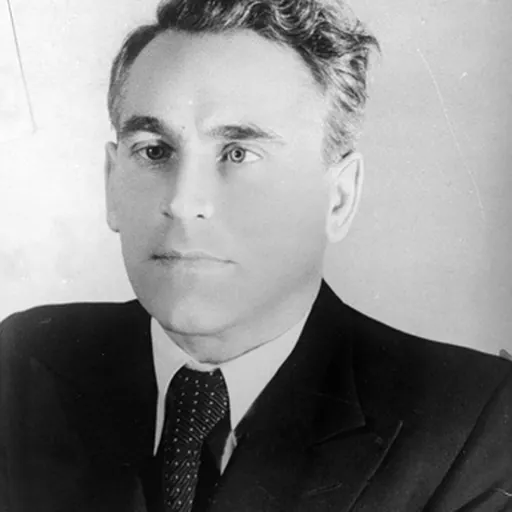
About Dmitry Chechulin
Lived 1901 – 1981 (aged 80). Dmitry Chechulin was a Russian painter, architect, urban planner, politician and engineer.
Dmitry Nikolaevich Chechulin (; – 29 October 1981) was a Russian Soviet architect, city planner, author, and leading figure of Stalinist architecture.
Life Born in Shostka (Sumy Oblast, today in Ukraine) to a working-class family, after service in the Red Army Chechulin enrolled in the state school Vkhutemas and graduated in 1929, doing post-graduate work under Alexey Shchusev.
In the 1930s Chechulin was awarded commissions for four stations of the Moscow Metro, and developed his career to design a list of familiar Moscow landmarks. From 1945 through 1949 he served as chief architect of Moscow.
Chechulin's work intersects with the Palace of the Soviets competition (the major event in Soviet architectural history) at multiple points. He was among the twelve finalists in the final round. He is credited for the Kotelnicheskaya Embankment Building, one of the seven Moscow vysotki (tall buildings) commissioned by Stalin after World War II as a "frame" for, and then in lieu of, the unbuilt Palace. Chechulin had produced plans for the unbuilt eighth tower, the Zaryadye skyscraper, in 1947. And when, after decades of neglect and delay, the huge excavation for the Palace of the Soviets finally became the world's largest open-air swimming pool in 1958, he was the architect.
Chechulin wrote nearly 40 books, pamphlets, monographs and articles on architecture, urban planning and design issues. Among his many awards were Hero of Socialist Labour (1976), People's Architect of the USSR (1971), two Orders of Lenin, two Orders of the Red Banner of Labour, the Order of Honour, and three Stalin Prizes (1941, 1949, 1953).
He died 29 October 1981 and is buried at Novodevichy Cemetery.
Work
The following works are in Moscow unless otherwise indicated:
Komsomolskaya (Sokolnicheskaya Line) station, Moscow Metro, 1935 vestibules for Okhotny Ryad Metro station, 1935 Kievskaya (Filyovskaya Line) Metro station, 1937 vestibules for the Dynamo Metro station, 1938 the Moscow Pavilion at the All-Union Agricultural Exhibition, now the All-Russia Exhibition Centre, 1939 Tchaikovsky Concert Hall, 1940 the Victory Bridge (with sculptor Nikolai Tomsky), 1943 the Stalinist skyscraper at the Kotelnicheskaya Embankment (one of the Seven Sisters), 1947–1952 the Peking Hotel, 1955 Moskva Pool, 1958 the White House, 1965–1981 the Rossiya Hotel, Moscow, on the site of the unbuilt Zaryadye tower, 1967 (razed 2006)
Don’t just read it —
keep it.
Full-length biographies made to live with: read them, listen on the way to work, watch them tonight.
- E-book
- Audio
- Video
Instant download · yours to keep · every purchase keeps this site free
Important facts
People in Dmitry Chechulin's life
Named in this biography and alive at the same time

Related people
Same field, nearest in time



Contemporaries
People whose lives overlapped Dmitry Chechulin's



Frequently asked questions
Who was Dmitry Chechulin?
Soviet architect (1901-1981)
When was Dmitry Chechulin born?
Dmitry Chechulin was born on 9 August 1901 in Shostka.
When did Dmitry Chechulin die?
Dmitry Chechulin died on 29 October 1981 in Moscow.
What was Dmitry Chechulin's occupation?
Dmitry Chechulin was a painter, architect, urban planner, politician and engineer.
What nationality was Dmitry Chechulin?
Dmitry Chechulin was Russian.
Sources & further reading
Cite this page
APA: Biography.guide. (2026). Dmitry Chechulin. https://biography.guide/dmitry-chechulin/
MLA: "Dmitry Chechulin." Biography.guide, https://biography.guide/dmitry-chechulin/.
Chicago: "Dmitry Chechulin." Biography.guide. https://biography.guide/dmitry-chechulin/.
Data last updated: 2026-09-21 · Spot an error? Report a correction.
Portrait: Wikimedia Commons · author & licence
Page generated 2026-09-27 04:59 UTC