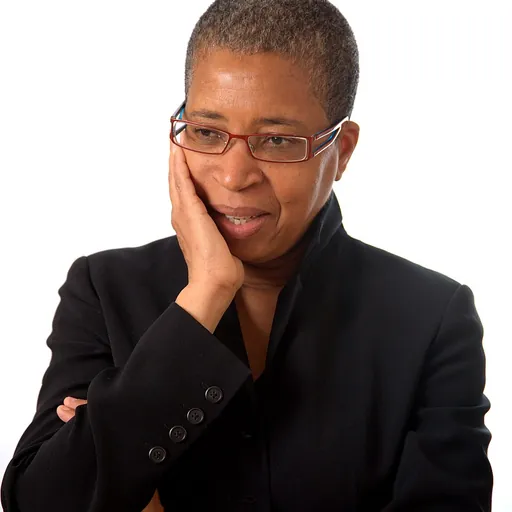
About Dionne Brand
Born 1953. Dionne Brand is a Canadian writer, poet, novelist and film director.
Dionne Brand (born 7 January 1953) is a Canadian poet, novelist, essayist and documentarian. She was Toronto's third poet laureate from September 2009 to November 2012 and its first Black poet laureate. She was admitted to the Order of Canada in 2017 and has won the Governor General's Award for English-language poetry, the Trillium Book Award, the Pat Lowther Award, the Harbourfront Festival Prize, and the Toronto Book Award. Brand lives in Toronto.
Early life and education Dionne Brand was born in Guayaguayare, Trinidad and Tobago. She graduated from Naparima Girls' High School in San Fernando in 1970 and emigrated to Canada. She attended Erindale College at the University of Toronto and earned a Bachelor of Arts degree in English and philosophy in 1975. She later attained an Master of Arts in Philosophy of Education from the Ontario Institute for Studies in Education in 1989. Distinguished Visiting Scholar and Writer-in-Residence at St. Lawrence University (2004–2005), and Ralph Gustafson Distinguished Poet at Vancouver Island University (2006). She is a professor emeritus of English at the School of English and Theatre Studies at the University of Guelph, where she held a University Research Chair.
In 2017, she was appointed as poetry editor of McClelland & Stewart, holding the position until 2021. Brand is a co-editor of the literary journal Brick.
Writing In her writing, Brand explores themes of gender, race, sexuality, feminism, diaspora, nation, white male domination, injustice, and "the moral hypocrisies of Canada." Despite being often characterized as a Caribbean writer,
She has written about topics including the violent killings of Black people, the École Polytechnique massacre, racism against Indigenous women in Canada, and the sexual exploitation of African women.
A Map to the Door of No Return
Brand explores inter-generational trauma in her piece A Map to A Door of No Return. She explores her own experiences through an autobiographical perspective as well as diving into explain a concept she calls the "Door of No Return". The Door is the space in which the history of Black people is lost, specifically when enslaved people from Africa were transported through the Atlantic slave trade. Brand defines the Door of No Return as "that place where our ancestors departed one world for another; the Old World for the New." The Door can bring profound grief and pain to many in the diaspora when they encounter it. The Door is a site of traceable beginnings that are eventually lost in historical memory, as demonstrated when Brand's grandfather can no longer remember the name of the ancestral people they belong to. When passing through The Door, people lose their history, their humanity, and their ancestry.
Brand also describes how her interactions with her grandfather became "mutually disappointing" and led to estrangement, as he could not remember the name of the people they came from and thus could not remember their family history. She marks this as being the first time she felt a burning desire to know her ancestry. In this moment, she is confronted with the reality that her life will consist of a never ending battle to complete her identity. Brand notes that her desire only came into full effect when she was denied knowledge of her ancestry. The onset of her inner struggle to find belonging occurred in an entirely Black space, not dependent on the white world. Brand argues that this feeling of being incomplete is common among Black people throughout the diaspora.
Another theme explored in A Map to the Door of No Return is the theory and praxis of geography. She begins to deconstruct and challenge the systems of logic that constitute geography and borders, the way geography has been constructed as truth, the emphasis placed on origins, and the violence of the nation-state.
Rivers Have Sources, Trees Have Roots In Rivers Have Sources, Trees Have Roots (1986), Brand and co-author Krisantha Sri Bhaggiyadatta interviewed a hundred people from the Canadian Indigenous, Black, Chinese, and South Asian communities about their perceptions of racism and its impact on their lives.
No Language Is Neutral No Language is Neutral was originally published in 1990 by Coach House Books. In its 50 pages, it tackles issues of immigration, environmentalism, slavery, lesbianism, identity, place, and the female body, all from a Black feminist perspective. It is in conversation with writers of the Black diaspora, namely Derek Walcott. In her opinion, Walcott wrongly plays to the belief that "colonization brought civilization [and] culture." Susan Gingell calls Walcott Brand's "antithetical literary ancestor." The critic Winfried Siemerling described No Language is Neutral as a "breakthrough volume" for its unrestraint. No Language Is Neutral sold over 6,000 copies and was nominated for a Governor General's Award.
"St. Mary Estate" In her short story "St. Mary Estate" from Sans Souci and Other Stories, the narrator, accompanied by her sister, revisits the cocoa estate of their childhood, recalling past experiences of racism and shame. She focuses on the summer beach house belonging to "rich whites" that was cleaned by their mother, the daughter of her overseer grandfather. Her anger over discrimination and poverty is triggered by the recollection of living quarters made of thin cardboard with newspapers walls, barracks that metaphorically depict the physical, social, and psychological degradation endured by the enslaved who were denied basic human rights and freedom.
"This Body For Itself" In "This Body For Itself" from Bread Out of Stone (1994), Brand discusses the way the Black female body is represented. She asserts that in male-authored texts, the Black female body is often portrayed as motherly or virginal. In female-authored texts, the Black female body is often portrayed as a protector from or resistor to rape. Brand states that the avoidance of portraying Black female bodies as sexual is out of self-preservation, as Black female bodies are often overly sexualized. However, Brand argues that desire and sexuality can be a great source of power.
Chronicles of the Hostile Sun Brand wrote many of the poems in her fifth book of poetry, Chronicles of the Hostile Sun, in response to the United States invasion of Grenada. Brand had been living in Grenada and working for a Canadian non-profit organization when the invasion took place. Brand's Chronicles of the Hostile Sun, published one year later in 1984, is divided into three sections: Languages, Sieges, and Military Occupations.
Filmmaking Brand made a number of documentaries with the National Film Board of Canada's feminist-film production unit, Studio D, from 1989 to 1996. When Studio D was criticized for its lack of diversity, Rina Fraticelli, the executive producer at the time, created a program called New Initiatives in Film (NIF). It was through this program that Brand partnered with producer Ginny Stikeman to create Sisters in the Struggle (1991), a "look at Black women in community, labour and feminist organizing." This was part of the Women at the Well trilogy that also included Older, Stronger, Wiser (1989) and Long Time Comin (1991). Brand's collaboration with Stikeman also became the model for the internship component of NIF, which offered production experience at various regional studios across Canada and at Studio D in Montreal
Brand did not have an interest in filmmaking until an opportunity arose to consult on a documentary about racism at Studio D. A white filmmaker was the lead on the project and after meeting with her for several days, Brand decided she did not want to be a part of the film. She told the Studio that she would be willing to "do something about Black women from their point of view," which resulted in Long Time Comin.
Brand directed Listening for Something… Adrienne Rich and Dionne Brand in Conversation (1996). Listening for Something was made as Studio D was being dismantled. Brand also wrote the script for Under One Sky… Arab Women in North America Talk About the Hijab. Academic J. Edward Chamberlain called her "a final witness to the experience of migration and exile" whose "literary inheritance is in some genuine measure West Indian, a legacy of [Derek] Walcott, Brathwaite and others."
Peter Dickinson argues that "Brand 'reterritorializes' [...] boundaries in her writing, (dis)placing or (dis)locating the national narrative of subjectivity [...] into the diaspora of cross-cultural, -racial, -gender, -class, and –erotic identifications." Critic Leslie Sanders argues that "by becoming a Canadian writer, Brand is extending the Canadian identity in a way [Marshall] McLuhan would recognize and applaud" but Dickinson states that "her work remains marginal/marginalizable in academic discussions of Canadian literary canons."
Academic Franca Bernabei writes in the preamble to Luce ostinata/Tenacious Light (2007), an Italian-English selected anthology of Brand's poetry, that "Brand's poetic production reveals a remarkable variety of formal-stylistic strategies and semantic richness as well as the ongoing pursuit of a voice and a language that embody her political, affective, and aesthetic engagement with the human condition of the black woman—and, more exactly, all those oppressed by the hegemonic program of modernity." Editor and critic Constance Rooke calls Brand "one of the very best [poets] in the world today."
Activism Openly identifying as a lesbian, Brand is vocal against the anti-LGBTQ discrimination. She is a founder of the newspaper Our Lives, the first Canadian newspaper devoted to Black women. She is also a past chair of the Women's Issues Committee of the Ontario Coalition of Black Trade Unionists, and does work with immigrant organizations in Toronto. In 2009, she was named the Poet Laureate of Toronto. Also in 2017, she was made a Member of the Order of Canada, with the award invested in 2018.
Don’t just read it —
keep it.
Full-length biographies made to live with: read them, listen on the way to work, watch them tonight.
- E-book
- Audio
- Video
Instant download · yours to keep · every purchase keeps this site free
Important facts
People in Dionne Brand's life
Named in this biography and alive at the same time






Related people
Same field, nearest in time


Contemporaries
People whose lives overlapped Dionne Brand's

Frequently asked questions
Who is Dionne Brand?
Canadian writer, poet
When was Dionne Brand born?
Dionne Brand was born on 7 January 1953 in Port of Spain, Guayaguayare.
What is Dionne Brand's occupation?
Dionne Brand is a writer, poet, novelist and film director.
What nationality is Dionne Brand?
Dionne Brand is Canadian.
Sources & further reading
Cite this page
APA: Biography.guide. (2026). Dionne Brand. https://biography.guide/dionne-brand/
MLA: "Dionne Brand." Biography.guide, https://biography.guide/dionne-brand/.
Chicago: "Dionne Brand." Biography.guide. https://biography.guide/dionne-brand/.
Data last updated: 2026-09-22 · Spot an error? Report a correction.
Portrait: Wikimedia Commons · author & licence
Page generated 2026-09-27 05:02 UTC