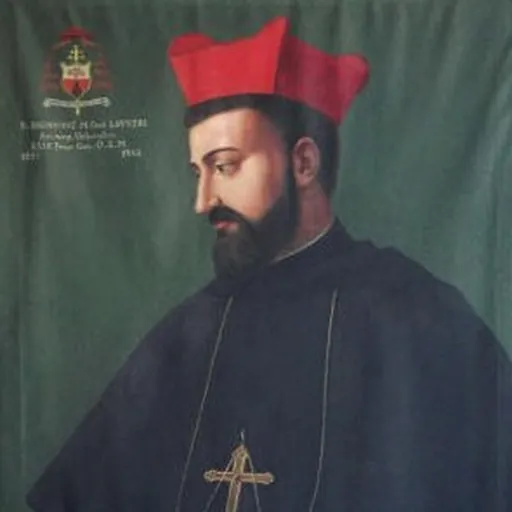
About Dionisio Laurerio
Lived 1497 – 1542 (aged 44–45). Dionisio Laurerio was an Italian catholic priest, bishop (Catholic Church) and servite Order.
Dionisio Laurerio (1497–1542) (also known as fra Dionisio da Benevento and as the Cardinal of San Marcello) was an Italian Roman Catholic cleric who was the superior general of the Servite Order from 1535 to 1542, a cardinal from 1539, and a bishop from 1540.
Biography
Early years, 1497–1535
Dionisio Laurerio was born in Benevento in 1497. He was from a little-known family with links to the Pedicini family, a local patrician family. Both of his parents were originally from Florence.
He entered the Servite Order at a young age and was educated by his order. He obtained a doctorate in theology in 1521. then at the Sapienza University of Rome. He was also a papal Penitentiary of the Basilica of S. Peter and S. Paul, attested in 1530.
On 5 November 1531, the Prior General of the Servites, Jerónimo de Lucca (1523-1535), detached the new monastery called "Il Mergollino" from the jurisdiction of the Order's Neapolitan province, and assigned Fr. Dionysio to be its Vicar Perpetuus with full powers. Laurerio had been the organizer of the monastery and its properties in the immediately preceding years, the gift of the humanist Jacopo Sannazzaro.
In 1534, when Thomas Cranmer, the representative of King Henry VIII of England at the papal Court, returned to England, having been approved as Archbishop of Canterbury by Pope Clement VII, Cranmer made such a good report of Laurerio's friendliness and usefulness in doing the king's business, that Henry named Laurerio as Cranmer's successor at the papal court. Laurerio traveled to London to deal with urgent religious matters in the Kingdom of England.
Superior General of the Servite Order, 1535–1539
In 1534, after the election of Pope Paul III (Farnese) on 13 October, the Servite general, Jerónimo de Lucca, was deluged with various contentions, complaints, slanders, and accusations against himself before the pope. Tired, and wishing to avoid all the unpleasantness, he went to the pope, laid the seals of his office at the pope's feet, and abdicated his office. Pope Paul III thereupon promoted Laurerio to the post vicar general of the Servite Order on 22 January 1535, to serve until a General Chapter was summoned and elected a successor to Jerónimo de Lucca. On 27 April 1535, at a chapter celebrated in Bologna, the Servite Order elected Laurerio to be its superior general. His assignment was to report on the desirability of holding an ecumenical council. He was also given the powers of a legate a latere to visit and reform institutions in the Kingdom of Scotland, to prevent them from joining Henry VIII of England in breaking with Rome. Laurerio met James in Paris on 27 January 1537 and probably never actually visited Scotland. He convinced the king to support an ecumenical council, but was unable to convince the cloistered of the Kingdom of France to agree. Pope Paul III, in beginning the process of reform of the Roman Curia, appointed a commission of cardinals (Contarini, Carafa, Simonetta and Ghinucci) to hold discussions and produce a plan of reform of the Apostolic Datary, the office that filled vacant benefices. A serious issue immediately arose, over the question of compulsory payments for a benefice received; in the eyes of many, such "compositions" amounted to simony. In autumn 1537, Laurerio participated in discussions on the reforming proposal, and wrote for the cardinals a memorandum entitled Compositionum defensio, arguing for a moderate reform against the strict view later adopted by the cardinals.
In December 1538, while on an inspection tour of houses of his Order, he took part in the provincial Chapter of Lombardy, held at Scandia, north of Alessandria.
Cardinal, 1539–42
Pope Paul III created Dionisio Laurerio a cardinal priest in the consistory of 19 December 1539. He received the red hat on 22 December 1539, and the titular church of San Marcello al Corso on 28 January 1540. He took possession of the see on 3 March 1540. He presented a proposal for reconciliation with the Protestants, supported by Alvise Priuli. Cardinal Laurerio vehemently opposed this proposal.
Cardinal Laurerio announced his intention of resigning as superior general of the Servite Order in a letter of 24 March 1542, and he therefore convoked a general chapter of the Order, to meet in Faenza. On 17 May 1542, his successor, Agostino Bonucci, was elected.
When, on 21 July 1542, Pope Paul III issued the papal bull Licet ab initio, reorganizing the Roman Inquisition, Laurerio was named one of the six cardinal inquisitors of the reformed Inquisition.
He died in Rome on 17 September 1542 after a brief illness.
Don’t just read it —
keep it.
Full-length biographies made to live with: read them, listen on the way to work, watch them tonight.
- E-book
- Audio
- Video
Instant download · yours to keep · every purchase keeps this site free
Important facts
People in Dionisio Laurerio's life
Named in this biography and alive at the same time
Related people
Same field, nearest in time



Contemporaries
People whose lives overlapped Dionisio Laurerio's





Frequently asked questions
Who was Dionisio Laurerio?
Italian cardinal
When was Dionisio Laurerio born?
Dionisio Laurerio was born in 1497 in Benevento.
When did Dionisio Laurerio die?
Dionisio Laurerio died on 17 September 1542 in Rome.
What was Dionisio Laurerio's occupation?
Dionisio Laurerio was a catholic priest, bishop (Catholic Church) and servite Order.
What nationality was Dionisio Laurerio?
Dionisio Laurerio was Italian.
Sources & further reading
· Wikipedia: Dionisio Laurerio
Cite this page
APA: Biography.guide. (2026). Dionisio Laurerio. https://biography.guide/dionisio-laurerio/
MLA: "Dionisio Laurerio." Biography.guide, https://biography.guide/dionisio-laurerio/.
Chicago: "Dionisio Laurerio." Biography.guide. https://biography.guide/dionisio-laurerio/.
Data last updated: 2026-09-20 · Spot an error? Report a correction.
Portrait: Wikimedia Commons · author & licence
Page generated 2026-09-27 04:57 UTC