
About Dionigi di Borgo San Sepolcro
Lived 1300 – 1342. Dionigi di Borgo San Sepolcro was a theologian and catholic bishop.
Dionigi di Borgo San Sepolcro OESA (Roberti of Roberti, Dennis) ( 1300 – 31 March 1342) was an Augustinian friar who was at one time Petrarch's confessor, and who taught Boccaccio at the beginning of his education in the humanities. He was Bishop of Monopoli in Apulia. He was surnamed, not uncommonly for the trecento, for the town in which he was born, now Sansepolcro in Tuscany. His family name was de' Roberti, which no longer exists. Dionigi is the Italian form of Dennis, Latin Dionysius.
Life
Dionigi joined the Order of Hermits at the Augustinian monastery in Borgo San Sepolcro at an early age.
He acquired the ranks of diffinitor and magister sacrae paginae, although these are rarely attested because he may have left the University of Paris.
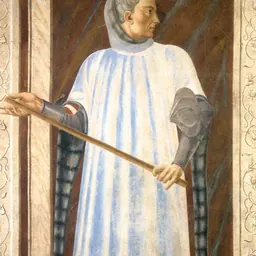
At Naples, he lived in the Augustinian convent, and was witness to a deed gift of land made by the Neapolitan nobleman Walter to build a church in honor of S. Giovanni Battista, executed 11 October 1339. Other intellectuals in Naples at the time include Andalò del Negro, Paolo Minorita, Niccolò Acciaioli, Paolo dell'Abbaco, Paolo da Perugia, Graziolo de' Bambaglioli, and Cino da Pistoia. On 17 March 1340, he was consecrated bishop of Monopoli, at the King's request.
He died on 31 March 1342 and was buried in the local church yard of Agostino alla Zecca.
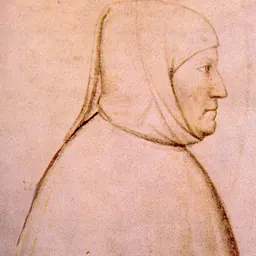
Petrarch Dionigi had been Petrarch's confessor during his stay in Avignon, and Petrarch wrote three letters to him. Much of what we know about Dionigi is inferred from this correspondence; and is correspondingly uncertain. Moschella holds, for example that he was introduced to Petrarch in 1333, by Giacomo Colonna; but there has been other speculation that Petrarch met Dionigi in Paris.
Dionigi recommended Augustine's Confessions to Petrarch, who had never read it; Dionigi gave him a pocket copy, which Petrarch says he carried around with him everywhere. Moschella asserts that Dionigi's influence on Petrarch in his moral crisis over Laura amounted to a conversion.
Petrarch addressed his long account of his ascent of Mont Ventoux to Dionigi. Dionigi was also instrumental in persuading King Robert of Naples to present Petrarch with his crown of laurel: Petrarch had invited Dionigi to visit Vaucluse on his way to Naples in 1338, in a verse letter filled with flattery of the King. When Dionigi arrived in Naples, he did persuade King Robert to write Petrarch, and Petrarch responded to both of them, congratulating Dionigi on having the favor of so famous a king, and reminding him in a postscript: "You know what I think about the laurel."
Dionigi also arranged Petrarch's visit to Naples in February 1341, when King Robert examined him for his fitness for the laurel.
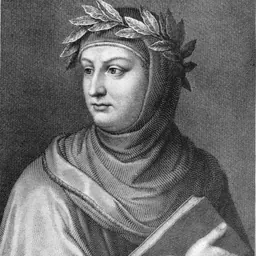
Boccaccio Giovanni Boccaccio had lived in Naples, and been welcome in the court of King Robert, since 1327, when he was fourteen. He returned to Florence, probably at the end of 1340, and wrote a letter there, bemoaning the death of his "reverend father and teacher", Dionigi; whose death "left nothing for him in the world." Dionigi had introduced him to the works of Augustine, Seneca, and Petrarch; Branca presumes that he had also taught him vernacular poetry and rhymed prose.
Works Most of Dionigi's writings are lost; but we have A commentary on the first book of Peter Lombard's Sententiae (on which, as was common, he had given his baccalaureate lecture) a treatise on logic (Compendiuni logicae juxta Doctrinam em ac funds), a commentary on Aristotle's Economics, a commentary on Valerius Maximus (printed in Strasbourg in the 1470s). Some other commentaries have been attributed to Dionigi.
Don’t just read it —
keep it.
Full-length biographies made to live with: read them, listen on the way to work, watch them tonight.
- E-book
- Audio
- Video
Instant download · yours to keep · every purchase keeps this site free
Important facts
People in Dionigi di Borgo San Sepolcro's life
Named in this biography and alive at the same time




Related people
Same field, nearest in time


Contemporaries
People whose lives overlapped Dionigi di Borgo San Sepolcro's
Frequently asked questions
Who was Dionigi di Borgo San Sepolcro?
Italian monk
When was Dionigi di Borgo San Sepolcro born?
Dionigi di Borgo San Sepolcro was born in 1300 in Sansepolcro.
When did Dionigi di Borgo San Sepolcro die?
Dionigi di Borgo San Sepolcro died on 31 March 1342 in Naples.
What was Dionigi di Borgo San Sepolcro's occupation?
Dionigi di Borgo San Sepolcro was a theologian and catholic bishop.
Sources & further reading
· Wikipedia: Dionigi di Borgo San Sepolcro
· DBpedia: Dionigi di Borgo San Sepolcro
Cite this page
APA: Biography.guide. (2026). Dionigi di Borgo San Sepolcro. https://biography.guide/dionigi-di-borgo-san-sepolcro/
MLA: "Dionigi di Borgo San Sepolcro." Biography.guide, https://biography.guide/dionigi-di-borgo-san-sepolcro/.
Chicago: "Dionigi di Borgo San Sepolcro." Biography.guide. https://biography.guide/dionigi-di-borgo-san-sepolcro/.
Data last updated: 2026-09-22 · Spot an error? Report a correction.
Page generated 2026-09-27 05:10 UTC