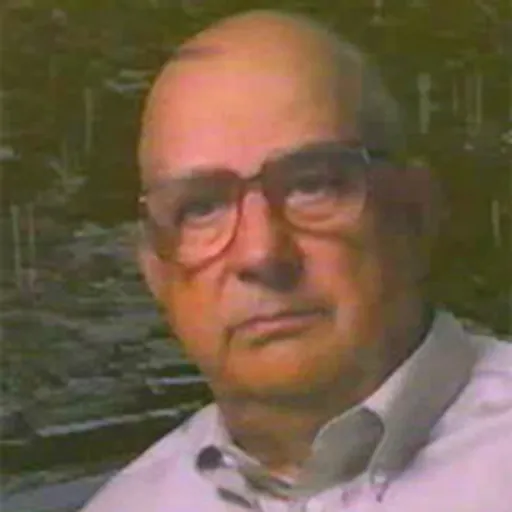
Dino Brugioni
Recipient of the Purple Heart medal
About Dino Brugioni
Lived 1921 – 2015 (aged 93). Dino Brugioni was an American bomb damage assessment and imagery analysis.
Dino Antonio Brugioni (December 16, 1921 – September 25, 2015) was an American intelligence analyst. He was a senior official at the CIA's National Photographic Interpretation Center (NPIC), working as an imagery analyst and also serving as NPIC's Chief of Information. During his 35-year career, Brugioni helped establish imagery intelligence (IMINT) as a national asset to solve intelligence problems. Even after retirement, Brugioni was considered to be the world's foremost imagery intelligence analyst.
After retirement, he was active in encouraging the use of declassified photographic intelligence for historical research. His book, Eyeball to Eyeball is an extensive unclassified history of US imagery intelligence.
Background Brugioni, the son of Italian immigrants, was born in Bevier, Missouri on December 16, 1921, and grew up there and in Jefferson City, Missouri.
Brugioni flew in the 66th Bomb Squadron and a number of reconnaissance missions in World War II over North Africa, Italy, Germany, Yugoslavia and France. to form the National Photographic Interpretation Center (NPIC), as a part of the CIA Directorate of Science and Technology. Brugioni was a key deputy to Lundahl.
His first assignments included counting Russian bombers, finding new Soviet airbases and assessing Russian naval readiness. He then was intimately involved in the Cuban Missile Crisis (see below)
Role in the Cuban Missile Crisis U-2 photographs taken on October 14, 1962, by some of the first U-2 aircraft piloted by US Air Force members rather than CIA personnel, brought back photographs, in which the NPIC analysts found visual evidence of the placement of Soviet SS-4 medium-range ballistic missiles (MRBM), capable of hitting targets, in the continental United States, with nuclear warheads. This triggered the Cuban Missile Crisis, sending the US intelligence community into maximum effort and triggering an unprecedented military alert.
The October 14 high-altitude photographs, taken from the periphery of Cuba, led to the US taking the additional risk of direct overflights of Cuba, at the orders of Secretary of Defense Robert S. McNamara. McNamara, Chief of Naval Operations George Whelan Anderson Jr and Lundahl concurred that the US Navy's Light Photographic Squadron VFP-62, flying F8U-1P Crusader fighters in a reconnaissance role, were best qualified to take low-level photographs, flying directly over Cuba. As well as the U-2 photographs, the low-level Navy photographs also streamed into NPIC, where Brugioni and colleagues analyzed them around the clock.
described Lundahl's presenting the October 14 photographs and their interpretation to President John F. Kennedy: "Mr. Lundahl, when Kennedy was shown the photographs, he turned his head, looked at Lundahl, and said, "Are you sure?" And Mr. Lundahl said, "I'm as sure of this, Mr. President, as we can be sure of anything in the photo interpretation field. And you must admit that we have not led you astray on anything that we have reported to you previously." And the President said "Okay.""
Brugioni's book, although a general history, deals extensively with the role of imagery intelligence in the Cuban Missile Crisis. A selection of the actual photographs, as well as supporting data such as the chart of CIA photo are at the George Washington University National Security Archive.
Another source on technique, discussing the obscure technique of "crateology", or recognizing the characteristic ways in which the Soviets crated military equipment, is Hilsman's To Move a Nation. A photograph analyzed using the crateology technique is shown in.
Brugioni said he was not aware of a second examination of the film at NPIC, the night of Sunday November 24 and the early morning of Monday November 25, by a completely different team. Apparently the team that worked on the second examination was given 16mm film and made up another, and possibly larger, series of frame prints, and that another set of briefing boards was also created.
After retirement: using photo-intelligence for historical research
As more and more intelligence photographs are declassified, essentially all from World War II and a great many from the CORONA, ARGON, LANYARD and GAMBIT satellites, Brugioni became active in guiding historians to use these collections in historical research.
After-the-fact intelligence about Auschwitz Brugioni was one of the first historians to present photographic evidence of Auschwitz. A photographic plane was photographing an I.G. Farben factory in the general area, and didn't turn off its camera until after it had passed over the Monowitz camp. The factory was the main interest, and World War II interpreters just marked Auschwitz as an unidentified installation. No one in that organization knew about human intelligence reports of the death camps, and only in the seventies did researchers learn the significance of the camp photographs.
Brugioni explains why Allied intelligence knew little about the targets, even after the President asked that the camps be bombed.
Brugioni was an authority on contrived or altered photography, described in his book Photo Fakery. His interest in the Civil War in the West is chronicled in The Civil War in Missouri and his interest in reconnaissance in From Balloons to Blackbirds. Brugioni wrote more than 90 articles, mainly on the application of overhead imagery to intelligence and other fields. He helped with and appeared in over 75 news and historical television programs.
Brugioni received numerous citations and commendations, including the CIA Intelligence Medal of Merit, the CIA Career Intelligence Medal and the prestigious U.S. Government Pioneer in Space Medal for his role in the development of satellite reconnaissance. He twice received the Sherman Kent Award, the CIA's top award for outstanding contributions to intelligence. However, he was most proud of the commendation he received from President John F. Kennedy for contributions during the Cuban Missile Crisis. On April 13, 2005, he was inducted into the National Geospatial-Intelligence Agency Hall of Fame.
Don’t just read it —
keep it.
Full-length biographies made to live with: read them, listen on the way to work, watch them tonight.
- E-book
- Audio
- Video
Instant download · yours to keep · every purchase keeps this site free
Important facts
People in Dino Brugioni's life
Named in this biography and alive at the same time


Contemporaries
People whose lives overlapped Dino Brugioni's





Frequently asked questions
Who was Dino Brugioni?
Recipient of the Purple Heart medal (1921–2015)
When was Dino Brugioni born?
Dino Brugioni was born on 16 December 1921.
When did Dino Brugioni die?
Dino Brugioni died on 25 September 2015 in Stafford.
What was Dino Brugioni's occupation?
Dino Brugioni was a bomb damage assessment and imagery analysis.
What nationality was Dino Brugioni?
Dino Brugioni was American.
Sources & further reading
Cite this page
APA: Biography.guide. (2026). Dino Brugioni. https://biography.guide/dino-brugioni/
MLA: "Dino Brugioni." Biography.guide, https://biography.guide/dino-brugioni/.
Chicago: "Dino Brugioni." Biography.guide. https://biography.guide/dino-brugioni/.
Data last updated: 2026-09-22 · Spot an error? Report a correction.
Portrait: Wikimedia Commons · author & licence
Page generated 2026-09-27 05:02 UTC