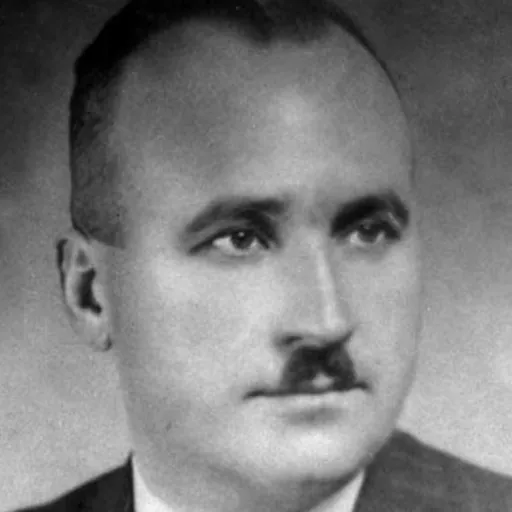
About Dimitar Peshev
Lived 1894 – 1973 (aged 78). Dimitar Peshev was a Bulgarian politician.
Dimitar Yosifov Peshev (; 25 June 1894 – 20 February 1973 ) was the Deputy Speaker of the National Assembly of Bulgaria and Minister of Justice (1935–1936), before World War II. He rebelled against the pro-Nazi cabinet and prevented the deportation of Bulgaria's 48,000 Jews. He was bestowed the title of "Righteous Among the Nations".
Context of Bulgaria during World War II Tsar Boris III of Bulgaria joined in an alliance with Adolf Hitler in 1940, agreeing to his anti-Semitic course. In January 1941, the parliament (National Assembly or Narodno Sabranie) of Bulgaria put into effect the "Law for the protection of the nation", which was modeled upon the Nuremberg Laws. Dimitar Peshev, then vice president of the Sabranie, did not object to the Bulgarian alliance with Nazi Germany when King Boris III joined Hitler’s Axis. He did not object to drafting anti-Jewish laws (Law for Protection of the Nation Закон за защита на нацията ). In 1940, he voted in favor of the Law to Protect the Nation . These laws depicted the Jews as the country's most vile enemies and defined a Jew as anybody who had at least one Jewish parent. Under the law, Jews were no longer eligible for Bulgarian citizenship, had to change their last names if they resembled anything Bulgarian, and could not intermarry with non-Jews. A strict quota of less than 1% was instituted dictating how many Jews could study in universities, and Jews could not hold employment in the majority of occupations. The majority of Bulgarians, including many members of parliament, the Orthodox Church, writers, artists, lawyers, and other members of the intelligentsia, opposed the law.
The Bulgarian government signed an agreement declaring that, on 10 March 1943, all of Bulgaria's 48,000 Jews would be deported from the Kyustendil railway station and sent to death camps in German-occupied Poland. This deportation was organized under the leadership of Theodor Dannecker, an SS officer very close to Eichmann. Jews in parts of Greece and Yugoslavia occupied by Bulgaria would also be rounded up and deported.
Personal background Born in 1894 in Kyustendil to an affluent family, Dimitar Peshev had studied languages in Saloniki and law in Sofia. He fought in World War I on the southern front. A year after the war, he completed his law studies and became a judge. He was known in Parliament and politics as being an honest and honorable man and, in 1938, won the position of Deputy Speaker. His main interests were in safeguarding human rights and the Constitution. He was strongly disliked by Prime Minister Bogdan Filov.
Role in preventing the Jewish deportation
Peshev was a good friend of Bulgaria's Jewish community. However, he had not objected to the institution of the "Law for the Defense of the Nation" (ZZN), an anti-Jewish bill. At the beginning of March 1943, the Jews of Kyustendil were ordered by the Commissariat on the Jewish Issues to leave their homes with only a few belongings. Understanding the implications of this order, the citizens of Kyustendil appointed a delegation to ask the government to repeal this evacuation order. However, the order did not reach all the Bulgarian cities on time, and, on the morning of 10 March, Bulgarian police began to round up Jews in Thrace and Macedonia. Almost all of the Jews in Bulgarian-occupied Thrace (some 4,000) were arrested and surrendered to the Germans, who then deported them to their deaths at Treblinka. Another group of about 1,200 Thrace Jews was moved to Salonika and then sent to Auschwitz. At the same time, all of the Jews of Macedonia were rounded up by the Bulgarian authorities; all but 165 were deported to Treblinka. Peshev wrote a letter to Filov on 19 March which aimed to prevent any future anti-Jewish legislation in Bulgaria. He, along with the Kyustendil delegates, got 43 government deputies to sign the letter. These signatures were only from members of the pro-government majority so that no one could accuse Peshev of acting against the government.
Even under the pressure from the Prime Minister, who was furious at Peshev's letter, 30 deputies refused to withdraw their signatures. As a result, Peshev was censured and dismissed from his position of Assembly Vice-chairman on 24 March.
Post-War accusations After the war, the Communists brought forth charges on the Old Bulgarian Parliament for collaboration with the Germans. Peshev was tried for being both an anti-Semite and anti-Communist and was even accused of having been bribed by the Jews in exchange for halting the deportation.
Recognition
On 25 January 2000, following the initiative of the Chairman of the Bulgarian delegation to PACE Latchezar Toshev, the Bulgarian Parliament presented the Council of Europe with a bronze bust of Dimitar Peshev. The donation of the bust was accepted by the Committee of Ministers of the Council of Europe and was inaugurated by Lord Russell Johnston in the presence of the Chairman of the Bulgarian National Assembly Yordan Sokolov, the Deputy Secretary General of the Council of Europe Hans Christian Krüger and Ronny Milo, member of the Israeli Knesset. The bust is exhibited in the Palace of Europe in Strasbourg. The creator of the bust is the prominent Bulgarian sculptor Ivan Minekov.
On 25 October 2002, the Dimitar Peshev House-Museum was inaugurated in Kyustendil, Peshev's hometown, to commemorate his life and actions to prevent the deportation of Bulgarian Jews during the Holocaust.
Honours
Peshev Ridge on Livingston Island in the South Shetland Islands of Antarctica is named for Dimitar Peshev.
In 2013, Washington, D.C. then Advisory Neighborhood Commissioner Neil Glick proposed giving the name Dimitar Peshev Plaza to the intersection adjacent to the Embassy of Bulgaria in Washington, D.C., at 22nd Street and R Street NW. The Council of the District of Columbia voted unanimously in favor of the proposal. On 12 November 2013, there was a 45-minute ceremony with 75 people. Bulgarian Ambassador Elena Poptodorova, D.C. Council Chairman Phil Mendelson, and Neil Glick spoke at the naming ceremony. It was Peshev's first honor in the Americas. EuroChicago, the largest Bulgarian-American expatriate organization, voted to name the creation of Dimitar Peshev Plaza as the 2013 Bulgarian Event of the Year in the U.S.
Don’t just read it —
keep it.
Full-length biographies made to live with: read them, listen on the way to work, watch them tonight.
- E-book
- Audio
- Video
Instant download · yours to keep · every purchase keeps this site free
Important facts
People in Dimitar Peshev's life
Named in this biography and alive at the same time







Related people
Same field, nearest in time



Contemporaries
People whose lives overlapped Dimitar Peshev's


Frequently asked questions
Who was Dimitar Peshev?
Bulgarian politician (1894-1973)
When was Dimitar Peshev born?
Dimitar Peshev was born on 25 June 1894 in Kyustendil.
When did Dimitar Peshev die?
Dimitar Peshev died on 20 February 1973 in Sofia.
What was Dimitar Peshev's occupation?
Dimitar Peshev was a politician.
What nationality was Dimitar Peshev?
Dimitar Peshev was Bulgarian.
Sources & further reading
Cite this page
APA: Biography.guide. (2026). Dimitar Peshev. https://biography.guide/dimitar-peshev/
MLA: "Dimitar Peshev." Biography.guide, https://biography.guide/dimitar-peshev/.
Chicago: "Dimitar Peshev." Biography.guide. https://biography.guide/dimitar-peshev/.
Data last updated: 2026-09-20 · Spot an error? Report a correction.
Page generated 2026-09-27 05:09 UTC