
About Dimitar Blagoev
Lived 1856 – 1924 (aged 67). Dimitar Blagoev was a Bulgarian politician.
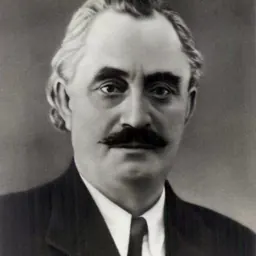
Dimitar Blagoev Nikolov (; ; 14 June 1856 – 7 May 1924) was a Bulgarian political leader and philosopher. Blagoev was the founder of socialism in Bulgaria and the first social-democratic party in the Balkans, the Marxist Bulgarian Social Democratic Party. He led the Narrow Socialists after a split in 1903. Blagoev was also an important figure in the early history of Russian Marxism, and later founded and led the Bulgarian Communist Party. He was a proponent for the establishment of a Balkan Federation.
Biography
Early years and education Blagoev was born on 14 June 1856 in village Zagorichani in the region of Macedonia (today Vasiliada in Agioi Anargyroi, Kastoria, Greece), at that time part of the Ottoman Empire, into a poor peasant family. Per historian John D. Bell and Blagoev himself, Zagorichani was a large Bulgarian village. The village was affected by the Bulgarian national awakening.
His father was a poor peasant, who went to Constantinople to gain additional income for his family by working as a dairyman. In 1870, Blagoev left Zagorichani, joining his father in Constantinople. He worked as an apprentice cobbler for two years and then enrolled into the Bulgarian school ran by Bulgarian national activist Petko Slaveykov. Slaveykov regarded Blagoev as a suitable pupil from the region of Macedonia to promote the Bulgarian national cause. In 1875, Slaveykov arranged for Blagoev to enroll into the high school in Gabrovo, but his studies were interrupted by the April Uprising of 1876 in which Blagoev participated. When the Ottoman Turks suppressed the rebellion, Blagoev fled to Stara Zagora.
In 1880, Blagoev enrolled into Saint Petersburg University, Blagoev managed to win over a group of around ten people who worked to promote Marxism among the students and to make contact with workers. In 1884, he formed the first Marxist group to operate within Russia, which was known as the Party of Russian Social Democrats. In 1885, the group published a newspaper, "Rabochii" (Worker), Russia's first Marxist publication. In 1885, it aligned with Georgi Plekhanov's Emancipation of Labour Group, based in Switzerland.
Return to Bulgaria After the Russian imperial authorities became familiar with his activity, In 1886, Blagoev moved to Shumen, where he taught in an elementary school and reunited with Sakazov. Blagoev moved to Viden, where he remained until 1890, trying to attract people to Marxism among the local intelligentsia. preserving Blagoev's adaptation of the Erfurt Program as its statute. A five-member central committee was elected, including Blagoev and Sakazov. Gabrovski’s Rabotnik was made the official party newspaper, Sakuzov's Den became its monthly journal, and Dabev's Drugar (Comrade) became the party's working-class publication. In 1894, Blagoev did not recognise the independence of the workers' political and economic struggles, advocating that the unions should be subordinated to the party and grant membership only to party members. In 1897, after Sakazov stopped publishing Den to focus more on the National Assembly, Blagoev started publishing a new monthly journal, Novo vreme (New Time), named after Karl Kautsky's Neue Zeit, which he edited from 1897 to 1923. Blagoev gained the support from a number of younger party members such as Georgi Bakalov, Georgi Kirkov, Hristo Kabakchiev, Vasil Kolarov, and Georgi Dimitrov. By 1901, Blagoev had a majority of the party's central committee supporting him. At the eighth and ninth party congresses in 1901 and 1902, his supporters issued resolutions condemning Sakazov and his doctrines. In March 1903, 53 of Blagoev's followers defected from the party, accusing its leadership of not paying enough attention to the party's proletarian base, and appealed for official recognition. Blagoev opposed war credits. He was a co-organizer of the Communist International. As an adherent of Marxism, Blagoev supported the Marxist concept of the international nature of socialism. He perceived proletarian internationalism as the love of one's own people and all other people, unlike the love of the country advocated by the nationalist bourgeoisie, which he perceived as being based on the exploitation of the people. Blagoev was especially interested in the Macedonian Question. such as in a speech before the Bulgarian National Assembly in 1917. Among the Balkan social democrats, Blagoev was the most critical of the Second International. Blagoev called for an class struggle without compromises, condemning "opportunism, social-imperialism, and social-patriotism." In February 1920, Blagoev allegedly confessed to a British military attaché in Sofia and a journalist from The Times that he was "first of all a Bulgarian patriot" and that only through Bolshevik principles could "the thousands of Bulgarians in Macedonia, Dobrudja and Thrace" gain their self-determination. According to British observers, his party, despite being socialist by name, was essentially imperialistic and aspired to a "Greater Bulgaria". The village of Blahoyeve in Odessa Oblast was renamed in 1923 after him (formerly Velikiy Buyalyk). The settlement of Blagoyevo in the Komi Republic of Russia also bears Dimitar Blagoev's name. The Buzludzha Monument on the peak of Buzludzha was built by the Bulgarian communist regime to commemorate the 1891 founding of the Bulgarian Social Democratic Party. It was opened in 1981.
Gallery
Don’t just read it —
keep it.
Full-length biographies made to live with: read them, listen on the way to work, watch them tonight.
- E-book
- Audio
- Video
Instant download · yours to keep · every purchase keeps this site free
Important facts
Family & relationships
People in Dimitar Blagoev's life
Named in this biography and alive at the same time





Related people
Same field, nearest in time





Contemporaries
People whose lives overlapped Dimitar Blagoev's





Frequently asked questions
Who was Dimitar Blagoev?
Bulgarian politician (1856–1924)
When was Dimitar Blagoev born?
Dimitar Blagoev was born on 14 June 1856 in Vasileiada.
When did Dimitar Blagoev die?
Dimitar Blagoev died on 7 May 1924 in Sofia.
What was Dimitar Blagoev's occupation?
Dimitar Blagoev was a politician.
What nationality was Dimitar Blagoev?
Dimitar Blagoev was Bulgarian.
Sources & further reading
Cite this page
APA: Biography.guide. (2026). Dimitar Blagoev. https://biography.guide/dimitar-blagoev/
MLA: "Dimitar Blagoev." Biography.guide, https://biography.guide/dimitar-blagoev/.
Chicago: "Dimitar Blagoev." Biography.guide. https://biography.guide/dimitar-blagoev/.
Data last updated: 2026-09-24 · Spot an error? Report a correction.
Page generated 2026-09-27 05:00 UTC