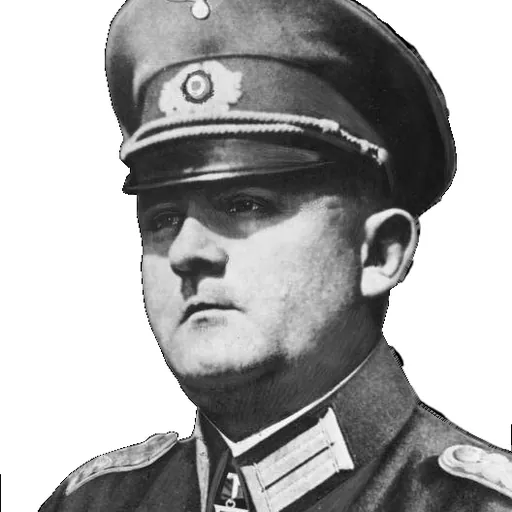
About Dietrich von Choltitz
Lived 1894 – 1966 (aged 71). Dietrich von Choltitz was a German military officer.
Dietrich Hugo Hermann von Choltitz (; 9 November 1894 – 5 November 1966) was a German general. Sometimes referred to as the Saviour of Paris, he served in the Wehrmacht (armed forces) of Nazi Germany during World War II, as well as serving in the Reichswehr of the Weimar Republic, and the Royal Saxon Army during World War I.
Born into an aristocratic Prussian family with a long history of military service, Choltitz joined the army at a young age and saw service on the Western Front during the First World War (1914–1918). He rose to the rank of Leutnant by the end of the war and was active in the interwar period helping Germany rebuild its armed forces. In September 1939, during the invasion of Poland at the beginning of World War II, he was serving in Gerd von Rundstedt's Army Group South. In May 1940, Choltitz participated in the Battle of Rotterdam, making an air landing and seizing some of the city's key bridges.
Choltitz is chiefly remembered for his role as the last commander of Nazi-occupied Paris in 1944, when he disobeyed Adolf Hitler's orders to destroy the city, and instead surrendered it to Free French forces when they entered the city on 25 August. Choltitz later asserted that his defiance of Hitler's direct order stemmed from its obvious military futility, his affection for the French capital's history and culture, and his belief that Hitler had by then become insane. Other sources suggest that he had little control of the city thanks to the operations of the French Resistance, and could not have carried out such orders anyway. His uncle Hermann von Choltitz was a governor of Landkreis Neustadt O.S. from 1907 to 1920. His family owned a forest between Prudnik and Niemysłowice.
In 1907 Dietrich von Choltitz enrolled in the Dresden Cadet School.
World War I
He joined the 8. Infanterie-Regiment Prinz Johann Georg Nr. 107 of the Royal Saxon Army as a Fähnrich (officer candidate) just months before the First World War broke out. His unit served on the Western Front, where he fought in the First Battle of the Marne, the First Battle of Ypres, the Battle of the Somme, and the Battle of St. Quentin (1914).
Between the wars
After World War I he returned to Prudnik, where on 20 August 1929 he married Huberta (1902–2001), the daughter of General of the Cavalry Otto von Garnier. The couple had two daughters, Maria Angelika (1930–2016) and Anna Barbara (born 1936), and a son, Timo (born 1944). He was transferred to the riding school in Soltau, as a rider he successfully participated in domestic and international riding competitions. It participated in the Battle of the Bzura, during which Choltitz was wounded.
On 15 August 1944, the Paris police went on strike, followed on 19 August by a general insurrection led by the French Communist Party. The German garrison under Choltitz fought back but was far too small to quell the uprising, and they lost control of many public buildings, many roads were blocked, and German vehicles and communications were damaged. With the help of the Swedish consul-general in Paris, Raoul Nordling, a ceasefire was brokered with the insurgents on 20 August, but many Resistance groups did not accept it, and a series of skirmishes continued on the next day.
On 23 August, Hitler, by cable, gave the order to destroy the city: "Paris must not pass into the enemy's hands, except as a field of ruins." ("Paris darf nicht oder nur als Trümmerfeld in die Hand des Feindes fallen"), after which explosives were laid at various bridges and monuments (which later had to be de-mined ).
With the arrival of Allied troops on the edge of the city at dawn the next day on the 24th, Choltitz made the decision not to destroy the city, and on 25 August, surrendered the German garrison at the Caserne de la Cité. He did so not to the Supreme Allied Command, but rather to representatives of the provisional government, the Free French.
Hitler did not completely give up on the destruction, with the Luftwaffe conducting an incendiary bombing raid on 26 August, and V2 rockets fired from Belgium, causing extensive damage. ) where he took credit for disobeying Hitler's orders and saving Paris because of its obvious military futility, his affection for the French capital's history and culture, and his belief that Hitler had by then become insane, and his version of events were the basis for the 1965 book and 1966 film, Is Paris Burning? (repeated as factual in many sources, and a 2019 publication ). His motivation not to destroy the city may have been in part because it was a futile and destructive gesture, but also in order to ensure his better treatment after capitulation.
The memoirs also state that he was persuaded to spare the city in part by an all-night meeting with Nordling on the night of 24 August. This event was depicted in the 2014 film Diplomacy in which Nordling persuades Choltitz to spare the city in return for a pledge to protect his family, which was reported as factual following the publication of his memoirs in some newspaper stories, He did hold several meetings with Nordling, along with the president of the municipal council, Pierre Taittinger, hoping to limit the bloodshed and damage to the city, and which led to the release of some political prisoners.
Captivity and later life
Choltitz was held for the remainder of the war at Trent Park, in north London, with other senior German officers. Choltitz later was transferred to Camp Clinton in Mississippi. No specific charges were ever filed against him, and he was released from captivity in 1947. In 1956 he visited his wartime headquarters at the Hôtel Meurice in Paris. Reportedly the long-time head barman of the hotel recognised the short, rotund man with "impossibly correct posture" wandering around the bar as if in a daze. After the manager of the hotel met him in the bar, he asked to see his old room. After seeing his old quarters for no more than fifteen minutes, Choltitz declined the manager's offer of champagne and left the hotel to meet with Pierre Taittinger.
Choltitz died on 5 November 1966 from a longstanding war illness (pulmonary emphysema) in the city hospital of Baden-Baden. Four days later, he was buried at the city cemetery of Baden-Baden in the presence of high-ranking French officers, including colonels Wagner (Military Commander of Baden-Baden), Ravinel, and Omézon. Baden-Baden was the French headquarters in Germany after the end of the Second World War.
Choltitz was the last German owner of the castle in Łąka Prudnicka, his birthplace (until 1945 it had been part of Germany as Gräflich Wiese). In 2016 his son, Timo, tried to get it back during his visit in Prudnik, but without success.
Complicity in war crimes During his internment in Trent Park many of the officers' private conversations were secretly recorded by the British in the hope that they might reveal strategic information. In one such conversation, on 29 August 1944, Choltitz was quoted as saying "The worst job I ever carried out - which however I carried out with great consistency - was the liquidation of the Jews. I carried out this thoroughly and entirely." Randall Hansen says that there is a lack of corroboration but that since many German generals committed atrocities it is possible, even probable, that Choltitz ordered the massacre of Jews. He observed that "it is easier to believe that Choltitz was the sort of unreflective anti-Semite that one would expect, given his age, class and profession." Selected transcripts were dramatized in the History Channel 5-part series The Wehrmacht (2008). In the episode "The Crimes", General von Choltitz is quoted as saying in October 1944,
At the very least, Choltitz was fully aware that the Nazis were committing mass murder against the Jews. For example, Choltitz estimated that the Nazis shot 36,000 Jews from Sevastopol.
Awards Iron Cross 1st Class (2) 2nd Class (2) Knight's Cross (18 May 1940) German Cross (8 February 1942) Honour Cross of the World War (WWI) Order of St. Henry (26 December 1917) Order of the Star of Romania (1943) Wound Badge Silver (1918) Gold (25 March 1943) Infantry Assault Badge, WWII Albert Order, Saxony Civil Order of Saxony Order of Michael the Brave, Romania (6 October 1942) Sudetenland Medal (1938) Crimea Shield (July 1942)
In popular culture
Is Paris Burning?, a French-American ensemble cast production of 1966, with Gert Fröbe playing Choltitz. (Choltitz died around the time this film was being generally released in Europe and America). Diplomacy, a French-German film of 2014 directed by Volker Schlöndorff, based on the play Diplomatie by Cyril Gely. Depicting events in his headquarters at the Hotel Meurice the night before the Liberation of Paris, Niels Arestrup portrays Choltitz. Secrets of the Dead: Bugging Hitler's Soldiers, a PBS documentary which examines how MI19 spied on senior German prisoners of war. Pod presją (Under pressure): a Polish documentary directed in 2015 by Dagmara Spolniak.
Don’t just read it —
keep it.
Full-length biographies made to live with: read them, listen on the way to work, watch them tonight.
- E-book
- Audio
- Video
Instant download · yours to keep · every purchase keeps this site free
Important facts
People in Dietrich von Choltitz's life
Named in this biography and alive at the same time


Related people
Same field, nearest in time

Contemporaries
People whose lives overlapped Dietrich von Choltitz's
Frequently asked questions
Who was Dietrich von Choltitz?
German general (1894-1966)
When was Dietrich von Choltitz born?
Dietrich von Choltitz was born on 9 November 1894 in Łąka Prudnicka.
When did Dietrich von Choltitz die?
Dietrich von Choltitz died on 5 November 1966 in Baden-Baden.
What was Dietrich von Choltitz's occupation?
Dietrich von Choltitz was a military officer.
What nationality was Dietrich von Choltitz?
Dietrich von Choltitz was German.
Sources & further reading
· Wikipedia: Dietrich von Choltitz
· DBpedia: Dietrich von Choltitz
Cite this page
APA: Biography.guide. (2026). Dietrich von Choltitz. https://biography.guide/dietrich-von-choltitz/
MLA: "Dietrich von Choltitz." Biography.guide, https://biography.guide/dietrich-von-choltitz/.
Chicago: "Dietrich von Choltitz." Biography.guide. https://biography.guide/dietrich-von-choltitz/.
Data last updated: 2026-09-24 · Spot an error? Report a correction.
Portrait: Wikimedia Commons · author & licence
Page generated 2026-10-03 09:37 UTC