
Diego de Covarubias y Leyva
Spanish bishop
About Diego de Covarubias y Leyva
Lived 1512 – 1577 (aged 65). Diego de Covarubias y Leyva was a Spanish latin Catholic priest, university teacher, economist, jurist, catholic bishop and bishop.
Diego de Covarrubias y Leyva (July 25, 1512 – September 27, 1577) was a Spanish jurist and Roman Catholic prelate who served as Archbishop of Cuenca (1577-1577), Archbishop of Segovia (1564-1577), Archbishop of Ciudad Rodrigo (1560-1564), and Archbishop of Santo Domingo (1556-1560).
Life
Early years
Covarruvias was born in Toledo, Spain, on 25 July 1512. His father was Alonso de Covarrubias (1488-1570), an architect who designed the New Kings chapel of the Cathedral of Toledo. Diego's younger brother, Antonio de Covarrubias (1514/24-1602), would be a professor of law at the University of Salamanca and served as consejero of Castile.
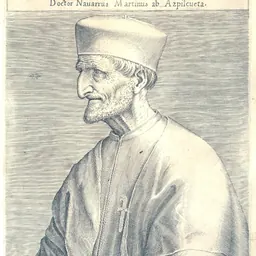
Diego de Covarrubias was educated at the University of Salamanca, where he studied canon law under Martín de Azpilcueta and theology under Francisco de Vitoria and Domingo de Soto. At the age of twenty-one, Covarruvias was appointed professor of canon law in the University of Salamanca. Later on he was entrusted with the work of reforming that institution, already venerable for its age, and the legislation which he drew up looking to this end remained in effect long after his time.
He was widely recognized for his expertise in legal scholarship and was referred to by some of his contemporaries as the "Bartolus of Spain". His legal writings were noted for their clarity and effective use of language. In addition to law, he demonstrated knowledge of several related fields that contributed to his scholarly work. According to historical accounts, during his tenure as professor at the University of Oviedo at the age of twenty-six, he had studied and annotated a large portion of the university library's collection.
Episcopate On April 24, 1556, Covarruvias was designated by Charles V for the archiepiscopal see of San Domingo
Having returned to Spain, Covarruvias was in 1565 transferred to the See of Segovia. Up to this time his extraordinary talents had been discovered in matters more or less scholastic only; they were hereafter to reveal themselves also in practical affairs of state. Appointed in 1572 a member of the Council of Castile, he was two years later raised to the presidency of the Council of State. In the discharge of this office he was eminently successful. While president of the Council of State he was nominated by Philip II for the Bishopric of Cuenca, but death prevented him from assuming his duties. Covarruvias died in Madrid, on 27 September 1577. While Bishop, he was the principal co-consecrator of Pedro de la Peña, Bishop of Quito.
He was buried in a marble sarcophagus in Segovia Cathedral, near the old entrance to the cathedral built by the Catholic Monarchs, which today leads to the cloister.
Doctrine
Considered as the greatest canonist of 16th century, his opinions are often quoted by Grotius and Dietrich Reinkingk.
Very influential within the School of Salamanca, he is very often quoted by the members of this movement in their reflections on the law of contracts, whether it is a theory of the vice of duress by Lessius, of good faith, the concepts of just price and injury or even on the validity of a contract with a prostitute. However, he rejects the idea of a contractual consensualism in matters of civil law, defended by Fortunius Garcia, and prefers to consider that the restrictions on contractual freedom are justified by the public interest or the common good.
Works
The principal work of Covarruvias is his Variarum resolutionum ex jure pontificio regio et cæsareo libri IV. He wrote also on testaments, betrothal and marriage, oaths, excommunication, prescription, restitution, etc. Quite distinct in character from his other productions is his numismatic treatise, Veterum numismatum collatio cum his quæ modo expenduntur, etc. (1594). His complete works have been several times edited, the Antwerp edition (5 vols., 1762) being the best. Among his manuscripts have been found notes on the Council of Trent, a treatise on punishments (De poenis) and an historical tract, Catalogo de los reyes de España y de otras cosas, etc.
Don’t just read it —
keep it.
Full-length biographies made to live with: read them, listen on the way to work, watch them tonight.
- E-book
- Audio
- Video
Instant download · yours to keep · every purchase keeps this site free
Important facts
People in Diego de Covarubias y Leyva's life
Named in this biography and alive at the same time

Related people
Same field, nearest in time


Contemporaries
People whose lives overlapped Diego de Covarubias y Leyva's


Frequently asked questions
Who was Diego de Covarubias y Leyva?
Spanish bishop (1512-1577)
When was Diego de Covarubias y Leyva born?
Diego de Covarubias y Leyva was born on 25 July 1512 in Toledo.
When did Diego de Covarubias y Leyva die?
Diego de Covarubias y Leyva died on 27 September 1577 in Madrid.
What was Diego de Covarubias y Leyva's occupation?
Diego de Covarubias y Leyva was a latin Catholic priest, university teacher, economist, jurist, catholic bishop and bishop.
What nationality was Diego de Covarubias y Leyva?
Diego de Covarubias y Leyva was Spanish.
Sources & further reading
· Wikipedia: Diego de Covarubias y Leyva
· DBpedia: Diego de Covarrubias y Leyva
Cite this page
APA: Biography.guide. (2026). Diego de Covarubias y Leyva. https://biography.guide/diego-de-covarubias-y-leyva/
MLA: "Diego de Covarubias y Leyva." Biography.guide, https://biography.guide/diego-de-covarubias-y-leyva/.
Chicago: "Diego de Covarubias y Leyva." Biography.guide. https://biography.guide/diego-de-covarubias-y-leyva/.
Data last updated: 2026-09-27 · Spot an error? Report a correction.
Page generated 2026-09-27 05:17 UTC