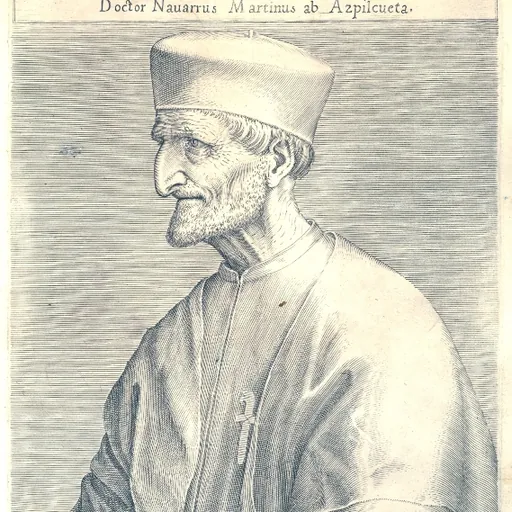
Martín de Azpilcueta
Theologian and economist from Navarre
About Martín de Azpilcueta
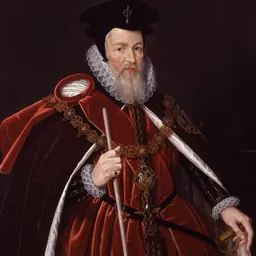
Lived 1492 – 1586 (aged 93). Martín de Azpilcueta was a Spanish economist, university teacher, philosopher, jurist, catholic priest and legal scholar.
Martín de Azpilcueta (Azpilkueta in Basque) (13 December 1492 – 1 June 1586), or Doctor Navarrus, was a Navarrese canonist, theologian and economist.
Renowned in his time, he was the first to formulate the quantity theory of money in 1556 and was with Francisco de Vitoria and Domingo de Soto one of the main thinkers of the School of Salamanca in relation to law and economics.
Life Born in Barásoain in a noble family of Navarre, Martín de Azpilcueta was a relative of Francis Xavier. In 1508, he was amongst the rare students accepted in the new Colegio Mayor de San Ildefonso, founded by the cardinal Cisneros.
After his obtention of degrees in philosophy and theology at Alcalá, then for political reasons he fled to France in 1516 to study at the university of Toulouse and obtained a degree of doctor in civil and canon law in 1518.
Beginning in 1524, Azpilcueta served in several canon law chairs at the University of Salamanca. He got the chair of Decretum in 1532 and then obtained the first chair of canon law in 1537, when he taught to Diego de Covarrubias and Arias Piñel.
At the invitation of Charles V of Spain and John III of Portugal, Then, he legitimated the practice of interest against the Catholic prohibition of usury.
Congitating about the effects of gold and silver arrivals from the Spanish Empire, Azpilcueta independently formulated the quantity theory of money in 1556. He also allegedly invented the mathematical concept of the time value of money.
In his work on the revenues of benefices, which was dedicated to Philip II of Spain and Pope Pius V, he maintained that beneficed clergymen were free to expend the fruits of their benefices only for their own necessary support and that of the poor.
Law His Manual de confesores y penitentes (1549), originally written in Spanish, was enormously influential in the fields of canon law and ethics, and by the first quarter of the seventeenth century, it had gone through 81 editions. One of the four appendices Azpilcueta wrote for the Manual, addressing exchange, supply and demand, and money, has recently been translated into English and published as On Exchange (2014).
He formulated a basic form of the principle of contractual consensualim, which was later elaborated upon by other members of the School of Salamanca like Leonardus Lessius and .
Azpilcueta cogitated also on the concepts of commutative justice, just price and fairness in exchange: with a large interpretation of the principe of laesio and of the seventh Commandment, he considered that contracts doesn't be burdens for a party and that any violation of the equity can be take to ecclesiastical courts.
Use of vernacular languages In the face of use by the reformed Church of natural languages in their liturgy and divulgation, the Counter-Reformation reacted by hanging onto Latin. On the other hand, Azpilcueta supported the use of vernacular languages in his 1545 Commento en Romance released in Coimbra, wrote down the prayers Our Father, Hail Mary, and Creed in both Latin and Romance, (Castilian) and encountered the opposition of the defenders of the Latin tradition.
Later, he had to explain in his 1586 Miscellaneum centum that vernacular languages had been used before, as approved by bishops and inquisitors. He cited "a pious and knowledgeable Cantabrian" in reference to Sancho de Elso from Estella, who had used Basque in different prayers. He explained the unfamiliarity of "the rustic dwellers and highlanders" with the Christian teachings as to be partly because of the use of Latin, "instead of their native language, learning them by heart".
Publications
Comentarii de Poenitentia, Coímbra, 1542. Si quando de Rescriptis in causa propria. Coímbra, 1543. Comentario [...] sobre el capítulo Inter Verba, Coímbra, 1543. Relectio sive iterata praelectio [...] de resit. Spoliat, Coímbra, 1547. Relectio in cap. Novit [...] de iudicis, Coímbra, 1548. Commento o repetición del capítulo Quando de consecratione, Coímbra, 1550. Relectio cap. ita quorundam de Iudaeis, Coímbra, 1550. Relectio in Levitico, Coímbra, 1550. Manual de confesores y penitentes o Enchirindion confessariorum, édition portugaise, Coímbra, 1550; édition en castillan, Salamanque, 1556; Pampelune, Adrián de Amberes, 1566; Cinco comentarios, Salamanque, 1556. Comentario resolutorio de usuras, Salamanque, 1556. Pampelune, Adrián de Amberes, 1565. Repertorio sobre hurtos, Salamanque, 1556. Tratado sobre las rentas de los beneficios eclesiásticos, Valladolid, 1566. Adiciones al Manual de confesores, 1569. Commentarii in tres De Poenitentia, 1569. Capítulo veyte y ocho de las adiciones del Manual de confesores, Valladolid, 1570. Respuesta [...] a De redditibus ecclesiasticis, 1571. Commentarius de spoliis clericorum, Rome, 1572. Tratado de alabanza y murmuración, Valladolid, 1572. Commentarius [...] de religiones sine debito, Rome, 1574. Comentarius de silentio in divinis Officciis, 1580. Miscellanea centum de oratione, praesertim de Psalterio et Rosario. Rome, 1586. Discurso del silencio que se deue guardar en los Diuinos Oficios, principalmente en el Coro, Salamanque, Pedro Lasso, 1588. Commentaria [...] Gregorii IX, ca. 1595. Consiliorum sive Responsorum Rome, 1602. Enajenación de las Cosas Eclesiásticas. Comentario sobre los expolios de los clérigos. Cuatro Comentarios de Regulares. Capitulo Humanae Aures. Tractatus de Finibus Humanorum Actuum. Tratado de Penitencia. Tratado de Indulgencias y Jubileo.
Don’t just read it —
keep it.
Full-length biographies made to live with: read them, listen on the way to work, watch them tonight.
- E-book
- Audio
- Video
Instant download · yours to keep · every purchase keeps this site free
Important facts
People in Martín de Azpilcueta's life
Named in this biography and alive at the same time



Related people
Same field, nearest in time




Contemporaries
People whose lives overlapped Martín de Azpilcueta's

Frequently asked questions
Who was Martín de Azpilcueta?
theologian and economist from Navarre
When was Martín de Azpilcueta born?
Martín de Azpilcueta was born on 13 December 1492 in Barásoain.
When did Martín de Azpilcueta die?
Martín de Azpilcueta died on 1 June 1586 in Rome.
What was Martín de Azpilcueta's occupation?
Martín de Azpilcueta was an economist, university teacher, philosopher, jurist, catholic priest and legal scholar.
What nationality was Martín de Azpilcueta?
Martín de Azpilcueta was Spanish.
Sources & further reading
· Wikipedia: Martín de Azpilcueta
· DBpedia: Martín de Azpilcueta
Cite this page
APA: Biography.guide. (2026). Martín de Azpilcueta. https://biography.guide/martin-de-azpilcueta/
MLA: "Martín de Azpilcueta." Biography.guide, https://biography.guide/martin-de-azpilcueta/.
Chicago: "Martín de Azpilcueta." Biography.guide. https://biography.guide/martin-de-azpilcueta/.
Data last updated: 2026-09-24 · Spot an error? Report a correction.
Portrait: Wikimedia Commons · author & licence
Page generated 2026-09-27 05:08 UTC