Diagoras of Rhodes
5th-century BC Olympic winner in boxing
About Diagoras of Rhodes
Lived 500 BC – 448 BC. Diagoras of Rhodes was a pugilist.
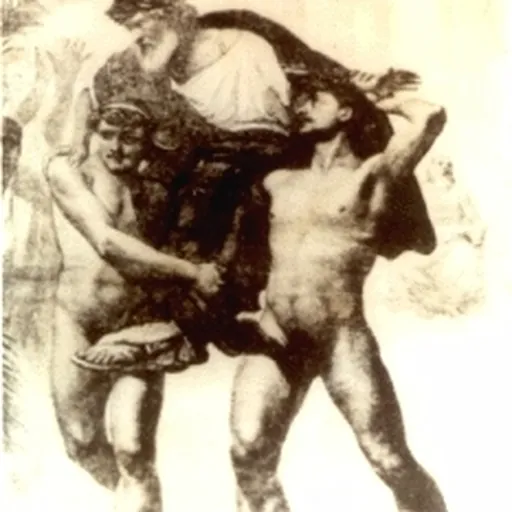
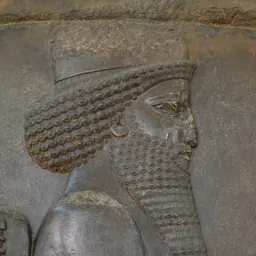
Depiction of Diagoras being carried by his two sons after an Olympic victory.
Diagoras of Rhodes (; ) was an Ancient Greek boxer from the 5th century BC, who was celebrated for his own victories, as well as the victories of his sons and grandsons. He was a member of the Eratidea family at Ialysos in Rhodes.
Biography Diagoras descended from Damagetus, king of Ialysus and, on his mother's side from Messenian hero and king Aristomenes. Diagoras was victor in boxing twice in the Olympic games, four times in the Isthmian, twice in the Nemean, and once at least in the Pythian Games. The fame of Diagoras and his descendants was celebrated by Pindar (Olympian Odes VII). A local soccer club, Diagoras F.C., and the Rhodes International Airport, "Diagoras" are named after him.
His three sons were Olympic champions. The oldest son, Damagetos, won the pankration in 452 and 448 BC. Akousílaos, the second son, won the boxing in 448 BC. The two celebrated their victory by carrying their father around the stadion on their shoulders, cheered loudly by the spectators. Legend has it that during Diagoras' triumphant ovation on the shoulders of his sons, a spectator shouted: "Die, Diagoras; you will not ascend to Olympus besides"- meaning being that he has reached the highest honor possible for a man- at which point, Diagoras would immediately pass away.
His youngest son, Dorieus, was even more successful than his brothers.
According to another legend revived by Pausanias, Diagoras' daughter Kallipáteira ("she of the beautiful father") was the only lay woman to enter the Olympic Games. Excepting the priestess of Demeter, all women were banned from watching because athletes performed in the nude. Kallipateira's son Peisírrhodos as well as her nephew Euklēs had both won in the Olympic Games, when she decided to sneak into the crowd disguised as a man. She was discovered and brought before the Hellanodíkai (judges of the games) to be tried for sacrilege on pain of death; there she proclaimed that if any woman could ever be allowed to defy the ban, it was she, having had a father, three brothers, a son and a nephew achieve victory eight times. The judges were awed and she was acquitted. However according to Pausanias a law was passed that future trainers should strip before entering the arena.
Similarly, Chilon of Sparta also supposedly died of joy the day when his son gained the prize for boxing at the Olympic games.
Fireless Sacrifices: Pindar's Olympian 7 In his seventh ode, Pindar writes of the glorious Olympic victories of Diagoras. This poem carries itself in a very Diagoras like fashion, telling the mythical tale of his home island of Rhodes. This further entrenches Diagoras' legacy not just in his personal victories, but also in his homeland and with the people he wished to carry that legacy. Pindar acknowledges his numerous boxing victories in Olympian 7 writing: "Diagoras has had himself crowned twice, and at the renowned Isthmus four times, in his good fortune, and again and again at Nemea and in rocky Athens". Pindar also then incorporated greek mythology into his work in honoring Diagoras in Olympian 7 saying: "Father Zeus, you who rule over the ridges of Atabyrium, grant honor to the hymn ordained in praise of an Olympian victor, and to the man who has found excellence as a boxer, and grant to him honored grace in the eyes of both citizens and strangers. For he walks a straight course on a road that hates arrogance, knowing clearly the sound prophetic wisdom of his good ancestors.". The great boxer went to new lengths to make his victories in sporting and the future of his family synonymous. It seems that there were two reasons for the unique manner in which Diagoras honored his family through statues and oral tradition.
The first was his affection for his family, especially his children. The second reason for this close association was as a personal angle. The Greek inscription, in letters of the Hellenistic period, refers to a Diagoras, slain in battle. They also mention his wife Aristomacha, a woman outstanding for her offspring and her moderation. Known for decades, the inscription was not associated by previous scholars with the famous 5th century Rhodian, given its distance from the island of Rhodes and the post-Classical lettering of the text. Turkish newspaper, Milliyet, reported that an inscription in the tomb, stating “I will be vigilant at the very top so as to ensure that no coward can come and destroy this grave,” was transcribed by experts.
Don’t just read it —
keep it.
Full-length biographies made to live with: read them, listen on the way to work, watch them tonight.
- E-book
- Audio
- Video
Instant download · yours to keep · every purchase keeps this site free
Important facts
People in Diagoras of Rhodes's life
Named in this biography and alive at the same time
Contemporaries
People whose lives overlapped Diagoras of Rhodes's



Frequently asked questions
Who was Diagoras of Rhodes?
5th-century BC Olympic winner in boxing
When was Diagoras of Rhodes born?
Diagoras of Rhodes was born in 500 BC in Ialysos.
When did Diagoras of Rhodes die?
Diagoras of Rhodes died in 448 BC in Olympia.
What was Diagoras of Rhodes's occupation?
Diagoras of Rhodes was a pugilist.
Sources & further reading
· Wikipedia: Diagoras of Rhodes
Cite this page
APA: Biography.guide. (2026). Diagoras of Rhodes. https://biography.guide/diagoras-of-rhodes/
MLA: "Diagoras of Rhodes." Biography.guide, https://biography.guide/diagoras-of-rhodes/.
Chicago: "Diagoras of Rhodes." Biography.guide. https://biography.guide/diagoras-of-rhodes/.
Data last updated: 2026-09-21 · Spot an error? Report a correction.
Portrait: Wikimedia Commons · author & licence
Page generated 2026-09-27 04:59 UTC