
About Dhu'l-Nun al-Misri
Lived 796 – 860 (aged 63–64). Dhu'l-Nun al-Misri was a theologian, physician, archaeologist, historian and poet.
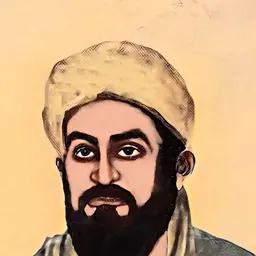
Dhū'l-Nūn al-Miṣrī (d. Giza, 859-862), often rendered in English literature as Dhū'n-Nūn al-Miṣrī or Zūl-Nūn al-Miṣrī, was an early Egyptian Sufi mystic and alchemist. His surname al-Miṣrī means "the Egyptian".
He was born in Akhmim, Upper Egypt in 796 and is said to be of Nubian descent. Dhu'l-Nun is said to have made some study of the scholastic disciplines of alchemy, medicine, and Greek philosophy in his early life, Dhu'l-Nun has been venerated as one of the greatest saints of the early era of Sufism. In 829 he was arrested on a charge of heresy and sent to prison in Baghdad, but after examination he was released on the caliph's orders to return to Cairo, where he died in 859; his tombstone has been preserved.
Dhu'l-Nun's name came about in relation to an incident on a sea voyage. He was falsely accused of stealing a jewel from a merchant. He cried out "O Creator, Thou knowest best", whereupon a large number of fish raised their heads above the waves, each bearing a jewel in its mouth.
A legendary alchemist and thaumaturge, he is supposed to have known the secret of the Egyptian hieroglyphs. His sayings and poems, which are extremely dense and rich in mystical imagery, emphasize knowledge or gnosis (marifah) more than fear (makhafah) or love (mahabbah), the other two major paths of spiritual realization in Sufism. None of his written works have survived, but a vast collection of poems, sayings, and aphorisms attributed to him continues to live on in oral tradition.
Osho mentions him as "an Egyptian Sufi mystic, one of the greatest who has ever walked on the earth".
In Yazidism In Yazidism, Dhū'l-Nūn al-Miṣrī (known in Yazidi tradition as Denûnê Misrî or Danūn of Egypt) is venerated as a key holy figure and precursor among early Sufi mystics highly revered in the religion alongside figures such as Hasan al-Basri, Rabi'a al-'Adawiyya, Bayazid Bastami, and Mansur al-Hallaj. Yazidi oral tradition draws a distinction between these early pre-institutional ascetics (zahids)—whose teachings on spiritual poverty and gnosis (ma'rifa) prefigured Yazidi theology—and later medieval Sufis, who are viewed as fully Islamicized. as well as in the Beyt of Shēkh Ālē Shamsā, and the liturgical text Diroze, which recount the spiritual suffering (hālē Danūn) of the mystic. In Yazidi tradition, Dhū'l-Nūn's spiritual initiation into the faith is commemorated by his receiving of the sacred woolen robe (Xerqe/Kharqa) associated with Sheikh 'Adī. According to the narrative, Dhū'l-Nūn was a pious ruler in Egypt who fell madly in love with a woman named Khazal after seeing her naked. Realizing his worldly lust was a betrayal of his divine devotion, he blinded himself with a knife out of remorse. Khazal, who had also fallen in love with him, began to weep and blame herself for his misfortune and, taking a knife, also blinded herself. His spiritual brother, Emir Ibrahim, miraculously restored the sight of both through prayer. To overcome his earthly passions, Dhū'l-Nūn renounced his wealth, donned the dervish robe, and began wandering the world. When Khazal encountered him again, he explained that his love for her had served as a path leading him toward mystical love for God. Inspired by his transformation, Khazal dedicated herself to God as a righteous woman, eventually guiding 40 dervishes through a 40-day blizzard to Lalish to seek the blessing of Sheikh 'Adī.
Mystical Significance Scholars note that the allegory of Dhū'l-Nūn and Khazal represents core mystical themes: overcoming carnal desire (şahwet) and accepting suffering as a prerequisite for attaining divine love. The presence of these narratives and classical Sufi terminology in Yazidi oral texts demonstrates the deep historical ties and shared mystical roots between early, unformalized Sufism and the formative period of Yazidism.
Don’t just read it —
keep it.
Full-length biographies made to live with: read them, listen on the way to work, watch them tonight.
- E-book
- Audio
- Video
Instant download · yours to keep · every purchase keeps this site free
Important facts
People in Dhu'l-Nun al-Misri's life
Named in this biography and alive at the same time

Related people
Same field, nearest in time




Contemporaries
People whose lives overlapped Dhu'l-Nun al-Misri's




Frequently asked questions
Who was Dhu'l-Nun al-Misri?
Sufi saint
When was Dhu'l-Nun al-Misri born?
Dhu'l-Nun al-Misri was born in 796 in Akhmim.
When did Dhu'l-Nun al-Misri die?
Dhu'l-Nun al-Misri died in 860 in Cairo, Giza.
What was Dhu'l-Nun al-Misri's occupation?
Dhu'l-Nun al-Misri was a theologian, physician, archaeologist, historian and poet.
What nationality was Dhu'l-Nun al-Misri?
Dhu'l-Nun al-Misri's recorded nationality: Medieval Egypt.
Sources & further reading
· Wikipedia: Dhu'l-Nun al-Misri
Cite this page
APA: Biography.guide. (2026). Dhu'l-Nun al-Misri. https://biography.guide/dhu-l-nun-al-misri/
MLA: "Dhu'l-Nun al-Misri." Biography.guide, https://biography.guide/dhu-l-nun-al-misri/.
Chicago: "Dhu'l-Nun al-Misri." Biography.guide. https://biography.guide/dhu-l-nun-al-misri/.
Data last updated: 2026-09-20 · Spot an error? Report a correction.
Page generated 2026-09-27 05:27 UTC