
About Bayazid Bastami
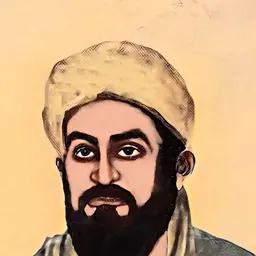
Lived 804 – 846 (aged 41–42). Bayazid Bastami was an Arab sheikh, educator and teacher.
Bāyazīd Basṭāmī, (d. 875), commonly known as the Sultān-ul-Ārifīn (King of Those Who Know) was a Persian Sufi who became famous for his bold articulation of fanāʾ–the Sufi notion of self-annhilation.
Abu Ali al-Sindhi, a Buddhist convert from Sindh, was one of the tutors of Bayazid al-Basṭāmī, and he taught him the concept of fanaa.
Many "ecstatic utterances" ( shatˤħāt) have been attributed to Basṭāmī, which lead to him being known as the "drunken" or "ecstatic" (, sukr) school of Islamic mysticism. Such utterance may be argued as Basṭāmī dying with mystical union and the deity speaking through his tongue. Bisṭāmī also claimed to have ascended through the seven heavens in his dream. His journey, known as the Mi'raj of Basṭāmī, is clearly patterned on the Mi'raj of the Islamic prophet Muhammad. The Mi'raj of Bisṭāmī seems as if Bisṭāmī is going through a self journey; as he ascends through each heaven, Basṭāmī is gaining knowledge in how he communicates with the angels (e.g. languages and gestures) and the number of angels he encounters increases.
His grandfather, Surūshān, was born a Zoroastrian, an indication that Basṭāmī had Persian heritage, despite the fact that his transmitted sayings are in Arabic. Very little is known about the life of Basṭāmī, whose importance lies in his biographical tradition, since he left no written works. The early biographical reports portray him as a wanderer but also as the leader of teaching circles. The early biographers describe him as a mystic who dismissed excessive asceticism; but who was also scrupulous about ritual purity, to the point of washing his tongue before chanting God's names. He also appreciated the work of the great jurists. A measure that shows how influential his image remains in posterity is the fact that he is named in the lineage (silsila) of one of the largest Sufi brotherhoods today, the Naqshbandi order.
Background The name Bastami means "from Bastam". Bayazid's grandfather, Sorūshān, was a Zoroastrian who converted to Islam. His grandfather had three sons, who were named: Adam, İsa and Ali. All of them were ascetics. Bayazid was the son of İsa. Not much is known of Bayazid's childhood, but he spent most of his time isolated in his house, and the mosque. Although he remained in isolation from the material world, he did not isolate himself from the Sufi realm. He welcomed people into his house to discuss Islam. Like his father and uncles, Bayazid led a life of asceticism and renounced all worldly pleasures in order to be one with Allah The Exalted. Ultimately, this led Bayazid to a state of "self union" which, according to many Sufi orders, is the only state a person could be in order to attain unity with God.
Influence Bastami's predecessor Dhul-Nun al-Misri (d. CE 859) was a murid "initiate" as well. Al-Misri had formulated the doctrine of ma'rifa (gnosis), presenting a system which helped the murid and the sheikh (guide) to communicate. Bayazid Bastami took this a step further and emphasized the importance of religious ecstasy in Islam, referred to in his words as drunkenness (Sukr or wajd), a means of self-annihilation in the Divine Presence of the Creator. Before him, the Sufi path was mainly based on piety and obedience and he played a major role in placing the concept of divine love at the core of Sufism.
He was known to have studied with Shaqiq al-Balkhi when he was younger.
When Bayazid died, he was over seventy years old. Before he died, someone asked him his age. He said: "I am four years old. For seventy years, I was veiled. I got rid of my veils only four years ago."
Bayazid died in 874 CE and is likely buried in Bistam. There is also a shrine in Kirikhan, Turkey in the name of Bayazid Bastami. His corpus of writings is minimal when compared to his influence. His ascetic approach to religious studies emphasizes his sole devotion to the almighty.
Shrine in Chittagong, Bangladesh
There is a Sufi shrine in Chittagong, Bangladesh, dating back to 850 AD, that is said to be Bastami's tomb. Although this may be unlikely, given the fact that Bastami was never known to have visited Bangladesh. However, Sufism spread throughout the Middle East, parts of Asia and Northern Africa, and many Sufi teachers where influenced in the spread of Islam in Bengal. Also, one local legend says that Bastami did visit Chattagong, which might explain the belief of the locals in Chittagong. Nevertheless, Islamic scholars usually attribute the tomb to Bayazid. While there is no recorded evidence of his visit to the region, Chittagong was a major port on the southern silk route connecting India, China and the Middle East, and the first Muslims to travel to China may have used the Chittagong-Burma-Sichuan trade route. Chittagong was a religious city and also a center of Sufism and Muslim merchants in the subcontinent since the 9th century, and it is possible that either Bayazid or his followers visited the port city around the middle of the 9th century.
Gallery
Don’t just read it —
keep it.
Full-length biographies made to live with: read them, listen on the way to work, watch them tonight.
- E-book
- Audio
- Video
Instant download · yours to keep · every purchase keeps this site free
Important facts
Related people
Same field, nearest in time



Contemporaries
People whose lives overlapped Bayazid Bastami's




Frequently asked questions
Who was Bayazid Bastami?
9th century Persian Sufi mystic
When was Bayazid Bastami born?
Bayazid Bastami was born in 804 in Bastam.
When did Bayazid Bastami die?
Bayazid Bastami died on 16 April 846 in Bastam District.
What was Bayazid Bastami's occupation?
Bayazid Bastami was a sheikh, educator and teacher.
What nationality was Bayazid Bastami?
Bayazid Bastami was Arab.
Sources & further reading
Cite this page
APA: Biography.guide. (2026). Bayazid Bastami. https://biography.guide/bayazid-bastami/
MLA: "Bayazid Bastami." Biography.guide, https://biography.guide/bayazid-bastami/.
Chicago: "Bayazid Bastami." Biography.guide. https://biography.guide/bayazid-bastami/.
Data last updated: 2026-09-20 · Spot an error? Report a correction.
Page generated 2026-09-27 05:18 UTC