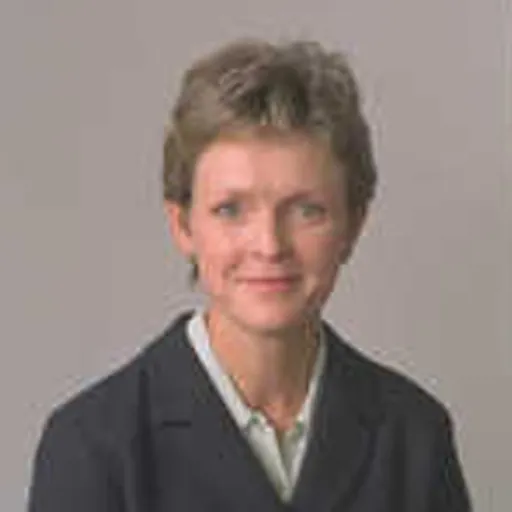
About Delyth Evans
Born 1958. Delyth Evans is a British politician and journalist.
Margaret Delyth Evans (born 17 March 1958) is a Welsh executive and former politician who served as Deputy Minister for Rural Affairs, Culture and Environment in the National Assembly for Wales from 2000 to 2003. She is the current chair of the Welsh language television channel S4C. A member of the Labour Party, she was the Assembly Member (AM) for Mid and West Wales from 2000 until her retirement from the National Assembly in 2003. In 2010, she became the chief executive of the charity Dress For Success London, where she remained until 2014. She has also been a director at the Film Agency for Wales, a trustee at the charity United Response, and has sat on the board of Sport Wales since 2019.
Evans was born in Cardiff, Wales. She joined the Labour Party in 1984, where she later served as an adviser to Labour leader John Smith from 1992 to 1994. Labour selected her to stand in the 1999 National Assembly for Wales election as the second top-up candidate in the party list for the Mid and West Wales region, behind Welsh Labour leader Alun Michael. After Michael's resignation from the assembly in 2000, Evans automatically succeeded him as AM for Mid and West Wales in accordance with the assembly's electoral system. From July 2000, she served in the administration of Rhodri Morgan as Deputy Secretary for Agriculture, Local Government and Environment, later serving as Deputy Minister for Rural Affairs, Culture and Environment after the office was reorganised in October 2000, before retiring at the 2003 assembly election to spend more time with her family. In 2013, she was selected as the Labour Party's candidate for the House of Commons constituency of Camarthen West and South Pembrokeshire at the 2015 general election, where she lost to Simon Hart of the Conservative Party, the incumbent member of Parliament at the time.
Early life and career
Margaret Delyth Evans was born in Cardiff, Wales on 17 March 1958. She was educated at Ysgol Gyfun Rhydfelen near Pontypridd and at the University College of Wales, Aberystwyth, where she achieved BA Hons in French. She is a native speaker of Welsh. She has said that she grew up in Carmarthenshire and that she was raised in the non-conformist faith. She also has a sister, Carys Evans, who worked in the policy unit of the National Assembly for Wales during the premiership of Alun Michael and has a background in HM Treasury.
Prior to her career in politics, Evans was a journalist and a management consultant. At the BBC, she worked on The World at One and afternoon programmes. In 1984, she joined the Labour Party, later working on Margaret Beckett's successful deputy leadership campaign in 1992. In the same year, she became an assistant to the shadow chancellor Gordon Brown and a policy adviser, researcher and speechwriter for the UK Labour leader John Smith. She stopped advising the Labour leadership in 1994 before later becoming a special adviser and speechwriter In July 1999, Michael employed her as one of four special advisers to the Welsh Cabinet, alongside advisers Julie Crowley, Gareth Williams and Andrew Bold.
National Assembly for Wales In February 1999, Evans was selected as the Labour Party's second top-up candidate in the party list for the Mid and West Wales region at the 1999 National Assembly for Wales election, behind Welsh party leader Alun Michael. Evans' selection was controversial with Morgan's supporters, who claimed that the Labour leadership was unfairly stacking Labour's top-up lists with Michael's supporters. Under the additional-member system of proportional representation used by the assembly, political parties were granted top-up seats in each region depending on the number of votes cast for them to make election results more proportional, with the parties selecting which of their candidates took the seats granted to them through their order on party lists for each region. At the assembly election in May 1999, Labour won enough votes in Mid and West Wales to secure a single top-up seat, which was granted to Michael because of his place on top the party list.
On 1 May 2000, Michael stood down from the assembly after a motion of no confidence in his premiership which was passed in February 2000 had forced him to resign as first secretary. In this role, she served alongside Conservative AMs Nick Bourne and Glyn Davies and Plaid Cymru AM Cynog Dafis, who represented the same region. On the issue of devolution, Evans aligned herself with the devolutionist faction of the Labour group in the assembly.
On 24 July 2000, Evans was appointed to the interim administration of Rhodri Morgan as Deputy Secretary for Agriculture, Local Government and Environment, succeeding Carwyn Jones. With the formation of the coalition partnership later that year, her post was reorganised and on 17 October she became Deputy Minister for Rural Affairs, Culture and Environment, remaining in this role until the 2003 assembly election in May 2003. Her role gave her responsibility for assisting the Minister for Rural Affairs, the Minister for Culture, Sport and the Welsh Language and the Minister for the Environment in their work and in the implementation of government policy related to their portfolios.
In February 2001, Evans asked farmers in Wales to remain alert to the possibility of the spread of England's foot-and-mouth outbreak into Wales and urged them to look out for symptoms of the disease in their livestock. In December 2001, she announced a review into the assembly's grants policy for planting trees. In 2002, she chaired the Task and Finish Group on Publishing of the Welsh Assembly Government on the behalf of Jenny Randerson, the minister for culture, sport and the Welsh language, which recommended a series of measures to make Welsh language books more commercially viable and appealing to the market. It also introduced new financial schemes to enable the Books Council of Wales to support publishers in commissioning well-known authors, appointing creative editors and setting up marketable revenue initiatives. These measures were generally seen as improving the infrastructure of the Welsh language publishing industry and as leading to its professionalisation. She said she felt she was not spending enough time with her children and had therefore decided to resign to spend more time with them. By this time, she was considered a rising star in the Labour Party and had been reportedly earmarked for a role in the cabinet if Labour won the election. She said she was open to returning to frontline politics sometime in the future, but not for the next few years. As planned, Evans did not contest the 2003 election, and her seat in Mid and West Wales was taken by Conservative politician Lisa Francis.
Later career
Professional career In November 2009, Evans was appointed to the board of directors of the Film Agency for Wales, the public organisation responsible for promoting the Welsh film industry. She also served as a trustee at United Response, a charity for those who have learning disabilities, before leaving the organisation sometime before June 2012. a charity which aimed to support women who were on a low-income or unemployed by training them for job interviews and donating them the formal wear needed to attend them. In September 2013, the charity announced a partnership with clothes supplier Kwintet. In 2014, Evans left the charity to resume her political activities. The group finished its review in July 2017 and made a number of recommendations, including the continuation of funding of the coleg from the Welsh Government and the expansion of its duties to work-based learning and further education, among others. In August 2019, the Welsh Government appointed Evans to the board of Sport Wales, the public body responsible for promoting sports in Wales.
In March 2025 Evans was announced by UK government Culture Secretary Lisa Nandy as the Government's preferred candidate to chair the Welsh language public-service broadcaster, S4C, leadership board. This move was criticised by Welsh Conservative MS Andrew RT Davies who said that the appointment was partisan because of Evans' background. According to the party, Evans had already voiced her interest in possibly standing for Labour in the constituency before Law's death. who stood for Labour in the election but lost to Blaenau Gwent People's Voice candidate Dai Davies by 2,484 votes. Evans was also shortlisted for Labour's candidacy in the parliamentary constituency of Pontypridd ahead of the 2010 general election but lost out again to Smith, who went on to hold the seat for Labour in the election with a reduced majority of 2,785 votes.
In September 2013, Evans was selected as the Labour Party's prospective parliamentary candidate for the House of Commons constituency of Camarthen West and South Pembrokeshire at the 2015 general election. Camarthen West and South Pembrokeshire had been held by the Conservative Party since the 2010 general election, when the Conservatives secured a 6.9% swing from Labour MP Nick Ainger. Evans launched her election campaign in April 2015 on the same week as her main opponent, the incumbent Conservative MP Simon Hart, ahead of the election in May. Her campaign launch focussed on Labour's national policies such as the abolition of the bedroom tax and the creation of new apprenticeships for the youth.
Political views Evans is a member of the Labour Party, having joined the party in 1984. Evans expressed her opposition to Welsh independence in a speech from 2017, stating that while she did not personally identify as being British, she had "always believed that Wales is better off being part of the UK. I am very firmly of the view that arguments about independence and talk of setting up new borders, and appeals to nationalism, are completely irrelevant to the economic and social challenges we face in Britain today". In the same speech, she also spoke of her opposition to Brexit and Scottish independence.
On the Welsh language, Evans opposed proposals for a new Welsh language act in 2000 which would require businesses in Wales to provide the Welsh language, stating that this could "send the wrong message" and deter companies from investing in Wales. In 2002, her constituency office was targeted by Welsh language campaigners who sprayed it with black paint . She condemned their actions and said that Welsh language policies should be decided through the democratic processes of the National Assembly for Wales rather than direct action. They have two children and live in Penarth.
Notes and references
Don’t just read it —
keep it.
Full-length biographies made to live with: read them, listen on the way to work, watch them tonight.
- E-book
- Audio
- Video
Instant download · yours to keep · every purchase keeps this site free
Important facts
People in Delyth Evans's life
Named in this biography and alive at the same time






Related people
Same field, nearest in time




Contemporaries
People whose lives overlapped Delyth Evans's

Frequently asked questions
Who is Delyth Evans?
Welsh executive and former politician
When was Delyth Evans born?
Delyth Evans was born on 17 March 1958 in Cardiff.
What is Delyth Evans's occupation?
Delyth Evans is a politician and journalist.
What nationality is Delyth Evans?
Delyth Evans is British.
Sources & further reading
Cite this page
APA: Biography.guide. (2026). Delyth Evans. https://biography.guide/delyth-evans/
MLA: "Delyth Evans." Biography.guide, https://biography.guide/delyth-evans/.
Chicago: "Delyth Evans." Biography.guide. https://biography.guide/delyth-evans/.
Data last updated: 2026-09-20 · Spot an error? Report a correction.
Portrait: Wikimedia Commons · author & licence
Page generated 2026-09-27 04:57 UTC