
About Defao
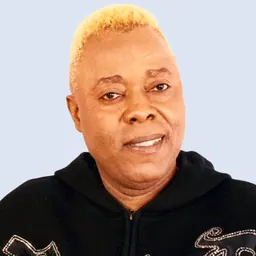
Lived 1958 – 2021 (aged 62). Defao was a Congolese singer, songwriter and musician.
François Lulendo Matumona (31 December 1958 – 27 December 2021), known professionally as Général Défao or Défao, was a Congolese singer-songwriter, dancer and bandleader. Born in Kinshasa, he began performing at the age of 17 with local groups such as Suka Movema, Forgo Stars, Korotoro, and Somo West before joining Félix Manuaku Waku's band Grand Zaïko Wawa in 1981. In partnership with Djo Poster, known as "Grand Muyaka", he quickly became a crowd favorite in Kinshasa for his stage presence and innovative dance moves. He died in Douala, Cameroon, on 27 December 2021, from complications related to COVID-19.
Early life and career
1958–1980: Childhood, education and music debut Défao was born François Lulendo Matumona on 31 December 1958 in Léopoldville (now Kinshasa), in what was then the Belgian Congo (now the Democratic Republic of the Congo). In the 1970s, during Mobutu Sese Seko's cultural authenticity campaign (recours à l'authenticité), his parents added the post-name "Tulendo" in accordance with the regime's policy to Africanize personal identities. The band quickly garnered regional attention in towns such as Kimpese and Mbanza-Ngungu. Big Stars served as a launching platform for several emerging Congolese artists, including Montana Kamenga, Kabosé Bulembi, Théo Mbala, as well as musicians such as Serge Kasongo Mboka Liya (aka Burkina Faso), Jagger Bokoko, Lufu Toto "Sénéchal", Djo Djo Bayenge, Trocadero, Azanga, Anthony Sampaïo, Gipson, Bleu Kinanga, Bakolo Keta, Ladji Son, Adoli Bamweniko, Mogus, Guy Wa Nzambi, Richa Cogna Cogna, Sejo, and Kavanda. Throughout the 1990s, Défao experienced a period of unprecedented productivity. He released at least seventeen albums during the decade, six of which were distributed in European markets. Riding the wave of the emerging ndombolo genre, Défao released the album Sala Noki in 1997, which received widespread acclaim. The nine-track album included popular songs such as "Sala Noki", "Sam Samitanga", "Agence Courage", "Maintenance," and "Copinage". In 1998, he followed up with the album Copinage, which included guest vocals by Mbilia Bel. In October of that year, Défao and Big Stars made their debut performance at the Coast Car Park in Mombasa, Kenya. The concert, organized with an ensemble of eleven musicians and five dancers, including lead singer Suke Chule, featured a repertoire of Défao's most popular songs, with the performance of "Nikusema Nakutaka". Despite this critical stance, Défao also participated that year in Souzy Kasseya's "Tokufa Po Na Congo", a patriotic ensemble piece praising national unity that featured several leading figures in Congolese music under the supergroup Les Plus Grandes Stars, including Wendo Kolosoy, Tabu Ley Rochereau, Jossart N'Yoka Longo, Koffi Olomide, King Kester Emeneya, Werrason, JB Mpiana, Simaro Lutumba, Madilu System, Félix Wazekwa, Tshala Muana, Mbilia Bel, Pépé Kallé, Marie Paul, Pascal Poba, and Manda Chante, among others. The tour had been slated to culminate in the launch of Orchestre Benta Musica, a multinational band, at the Hotel Kilimanjaro, where Défao was expected to serve as guest of honor. Big Stars was later revived in the early 2010s.
Solo career
2000–2021: Piracy, releases, detention, and performances In 2000, Défao signed with JPS Productions, a Paris-based label founded by Cameroonian producer Jean Pierre Saah. He subsequently recorded the solo album Nessy De London with a lineup of accomplished session musicians, including Nyboma, Wuta Mayi, Luciana De Mingongo, Dally Kimoko, 3615 Code Niawu, Ballou Canta, Deesse Mukangi, and Djudjuchet Luvengoka. Before the official launch on 4 September, reports surfaced that pirated copies were already circulating in Tanzania. According to the Tanzania Music Copyright Association (TMCA), Congolese artists had filed complaints against Tanzanian producers and wholesalers accused of unauthorized reproduction and distribution. Défao had previously condemned such practices in 1999, when pirated cassettes of his songs were sold in Dar es Salaam before their official release. After encountering bootlegged versions of Nessy De London on the streets, he was reportedly moved to tears before his entourage, later organizing a press conference to denounce the piracy and express frustration that his Tanzanian visit, intended for the album's official launch, had been undermined. The band had entered Tanzania in August 2001 for a performance tour but encountered significant hardships, with local promoters allegedly failing to meet contractual obligations for accommodation and expenses.
After several years of limited activity, Défao returned to the stage in September 2006 with a new 16-member band named Kisanula, accompanied by dancers.
In 2011, he began preparing a more ambitious return with the album The Undertaker Vol. 1. The project was produced over an extended period to ensure high production standards and was released by Éditions Kaluila. Initially expected on 4 January 2022, the body arrived in Kinshasa on 12 January. In discussions with Catherine Furaha, Défao's family expressed their desire for him to be buried on 23 January in Kisantu, Kongo Central, a choice opposed by fellow artists who preferred a burial at the Nécropole Entre ciel et terre cemetery in Nsele, Kinshasa. Pending an agreement, his body was held at the Cinquantenaire Hospital morgue in Kasa-Vubu, Kinshasa. On 22 January, the body was moved from the morgue for a requiem ceremony at the National Museum of the Democratic Republic of the Congo, allowing the public to pay final respects before the burial.
Legal issues
2002 hotel debt case In early 2002, Défao was arrested in Nairobi by officers of the Criminal Investigation Department (CID). The management of the Palacina Residential Hotel accused him of defaulting on a cumulative debt of KSh 594,400 for services incurred between October 2001 and March 2002. Police reports indicated that a friend had attempted to settle the matter with a counterfeit Mastercard, which heightened concerns and delayed bail. Défao's Kenyan promoter, identified as Mr. Njoroge, publicly dissociated himself from the affair, asserting that the artist had been living in the country on his own accord. They also emphasized his fragile health, presenting documentation that he suffered from diabetes and high blood pressure. Défao was unable to immediately secure the sureties and remained in custody at Nairobi's Industrial Area Prison. Although the trial was initially slated to begin on 10 April, negotiations between Défao's defense and the hotel management began in an effort to reach an out-of-court settlement. On 27 May, Miller informed the court that discussions with the Palacina Hotel were progressing and requested additional time. The hotel's general manager, Macksoud A. Macksoud, confirmed the negotiations but noted that the outstanding debt had yet to be paid. However, the matter was transferred into a civil suit filed by the Palacina Hotel at the Milimani Commercial Courts. The hotel's assistant general manager, Cynthia Wanjiru Edith, testified that Défao had failed to make meaningful efforts to settle the debt, prompting management to pursue the matter through civil litigation. Press reports stated that Kenyan authorities had detained him in Mombasa over unsettled debts, including an unpaid hotel bill of $500 and an immigration fine of $10,000 for overstaying his residence permit. He was reportedly arrested at Jomo Kenyatta International Airport while attempting to board a flight to Zimbabwe. Big Stars members alleged that his financial mismanagement and extravagant lifestyle had contributed to the debt. Later that year, in July, the Zimbabwean Department of Immigration launched an investigation into 19 Congolese musicians associated with Big Stars who were alleged to be residing in the country illegally and performing without authorization. Principal Immigration Officer Evans Siziba declared his stay unlawful and announced that deportation proceedings were underway. Madhake reiterated that the case was under review by the Ministry of Home Affairs, which was evaluating his appeal under provisions of the Immigration Act. Authorities clarified that his departure had been necessitated by the expiration of his work permit but affirmed that he remained eligible to reapply should he wish to return. Although some reports suggested that he may have cohabited with a Kenyan partner, close associates indicated that he was not known to have had a wife or children. Known previously for his fuller figure, Défao appeared noticeably slimmer and significantly lighter in skin tone.
Initially silent on the matter, Défao addressed the controversy in a 2017 interview with Metropolitan, explaining that the lightening of his skin was not intentional. He attributed the change to the use of a prescription cream clobetasol propionate, which he had reportedly been applying to treat a chronic dermatological condition.
Don’t just read it —
keep it.
Full-length biographies made to live with: read them, listen on the way to work, watch them tonight.
- E-book
- Audio
- Video
Instant download · yours to keep · every purchase keeps this site free
Important facts
People in Defao's life
Named in this biography and alive at the same time



Related people
Same field, nearest in time



Contemporaries
People whose lives overlapped Defao's



Frequently asked questions
Who was Defao?
Congolese singer and songwriter
When was Defao born?
Defao was born on 31 December 1958 in Kinshasa.
When did Defao die?
Defao died on 27 December 2021 in Douala.
What was Defao's occupation?
Defao was a singer, songwriter and musician.
What nationality was Defao?
Defao was Congolese.
Sources & further reading
Cite this page
APA: Biography.guide. (2026). Defao. https://biography.guide/defao/
MLA: "Defao." Biography.guide, https://biography.guide/defao/.
Chicago: "Defao." Biography.guide. https://biography.guide/defao/.
Data last updated: 2026-09-20 · Spot an error? Report a correction.
Page generated 2026-09-27 05:21 UTC