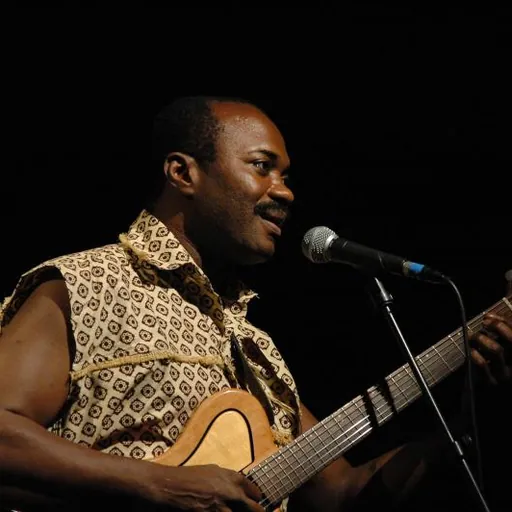
About Félix Manuaku Waku
Born 1954. Félix Manuaku Waku is a Congolese singer and guitarist.
Félix Manuaku Waku (born 19 August 1954) is a Congolese guitarist, composer, singer, producer and bandleader. He is regarded as one of the most influential figures in Congolese rumba and modern African guitar playing. Also known under the name Pépé Felly, he was the first lead guitarist of Zaïko Langa Langa, where he introduced a radical shift in guitar technique and rhythm in the early 1970s. His percussive guitar style, departing from the melodic solos of earlier generations, contributed to the emergence of the third school of Congolese rumba, with his innovations shaping the sebene structure that became the hallmark of modern Congolese rumba and soukous.
He composed several of the band's breakout hits, including "Yudasi", "Obi", and "Femme Ne Pleure Pas", and was the first Congolese musician to play a double-neck guitar, as well as one of the earliest to incorporate distortion pedals and synthesizers into Congolese music. He later took part in the reunion project Le Quatre de Langa-Langa with Papa Wemba, Bozi Boziana, Evoloko Jocker, and Gina Efonge, and released the album Kongo Alchimie in 1996. In 2009, he opened Le Griot, a music school in Kinshasa, where he worked as an educator and mentor. In 2014, he founded New Zaïko and released Les grands classiques de la musique congolaise, containing reinterpretations of Congolese rumba. In 2018, he became musical director of the Elikya band. Manuaku has been noted for his contributions as a guitarist and mentor, and his work has been studied at institutions including the National Institute of Arts (INA) in Kinshasa and the University of Limerick in Ireland. He was born with crooked fingers, which his mother massaged to straighten, an anatomical feature often cited as contributing to his distinctive guitar technique.
His passion for music began while watching his father play and later deepened when he attended a performance by OK Jazz. In parallel, he studied drawing at the Académie des beaux arts in Kinshasa. Zaïko Langa Langa was officially formed on December 24, 1969. Manuaku, just 15 years old, assumed the role of lead guitarist.
In March 1970, he participated in the band's first recordings, and began crafting a new stylistic language on guitar. Departing from the melodic sophistication of predecessors such as Franco, Docteur Nico and Gerry Gerard, his style emphasized rhythm, speed, and percussive patterns.
He introduced the bouzouki to Congolese rumba, used distortion pedals, and was the first Zairian guitarist to use the double-neck guitar. His gear experiments included lending pedals to keyboardist Nzenze Mongengo, a precursor to the integration of synthesizers in the genre. His debut solo album Zaïko Wa Wa / Souci Mady (1978) and recordings including "Révélation" and "Ange Bokumba" illustrated his dual role as technician and innovator. In 1980, he penned two final hits for Zaïko: "Obi" and "Femme Ne Pleure Pas". Tensions grew in October of 1980 leading to his departure from the band.
1981–1989: Grand Zaïko Wawa Manuaku launched a new musical venture in late 1980: Grand Zaïko Wawa. The band released its debut single Bonganga under the label Editions Veve, owned by Verckys Kiamuangana. Subsequent albums like Molunge Na Ndako, Eke Ya Pamba and Santamaria showcasing the ensemble's fluid interplay and Manuaku’s continued innovations on guitar. During a reconfiguration of the band in 1981, Manuaku brought in fresh voices and talents such as Defao, Shimita, Djo Poster and guitarist Baroza Bansimba. The band scored several hits across Kinshasa and West Africa, and by 1984, their momentum peaked when they were named Best Orchestra of the Year by the Congolese Music Association (ACMZA).
In 1985, Manuaku participated in the collaboration Le Choc Choc 85, joining artists from the Clan Langa Langa such as King Kester Emeneya and Dindo Yogo. Two years later, in 1987, he collaborated with Jamaican reggae star Jimmy Cliff during the latter's visit to Kinshasa. Driven by a desire to pass on his knowledge, Manuaku launched the Le Griot music school in Kinshasa in 2009, focusing on guitar instruction, arrangement, and music theory. Although the school was looted in 2010 during political unrest, Manuaku re-established his teaching activities in Europe.
Legacy Félix Manuaku Waku is considered one of the architects of the contemporary Congolese guitar idiom and a key figure of Central African music. His rhythmic innovations, use of technology, and commitment to artistic integrity have left a lasting imprint.
By placing the solo guitar at the center of rhythmic propulsion and melodic invention, he carved a space for future generations of soloists to emerge. His technical vocabulary became a blueprint for dozens of bands across Congo, Kenya, Uganda, Tanzania, and beyond.
Discography
Studio albums
Kongo Alchimie (1996) Les grands classiques de la musique congolaise (2014)
With Zaïko Langa Langa The following list includes studio albums only. Pépé Felly has recorded more than 70 singles as a member of Zaïko Langa Langa.
Non Stop Dancing (1974) Plaisir de l'Ouest Afrique (1976)
With Grand Zaïko Wawa
Le Maître Manuaku Waku Et Le Grand Zaiko Wawa (1980) Eke Ya Pamba (1983) Santamaria (1984) Mindondo / 15 (1984) Mwasi Ya Solo (1985) Wapi Consolation / Abulungani (1985) Drapeau Blanc (1986) Pole Pole (1986) Liteya (1986) Krishna (1987) Menace De Divorce (1987) Jalousie Abat (1988) Expérience 9 (1989)
Don’t just read it —
keep it.
Full-length biographies made to live with: read them, listen on the way to work, watch them tonight.
- E-book
- Audio
- Video
Instant download · yours to keep · every purchase keeps this site free
Important facts
People in Félix Manuaku Waku's life
Named in this biography and alive at the same time




Related people
Same field, nearest in time



Contemporaries
People whose lives overlapped Félix Manuaku Waku's




Frequently asked questions
Who is Félix Manuaku Waku?
Congolese musician
When was Félix Manuaku Waku born?
Félix Manuaku Waku was born on 19 August 1954 in M'banza-Kongo.
What is Félix Manuaku Waku's occupation?
Félix Manuaku Waku is a singer and guitarist.
What nationality is Félix Manuaku Waku?
Félix Manuaku Waku is Congolese.
Sources & further reading
· Wikipedia: Félix Manuaku Waku
Cite this page
APA: Biography.guide. (2026). Félix Manuaku Waku. https://biography.guide/felix-manuaku-waku/
MLA: "Félix Manuaku Waku." Biography.guide, https://biography.guide/felix-manuaku-waku/.
Chicago: "Félix Manuaku Waku." Biography.guide. https://biography.guide/felix-manuaku-waku/.
Data last updated: 2026-09-24 · Spot an error? Report a correction.
Portrait: Wikimedia Commons · author & licence
Page generated 2026-09-27 05:09 UTC