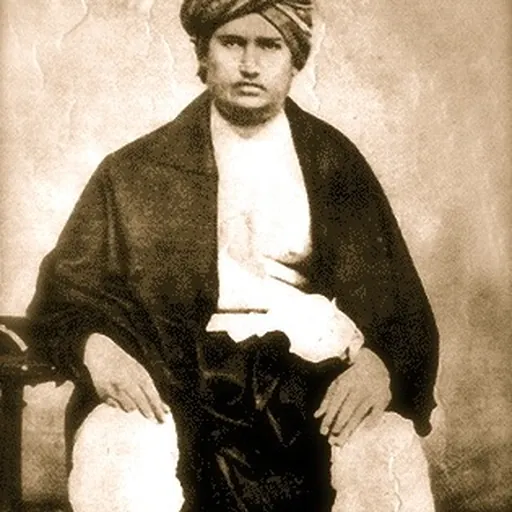
About Dayananda Saraswati
Lived 1824 – 1883 (aged 59). Dayananda Saraswati was an Indian philosopher, autobiographer, priest and swami.
Early life
Dayananda Saraswati was born on the 10th day of waning moon in the month of Purnimanta Phalguna (12 February 1824) on the tithi to an Indian Hindu Brahmin family in Tankara, Kathiawar region (now Morbi district of Gujarat). He belonged to the Audichya Brahmin sub-division. His original name was Mool Shankar Tiwari, because he was born in Dhanu Rashi and Mul Nakshatra. His father's name was Karshanji Lalji Tiwari, and his mother was Yashodabai.
When he was eight years old, his Yajnopavita Sanskara ceremony was performed, marking his entry into formal education. His father was devotee of Shiva and taught him the ways to worship Shiva. He also learnt the importance of keeping fasts. On the occasion of Shivratri, Dayananda sat awake the whole night in obedience to Shiva. During one of these fasts, he saw a mouse eating the offerings and running over the idol's body. After seeing this, he questioned that if Shiva could not defend himself against a mouse, then how could he be the saviour of the world.
The deaths of his younger sister and his uncle from cholera led Dayananda to ponder the meaning of life and death. He began asking questions about it to his parents and they were much worried by this. He was engaged in his early teens, but he decided marriage was not for him and ran away from home in 1846.
Between 1845 and 1869, Dayanand travelled extensively across India as a wandering ascetic. During this period, he visited forests, pilgrimage centres, and retreats in the Himalayas, dedicating himself to spiritual study and meditation. He practised various forms of yoga and sought teachers who could guide him toward spiritual truth. Saraswati was a strict vegetarian who recounted that he felt "sickened at the very sight of meat" after witnessing a Brahmin cut and prepare a rump steak.
Teachings of Dayananda Maharshi Dayanand advocated that all human beings are equally capable of achieving anything. He said all the creatures are the eternal Praja or citizens of the Supreme Lord. He said the four Vedas which are Rigveda, Yajurveda, Samaveda, and Atharvaveda are the only true uncorrupted sources of Dharma, revealed by the Supreme Lord, at the beginning of every creation, also because they are the only perfectly preserved knowledge without alterations using Sanskrit prosody or Chandas and different techniques of counting the number of verses with different Vedic chanting techniques. He says that confusion regarding the Vedas arose due to the misinterpretations of the Vedas, and the Vedas promote science and ask humans to discover the Ultimate Truth, which he has emphasised throughout his Commentary on the Vedas.
He accepted the teachings of the first ten Principal Upanishads also with Shvetashvatara Upanishad, which explains the Adhyatma part of the Vedas. He further said that any source, including Upanishads, should be considered and accepted to only that extent as they conform with the teachings of the Vedas.
He accepted the six Vedanga texts, which include grammar and the like required for the correct interpretation of the Vedas. Among Sanskrit grammatical texts, he says, Pāṇini's Aṣṭādhyāyī and its commentary, Mahabhashya by Maharshi Patanjali are the current surviving valid texts, and all other surviving modern-grammatical texts should not be accepted as they are confusing, dishonest, and will not help people in learning the Vedas. , Sati practice, child marriage, etc. which are against the spirit of the Vedas and advocated that all evils of society should be thoroughly investigated and should be removed. The Varna should be based on education and profession, and in his book Satyarth Prakash, he quotes passages from Manusmriti, Grihya Sutras, and Vedas which support his claims. He advocated the notion of Chakradhipatya (One Government Throughout the World). Hindu priests discouraged the laity from reading Vedic scriptures, and encouraged rituals, such as bathing in the Ganges and feeding of priests on anniversaries, which Dayananda pronounced as superstitions or self-serving practices. By exhorting the nation to reject such superstitious notions, his aim was to educate the nation to return to the teachings of the Vedas, and to follow the Vedic way of life. He also exhorted Hindus to accept social reforms, including the importance of cows for national prosperity as well as the adoption of Hindi as the national language for national integration. Through his daily life and practice of yoga and asanas, teachings, preaching, sermons and writings, he inspired Hindus to aspire for Swarajya (self-governance), nationalism, and spiritualism. He advocated the equal rights and respects to women and advocated for the education of all children, regardless of sex.
Dayanand also made critical analyses of faiths including Christianity and Islam, as well as of other Indian faiths like Jainism, Buddhism and Sikhism. In addition to discouraging idolatry in Hinduism, he was also against what he considered to be the corruption of the true and pure faith in his own country. Unlike many other reform movements of his times within Hinduism, the Arya Samaj's appeal was addressed not only to the educated few in India, but to the world as a whole as evidenced in the sixth principle of the Arya Samaj. As a result, his teachings professed universalism for all the living beings and not for any particular sect, faith, community or nation.
Arya Samaj allows and encourages converts to Hinduism. Dayananda's concept of Dharma is stated in the "Beliefs and Disbeliefs" section of Satyartha Prakash, he says:Dayananda's Vedic message emphasised respect and reverence for other human beings, supported by the Vedic notion of the divine nature of the individual. In the Ten Universal Principles of the Arya Samaj, he enshrined the idea that "All actions should be performed with the prime objective of benefiting mankind", as opposed to following dogmatic rituals or revering idols and symbols. The first five principles speak of Truth, while the last five speak of a society with nobility, civics, co-living, and disciplined life. In his own life, he interpreted Moksha to be a lower calling, as it argued for benefits to the individual, rather than calling to emancipate others.
Dayananda's "Back to the Vedas" message influenced many thinkers and philosophers the world over.
Activities
Dayanand Saraswati is recorded to have been active since he was 14, which time he was able to recite religious verses and teach about them. He was respected at the time for taking part in religious debates. His debates were attended by large crowds.
On 22 October 1869 in Varanasi he won a debate against 27 scholars and 12 expert pandits. The debate was said to have been attended by over 50,000 people. The main topic was "Do the Vedas uphold deity worship?"
Creation of Arya Samaj
Dayananda Saraswati's creation, the Arya Samaj, condemned practices of several different religions and communities, including such practices as animal sacrifice, pilgrimages, priest craft, offerings made in temples, the castes, child marriage, meat eating and discrimination against women. He argued that all of these practices ran contrary to good sense and the wisdom of the Vedas.
Views on superstitions
He severely criticised practices which he considered to be superstitions, including sorcery, and astrology, which were prevalent in India at the time. Below are several quotes from his book, Satyarth Prakash:
On astrology, he wrote:
He makes a clear distinction between Jyotiḥśāstra and astrology, calling astrology a fraud.
Views on other religions
He considered the prevalent religions to have either immoral stories, or badly practised, or some of them have sufficiently moved away from the Vedas. In his book Satyarth Prakash, Maharshi Dayanand has analysed critically current form of Hinduism, Jainism, Buddhism, Christianity and Islam.
Islam
He viewed Islam to be waging wars and immorality. He doubted that Islam had anything to do with the God, and questioned why a God would hate every non-believer, allowing the slaughter of animals, and command Muhammad to slaughter innocent people.
He further described Muhammad as "imposter", and one who held out "a bait to men and women, in the name of God, to compass his own selfish needs." He regarded Qur'an as "Not the Word of God. It is a human work. Hence it cannot be believed in."
Christianity
His analysis of the Bible was based on an attempt to compare it with scientific evidence, morality, and other properties. His analysis claimed that the Bible contains many stories and precepts that are immoral, praising cruelty, deceit and that encourage sin. One commentary notes many alleged discrepancies and fallacies of logic in the Bible e.g. that God fearing Adam eating the fruit of life and becoming his equal displays jealousy. His critique attempts to show logical fallacies in the Bible, and throughout he asserts that the events depicted in the Bible portray God as a man rather than an omniscient, omnipotent or complete being.
He opposed the perpetual virginity of Mary, adding that such doctrines are simply against the law of nature, and that God would never break his own law because God is omniscient and infallible.
Sikhism
He regarded Guru Nanak as "rogue", who was quite ignorant about Vedas and Sanskrit otherwise Nanak wouldn't be mistaken with words. He further said that followers of Sikhism are to be blamed for making up stories that Nanak possessed miraculous powers and met God. He criticised Guru Gobind Singh and other Sikh Gurus, saying they "invented fictitious stories", although he also recognised Gobind Singh to be "indeed a very brave man."
Jainism
He regarded Jainism as "a most dreadful religion", writing that Jains were intolerant and hostile towards the non-Jains.
Assassination attempts
Dayananda was subjected to many unsuccessful assassination attempts on his life.
Another account claims that he was attacked by Muslims who were offended by his criticism of Islam while meditating on the Ganges. They threw him into the water but he is claimed to have saved himself because his Pranayama practice allowed him to stay under water until the attackers left.
Assassination
Raja Nahar Singh was one of the devotees of Swami Dayanand Saraswati and he welcomed him with open heart when visited Shahpura on 9th March 1883. While Swami was in Shahpura, he received invitation to come to Jodhpur but Nahar Singhji had warned him against going to Jodhpur. In 1883, the Maharaja of Jodhpur, Jaswant Singh II, invited Dayananda to stay at his palace. The Maharaja was eager to become Dayananda's disciple and to learn his teachings. Dayananda went to the Maharaja's restroom during his stay and saw him with a dancing girl named Nanhi Jaan. Dayananda asked the Maharaja to forsake the girl and all unethical acts and to follow the Dharma like a true Arya (Noble). Dayananda's suggestion offended Nanhi, who decided to take revenge.
On 29 September 1883, Nanhi Jaan bribed Dayananda's cook, Jagannath, to mix small pieces of glass in his nightly milk. There was no improvement in the Swami's health, no medical aid was given and he died on the morning of the Hindu festival of Diwali on 30 October 1883 chanting Mantras.
Cremation and commemoration
He died at Bhinai Kothi at Bhinai 54 km south of Ajmer, and his ashes were scattered at Ajmer in Rishi Udyan as per his wishes. Rishi Udyan, which has a functional Arya Samaj Mandir with daily morning and evening Yajna Homa, is located on the banks of Ana Sagar Lake off the NH58 Ajmer-Pushkar Highway. An annual three day Arya Samaj Mela is held every year at Rishi Udyan on Swami Dayanand's death anniversary at the end of October, which also entails Vedic seminars, Vedas memorisation competition, Yajna, and Dhavaja Rohan flag march. It is organised by the Paropkarini Sabha, which was founded by Swami Dayanand Saraswati on 16 August 1880 in Meerut, registered in Ajmer on 27 February 1883, and since 1893 has been operating from its office in Ajmer.
Navlakha Mahal inside Gulab Bagh and Zoo at Udaipur is also associated with him; he wrote there the second edition of his seminal work, Satyarth Prakash, in Samvat 1939 (1882-83 CE).
Legacy
Maharshi Dayanand University in Rohtak, Maharshi Dayanand Saraswati University in Ajmer, DAV University (Dayanand Anglo-Vedic Schools System) in Jalandhar are named after him. So are over 800 schools and colleges under D.A.V. College Managing Committee, including Dayanand College at Ajmer. Industrialist Nanji Kalidas Mehta built the Maharshi Dayanand Science College and donated it to the Education Society of Porbandar, after naming it after Dayananda Saraswati.
Dayananda Saraswati is most notable for influencing the freedom movement of India. His views and writings have been used by various individuals, including Shyamji Krishna Varma, Subhas Chandra Bose, Lala Lajpat Rai, Madam Cama, Vinayak Damodar Savarkar, Lala Hardayal, Madan Lal Dhingra, Ram Prasad Bismil, Mahadev Govind Ranade, Swami Shraddhanand, S. Satyamurti, Pandit Lekh Ram, Mahatma Hansraj and others.
He also had a notable influence on Bhagat Singh. Singh, after finishing primary school, had joined the Dayanand Anglo-Vedic Middle School, of Mohan Lal Road, in Lahore. Sarvepalli Radhakrishnan, on Shivratri, 24 February 1964, wrote about Dayananda:
The places Dayanand visited during his life were often changed culturally as a result. Jodhpur adopted Hindi as main language, and later the present day Rajasthan did the same. Other admirers included Swami Vivekananda, Ramakrishna, Bipin Chandra Pal, Vallabhbhai Patel, Shyama Prasad Mukherjee, and Romain Rolland, who regarded Dayananda as a remarkable and unique figure.
American Spiritualist Andrew Jackson Davis described Dayanand's influence on him, calling Dayanand a "Son of God", and applauding him for restoring the status of the Nation. Sten Konow, a Swedish scholar noted that Dayanand revived the history of India.
Others who were notably influenced by him include Ninian Smart, and Benjamin Walker.
Achievements
Dayananda Saraswati wrote more than 60 works. This includes a 16-volume explanation of the Vedangas, an incomplete commentary on the Ashtadhyayi (Panini's grammar), several small tracts on ethics and morality, Vedic rituals and sacraments, and a piece on the analysis of rival doctrines (such as Advaita Vedanta, Islam and Christianity). Some of his major works include the Satyarth Prakash, Satyarth Bhumika, Sanskarvidhi, Rigvedadi Bhashya Bhumika, Rigved Bhashyam (up to 7/61/2) and Yajurved Bhashyam. The Paropakarini Sabha located in the city of Ajmer was founded by Saraswati to publish and preach his works and Vedic texts.
Complete list of works
Sandhya (Unavailable) (1863) Bhagwat Khandan or Paakhand Khandan or Vaishnavmat Khandan (1866) which criticised the Srimad Bhagavatam Advaitmat Khandan which criticised Advaita Vedanta. Panchmahayajya Vidhi (1874 & 1877) Satyarth Prakash (1875 & 1884) Vedanti Dhwant Nivaran (1875) which criticised Vedanta philosophy. Vedviruddh mat Khandan or Vallabhacharya mat Khandan (1875) which criticised Shuddhadvaita philosophy. Shikshapatri Dhwant Nivaran or Swaminarayan mat Khandan (1875) which criticised the Shikshapatri. Ved Bhashyam Namune ka Pratham Ank (1875) Ved Bhashyam Namune ka Dwitiya Ank (1876) Aryabhivinaya (Incomplete) (1876) Sanskarvidhi (1877 & 1884) Aaryoddeshya Ratna Maala (1877) Rigvedaadi Bhasya Bhumika (1878) which is a foreword on his commentary on the Vedas. Rigved Bhashyam (7/61/1) (Incomplete) (1877 to 1899) which is a commentary on the Rigveda according to his interpretation. Yajurved Bhashyam (Complete) (1878 to 1889) which is a commentary on the Yajurveda according to his interpretation. Asthadhyayi Bhashya (2 Parts) (Incomplete) (1878 to 1879) which is a commentary on Panini's Astadhyayi according to his interpretation.
Vedang Prakash (Set of 16 Books) Varnoccharan Shiksha (1879) Sanskrit Vakyaprabodhini (1879) VyavaharBhanu (1879) Sandhi Vishay Naamik Kaarak Saamaasik Taddhit Avyayaarth Aakhyatik Sauvar Paaribhaasik Dhatupath Ganpaath Unaadikosh Nighantu
Gautam Ahilya ki Katha (Unavailable) (1879) Bhrantinivaran (1880) Bhrmocchedan (1880) Anubhrmocchedan (1880) Go Karuna Nidhi (1880) which contains his views on cow slaughter in India. Chaturved Vishay Suchi (1971) Gadarbh Taapni Upnishad (As per Babu Devendranath Mukhopadhyay) (Unavailable) Hugli Shastrarth Tatha Pratima Pujan Vichar (1873) which is a record of his arguments with orthodox pandits at Bengal and his views regarding validity of idol worship in Hinduism. Jaalandhar Shastrarth (1877) which is a record of his arguments with orthodox pandits at Jalandhar. Satyasatya Vivek (Bareily Shastrarth) (1879) which is a record of his arguments with orthodox pandits at Bareily. Satyadharm Vichar (Mela Chandapur) (1880) which is a record of his arguments with Muslim and Christian theologians at an interfaith dialogue held in Chandapur of Shahjahanpur district. Kashi Shastrarth (1880) which is a record of his arguments with orthodox pandits at Varanasi.
For other miscellaneous Shastrarth read: Dayanand Shastrarth Sangrah published by Arsh Sahitya Prachar Trust, Delhi. Rishi Dayanand ke Shastrarth Evam Pravachan published by Ramlal Kapoor Trust Sonipat (Haryana). Arya Samaj ke Niyam aur Upniyam (30 November 1874) which deals with code of conduct for the Arya Samaj. Updesh Manjari (Puna Pravachan) (4 July 1875) which is a record of his sermons delivered to his followers at Pune. Swami Dayanand Dwara Swakathit Janm Charitra (During Puna Pravachan) (4 August 1875) which is a record of his early life spoken by himself to his followers at Pune. Maharshi Dayanand Saraswati Jivan Charitra Photo Gallery Swami Dayanand Dwara Swakathit Janm Charitra, for the Theosophist Society's monthly Journal: Nov & 1 Dec Rishi Dayanand ke Patra aur Vigyapan which is a collection of the letters and pamphlets written by him.
Don’t just read it —
keep it.
Full-length biographies made to live with: read them, listen on the way to work, watch them tonight.
- E-book
- Audio
- Video
Instant download · yours to keep · every purchase keeps this site free
Important facts
People in Dayananda Saraswati's life
Named in this biography and alive at the same time





Related people
Same field, nearest in time
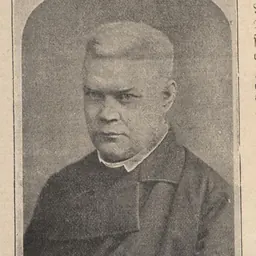
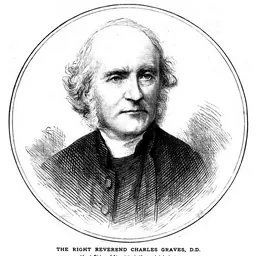
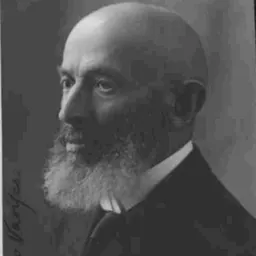


Contemporaries
People whose lives overlapped Dayananda Saraswati's




Frequently asked questions
Who was Dayananda Saraswati?
Indian social reformer (1824-1883)
When was Dayananda Saraswati born?
Dayananda Saraswati was born on 12 February 1824 in Tankara.
When did Dayananda Saraswati die?
Dayananda Saraswati died on 30 October 1883 in Ajmer.
What was Dayananda Saraswati's occupation?
Dayananda Saraswati was a philosopher, autobiographer, priest and swami.
What nationality was Dayananda Saraswati?
Dayananda Saraswati was Indian.
Sources & further reading
· Wikipedia: Dayananda Saraswati
· DBpedia: Dayananda Saraswati
Cite this page
APA: Biography.guide. (2026). Dayananda Saraswati. https://biography.guide/dayananda-saraswati-philosopher/
MLA: "Dayananda Saraswati." Biography.guide, https://biography.guide/dayananda-saraswati-philosopher/.
Chicago: "Dayananda Saraswati." Biography.guide. https://biography.guide/dayananda-saraswati-philosopher/.
Data last updated: 2026-09-22 · Spot an error? Report a correction.
Portrait: Wikimedia Commons · author & licence
Page generated 2026-09-27 05:02 UTC