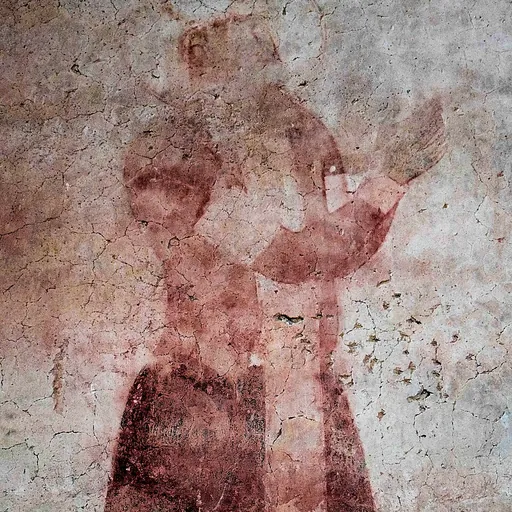
David VII of Georgia
King of Georgia
About David VII of Georgia
Lived 1215 – 1270 (aged 54–55). David VII of Georgia was a Georgian royalty.
David VII, also known as David Ulu (, "David the Senior" in the Mongol language) Because of this, he was considered an illegitimate son in the circles of the Georgian nobility, so his father was succeeded by his sister Rusudan upon his death in 1223. In 1246 the two Davids (the future David VI, who had been in Mongolia since 1243, and the recently proclaimed David VII Ulu) attended the enthronement of Guyuk Khan at the Mongol court in Karakorum, Mongolia, all bearing homage, tribute, and presents. The 13th-century historian Juvayni said:
In order to control the country more easily, due to the apparent succession crisis, although the majority of the nobility did not side with the illegitimate son, the Mongols divided the Georgian nobles into two rival parties, each representing its own candidate for the crown.
Decline of the kingdom In the following years, both David Ulu and David Narin showed unwavering loyalty to the Mongols even after the change at the head of the Mongol Empire and the coming to power of the great Khan Mongke in 1251. Georgia then came under the supreme rule of Batu Khan, who was given virtually independent rule over the western parts of the Mongol Empire by Mongke. Having embarked on an expedition to the Middle East in 1253, Mongke's brother Hulegu Khan was particularly keen to exploit the political and religious divisions of that part of the world. Attacking mostly Muslims, he tried to maintain the best possible relations with Georgians and Armenians. Numerous Georgian-Armenian military units participated in the Mongol conquest of Alamut in 1256, where they were personally led by David Ulu, and of Baghdad in 1258, and in the skirmishes between Mongol leaders during the campaign.
Later life
Tiflis coinage in the name of David VII citing Möngke as overlord, Persian, dated 1253. Georgia lost tens of thousands of soldiers in these campaigns, and was left without native defenders against the Mongol forces sent to suppress spontaneous rebellions that broke out due to high taxes and the heavy burden of military service. The country suffered heavily from the consequences of rebellions against the Mongol authorities, and even more devastating than the Mongol punitive expeditions were the internal conflicts between currents loyal and disloyal to the Mongols. In 1259, Georgian nobles led by David Narin rose up against the Mongols, separating the Kingdom of Western Georgia from the unified Georgia.
When in 1260 Hulegu Khan requested the presence of Georgians and Armenians as part of the Mongol units in the Levant, remembering the losses of his troops in the 1258 Siege of Baghdad, David Ulu rebelled. A large Mongol army led by General Arghun Aqa invaded Georgia from the south, inflicted a heavy defeat on David and Sargis I Jaqeli in a battle near Akhaldaba, and then brutally plundered the country. The Mongol campaign continued during the winter, and the following year the king was forced to flee to Imereti, which the Mongols failed to conquer. David's family was captured, and his wife Gvantsa was killed. Peace with the Mongols was achieved in 1262, when David Ulu returned to Tbilisi to reclaim his crown as a Mongol vassal, pledging allegiance to Hulegu, while David Narin only nominally recognized Mongol rule in Imereti. The reason for Hulegu's tolerance towards the rebel lies in the fact that since 1261, the Il-kan was at war with the Golden Horde, which was on a larger scale.
David VII Ulu died of a bowel infection at the age of 55 in the spring of 1270. He was buried at Mtskheta. He was succeeded by his son Demetre II.
Family David VII was married four times: first to Jigda-Khatun, a Mongolian; second to Altun, an Alanian; third to Gvantsa, daughter of Kakhaber Kakhaberidze, Duke of Racha; and fourth to Esukan, daughter of the Mongol general Chormaqan. His children were:
Prince George (died 1268), by Altun; Princess , by Altun, who was married firstly to a son of Arghun-Agha and secondly to Sadun Mankaberdeli; Demetrius II of Georgia (1259–1289), by Gvantsa, who succeeded his father as King of Georgia and reigned from 1270 until his execution by the Mongol Ilkhans in 1289.
Don’t just read it —
keep it.
Full-length biographies made to live with: read them, listen on the way to work, watch them tonight.
- E-book
- Audio
- Video
Instant download · yours to keep · every purchase keeps this site free
Important facts
People in David VII of Georgia's life
Named in this biography and alive at the same time



Related people
Same field, nearest in time




Contemporaries
People whose lives overlapped David VII of Georgia's


Frequently asked questions
Who was David VII of Georgia?
King of Georgia
When was David VII of Georgia born?
David VII of Georgia was born in 1215.
When did David VII of Georgia die?
David VII of Georgia died in 1270 in Tbilisi.
What was David VII of Georgia's occupation?
David VII of Georgia was a royalty.
What nationality was David VII of Georgia?
David VII of Georgia was Georgian.
Sources & further reading
· Wikipedia: David VII of Georgia
Cite this page
APA: Biography.guide. (2026). David VII of Georgia. https://biography.guide/david-vii-of-georgia/
MLA: "David VII of Georgia." Biography.guide, https://biography.guide/david-vii-of-georgia/.
Chicago: "David VII of Georgia." Biography.guide. https://biography.guide/david-vii-of-georgia/.
Data last updated: 2026-09-23 · Spot an error? Report a correction.
Portrait: Wikimedia Commons · author & licence
Page generated 2026-09-27 05:05 UTC