
About David Pohle
Lived 1624 – 1695 (aged 70–71). David Pohle was a German composer.
David Pohle (1624 – 20 December 1695) was a German composer of the Baroque era. His surname is also spelled Pohl, Pohlen, Pole, Pol or Bohle.
Biography Pohle was born in Marienberg into a family of civic musicians. He was a pupil of Heinrich Schütz in Dresden. He and his brother Samuel joined the Kapelle of Christian I, Duke of Saxe-Merseburg as instrumentalists. From 1650 to 1652 his presence at Kassel is documented. From 1653 he was at the Holstein-Gottorp court in Schleswig.
In a baptismal record of 1660 he is named as "Concertmeister to the prince of Magdeburg", namely Augustus, Duke of Saxe-Weissenfels. Pohle became the Kapellmeister for the Duke's court at Halle that same year, succeeding Philipp Stolle. The poet and dramatist David Elias Heidenreich worked in the Saxon courts as an official, and provided the libretti for a number of the Singspiel operas that Pohle composed. From 1674 to 1677 Pohle also worked at the secundogeniture courts at Saxe-Weissenfels and Saxe-Zeitz.
When the court at Halle moved to Weissenfels in 1680, Krieger, who had already become deputy Kapellmeister at the court, replaced Pohle as Kapellmeister. Violinist Christian Heinrich Aschenbrenner was also at Zeitz during that time. When the Zeitz Kapelle was disbanded,
Sacred German Der Engel des Herrn for 4 voices, 4 instruments and continuo Es wird ein Stern aus Jacob aufgehen for 4 voices, 3 instruments and continuo Herr, wenn ich nur dich habe for alto, 5 instruments and continuo Herr, wenn ich nur dich habe (other version) for 3 voices, 3 instruments and continuo Ihr Völker bringet her for 3 voices, 3 instruments and continuo Jesu, meine Freude for 4 voices, 3 instruments and continuo Nur in meines Jesu Wunden for 6 voices, 6 instruments and continuo Siehe, es hat überwunden der Löwe for 5 voices, 7 (8 ad lib.) instruments and continuo Wie der Hirsch schreiet for tenor, 3 instruments and continuo
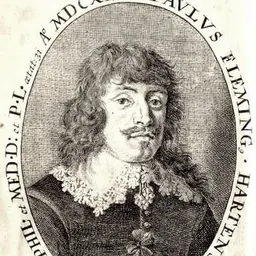
Secular German 12 arias after the fifth book of odes by Paul Fleming, for 2 voices, 2 instruments and continuo Kein Augenblick vergeht for 3 voices and continuo Marindgen, du siehst hold und schöne for 2 voices, 5 instruments and continuo Weiss und Schwarz for 2 voices, 2 instruments and continuo
Instrumental 20 sonatas for 5 to 8 instruments Sonata a 3 Sonata a 4 2 sonatas a 4 Sonata a 5 3 sonatas a 6 Sonata a 8 2 suites a 4 Le Testament du Sr. Belleville et Courante et Sarabande Ballet Sonata a 2 Violini (lost, mentioned in Codex Rost, No. 24)
Recordings Wie der Hirsch schreyet: Diligam te Domine; In te Domine speravi; Benedicam Dominum; Jesu chare; Paratum cor meum. Sonatas a 6 No.23–25, 29; Sonatas a 6 in F. Monika Mauch, David Erler, Hansjörg Mammel, L'arpa festante, Rien Voskuilen, Carus, DDD, 2004
Complete Sonatas & Ballet Music. Brice Sailly, Stéphanie de Failly, Ensemble Clematis, Ricercar RIC 460, 2024
Don’t just read it —
keep it.
Full-length biographies made to live with: read them, listen on the way to work, watch them tonight.
- E-book
- Audio
- Video
Instant download · yours to keep · every purchase keeps this site free
Important facts
People in David Pohle's life
Named in this biography and alive at the same time




Related people
Same field, nearest in time



Contemporaries
People whose lives overlapped David Pohle's





Frequently asked questions
Who was David Pohle?
German baroque composer
When was David Pohle born?
David Pohle was born in 1624 in Marienberg.
When did David Pohle die?
David Pohle died on 20 December 1695 in Merseburg.
What was David Pohle's occupation?
David Pohle was a composer.
What nationality was David Pohle?
David Pohle was German.
Sources & further reading
Cite this page
APA: Biography.guide. (2026). David Pohle. https://biography.guide/david-pohle/
MLA: "David Pohle." Biography.guide, https://biography.guide/david-pohle/.
Chicago: "David Pohle." Biography.guide. https://biography.guide/david-pohle/.
Data last updated: 2026-09-20 · Spot an error? Report a correction.
Page generated 2026-09-27 04:58 UTC