
About David Moule-Evans
Lived 1905 – 1988 (aged 82). David Moule-Evans was a British conductor and composer.
David Moule-Evans (21 November 1905 – 18 May 1988) was an English composer, conductor and academic.
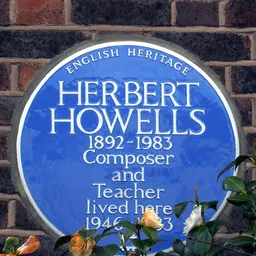
Life Moule-Evans was born in Ashford, Kent, and was educated at the Judd School in Tonbridge before studying at the Royal College of Music in London with Malcolm Sargent and Herbert Howells. While at the Royal College he became friendly with his contemporary Michael Tippett, beating him to gain the Mendelssohn Scholarship in 1928 and continuing studies at Queen's College, Oxford. Tippett asked him to conduct the first full concert of his own music at the Barn Theatre in Oxted on 5 April 1930. From 1945 to 1974 Moule-Evans returned to the RCM to teach harmony, counterpoint and composition.
He married Monica Warden Evans in March 1935 and the couple lived at Claremont, 10 Rose Hill, Dorking in Surrey.
Music As a composer Moule-Evans has been largely forgotten today, but during his lifetime he achieved a measure of success. His Concerto for String Orchestra won the Carnegie British Music award in 1928. The Dance Suite, scored for full orchestra with piano, five percussion players and timpani, was completed in December 1930 and received its first performance at a Royal College of Music Patrons' Fund Concert in March, 1931. He was one of several composer contributors (alongside Ralph Vaughan Williams, William Cole, Julian Gardiner and John Tilehurst) to the 1938 Dorking pageant play England's Pleasant Land, written by E.M. Forster.
His Symphony in G (1944) was the controversial £1,000 prizewinner of the Australian International Jubilee Symphony Competition of 1951 with The Musical Times and others claiming that the runner up, a symphony by Robert Hughes, was "definitely superior". (Malcolm Sargent revived the work in the UK for a Royal Festival Hall performance by the London Symphony Orchestra in 1952, but to mixed reviews, the Musical Times dismissing it as "conventional, banal and boring").
The orchestral poem September Dusk was premiered at the BBC Proms on 25 August 1945. Moule-Evans mostly wrote in a popular, straightforward "light music" style, although the composer Michael Hurd has commented that his later chamber works, including the Violin Sonata in F-sharp minor (1956) and the Piano Sonata (1966) are more adventurous in style.
Selected works
Orchestral 1926 Rhapsody No 2 1928 Concerto for String Orchestra 1930 Dance Suite 1935 Cliff Castle, symphonic poem 1935 Polka for Cello and Orchestra (dedicated to cellist Maurice Hardy) 1938 Divertimento for strings (first performance, Bristol 1939 under Reginald Redman) 1942 The Spirit of London, overture 1943 September Dusk, symphonic poem 1944 Symphony in G Major (awarded 1st prize at the Australian Jubilee Competition) 1948 Vienna Rhapsody, waltz 1949 The Haunted Place, miniature for string orchestra 1951 Old Tupper's Dance 1952 Sussex Downs, suite for small orchestra
Choral and Vocal 1945 Two Celtic Songs, soprano and piano (text: Fiona Macleod) (published Stainer & Bell) 1947 Duncton Hill, unaccompanied part song for mixed choir (text: Hilaire Belloc) (published Joseph Williams) 1948 The Ploughboy in Luck, two part song 1949 Bed in Summer, Hayloft, The Swing, songs (text: R.L Stevenson) 1949 O Mistress Mine, two part song (published Stainer & Bell) 1951 My Own Country and Twelfth Night, songs for middle voice and piano (text: Hilaire Belloc) 1951 Twilight, song for middle voice and piano (text: John Masefield)
Chamber music 1925 Sonata in E major for violin and piano 1938 Moto perpetuo for viola and piano 1956 Sonata in F sharp minor for violin and piano 1966 Piano Sonata Trio for flute, oboe and piano (dedicated to The Sylvan Trio)
Film music 1942 London, 1942 1943 Health of a Nation 1945 Make Fruitful the Land
Don’t just read it —
keep it.
Full-length biographies made to live with: read them, listen on the way to work, watch them tonight.
- E-book
- Audio
- Video
Instant download · yours to keep · every purchase keeps this site free
Important facts
People in David Moule-Evans's life
Named in this biography and alive at the same time




Related people
Same field, nearest in time


Contemporaries
People whose lives overlapped David Moule-Evans's




Frequently asked questions
Who was David Moule-Evans?
English composer and conductor (1905–1988)
When was David Moule-Evans born?
David Moule-Evans was born on 21 November 1905.
When did David Moule-Evans die?
David Moule-Evans died on 18 May 1988 in Dorking.
What was David Moule-Evans's occupation?
David Moule-Evans was a conductor and composer.
What nationality was David Moule-Evans?
David Moule-Evans was British.
Sources & further reading
· Wikipedia: David Moule-Evans
Cite this page
APA: Biography.guide. (2026). David Moule-Evans. https://biography.guide/david-moule-evans/
MLA: "David Moule-Evans." Biography.guide, https://biography.guide/david-moule-evans/.
Chicago: "David Moule-Evans." Biography.guide. https://biography.guide/david-moule-evans/.
Data last updated: 2026-09-20 · Spot an error? Report a correction.
Page generated 2026-09-27 05:02 UTC