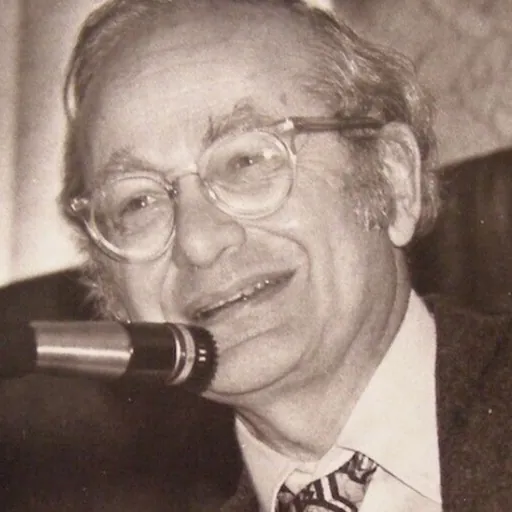
About David H. Hubel
Lived 1926 – 2013 (aged 87). David H. Hubel was a Canadian and American physician, neuroscientist, university teacher and neurologist, known for Visual system.
David Hunter Hubel (February 27, 1926 – September 22, 2013) was an American Canadian neurophysiologist noted for his studies of the structure and function of the visual cortex. He was co-recipient with Torsten Wiesel of the 1981 Nobel Prize in Physiology or Medicine (shared with Roger W. Sperry), for their discoveries concerning information processing in the visual system. For much of his career, Hubel worked as the Professor of Neurobiology at Johns Hopkins University and Harvard Medical School. In 1978, Hubel and Wiesel were awarded the Louisa Gross Horwitz Prize from Columbia University. In 1983, Hubel received the Golden Plate Award of the American Academy of Achievement.
Early life and education Hubel was born in Windsor, Ontario, Canada, to American parents in 1926. His grandfather emigrated as a child to the United States from the Bavarian town of Nördlingen. In 1929, his family moved to Montreal, where he spent his formative years. His father was a chemical engineer and Hubel developed a keen interest in science right from childhood, making many experiments in chemistry and electronics. From age six to eighteen, he attended Strathcona Academy in Outremont, Quebec, about which he said, "[I owe] much to the excellent teachers there, especially to Julia Bradshaw, a dedicated, vivacious history teacher with a memorable Irish temper, who awakened me to the possibility of learning how to write readable English."
Career In 1954, Hubel moved to the United States to work at Johns Hopkins School of Medicine as an assistant resident in Neurology. From 1988 to 1989 he was the president of the Society for Neuroscience. He was a member of the American Academy of Arts and Sciences, the United States National Academy of Sciences, and the American Philosophical Society.
Research
The Hubel and Wiesel experiments greatly expanded the scientific knowledge of sensory processing. The partnership lasted over twenty years and became known as one of the most prominent research pairings in science. Still other neurons, which they termed complex cells, detected edges regardless of where they were placed in the receptive field of the neuron and could preferentially detect motion in certain directions. These studies showed how the visual system constructs complex representations of visual information from simple stimulus features.
Hubel and Wiesel received the Nobel Prize for two major contributions: firstly, their work on the development of the visual system, which involved a description of ocular dominance columns in the 1960s and 1970s; and secondly, their work establishing a foundation for visual neurophysiology, describing how signals from the eye are processed by visual parcels in the neo-cortex to generate edge detectors, motion detectors, stereoscopic depth detectors, and color detectors, building blocks of the visual scene. By depriving kittens of using one eye, they showed that columns in the primary visual cortex receiving inputs from the other eye took over the areas that would normally receive input from the deprived eye. This has important implications for the understanding of deprivation amblyopia, a type of visual loss due to unilateral visual deprivation during the so-called critical period. These kittens also did not develop areas receiving input from both eyes, a feature needed for binocular vision. Hubel and Wiesel's experiments showed that the ocular dominance develops irreversibly early in childhood development. These studies opened the door for the understanding and treatment of childhood cataracts and strabismus. They were also important in the study of cortical plasticity.
Personal life Hubel married Ruth Izzard in 1953; she died February 17, 2013. The couple had three sons and four grandchildren. He died in Lincoln, Massachusetts, from kidney failure on September 22, 2013, at the age of 87.
Don’t just read it —
keep it.
Full-length biographies made to live with: read them, listen on the way to work, watch them tonight.
- E-book
- Audio
- Video
Instant download · yours to keep · every purchase keeps this site free
Important facts
more
D HubelPeople in David H. Hubel's life
Named in this biography and alive at the same time

Related people
Same field, nearest in time

Contemporaries
People whose lives overlapped David H. Hubel's


Frequently asked questions
Who was David H. Hubel?
Canadian neurophysiologist
When was David H. Hubel born?
David H. Hubel was born on 27 February 1926 in Windsor.
When did David H. Hubel die?
David H. Hubel died on 22 September 2013 in Lincoln.
What was David H. Hubel's occupation?
David H. Hubel was a physician, neuroscientist, university teacher and neurologist.
What was David H. Hubel known for?
David H. Hubel was known for Visual system.
What nationality was David H. Hubel?
David H. Hubel was Canadian and American.
Sources & further reading
Cite this page
APA: Biography.guide. (2026). David H. Hubel. https://biography.guide/david-h-hubel/
MLA: "David H. Hubel." Biography.guide, https://biography.guide/david-h-hubel/.
Chicago: "David H. Hubel." Biography.guide. https://biography.guide/david-h-hubel/.
Data last updated: 2026-09-22 · Spot an error? Report a correction.
Portrait: Wikimedia Commons · author & licence
Page generated 2026-09-27 05:03 UTC