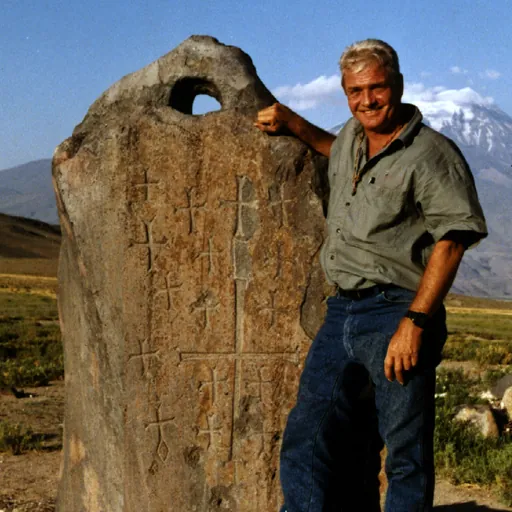
About David Fasold
Lived 1939 – 1998 (aged 59). David Fasold was an American archaeologist.
David Franklin Fasold (February 23, 1939 – April 26, 1998) was a United States Merchant Marine officer and salvage expert who is best known for his 1988 book The Ark of Noah, chronicling his early expeditions to the Durupınar Noah's Ark site in eastern Turkey. Repudiating and then changing his views about the site, Fasold was a participant in a suit with Australian geologist and skeptic Ian Plimer against an Australian creationist group. The suit, dubbed the "Monkey Trial II," was a notable case in the debate between science and religion and its role in society.
Biography and marine career Fasold was born in Chicago in 1939 and grew up in Wheaton, Illinois, son of Frank, an architect, and Ruth Fasold, who raised him as strict Plymouth Brethren. In 1957 he joined the United States Merchant Marine becoming an officer and traveling the world. He met his wife Anna Elizabeth Avila, from El Salvador, in San Jose, California, in the 1950s. After beginning a family he moved to Key West, Florida, where Fasold built up a respectable marine salvage company. In the 1970s and 1980s he assisted various marine treasure hunters, including Mel Fisher.
Fasold owned a photograph album showing the state visit of Benito Mussolini to Adolf Hitler's Nazi Germany that was published in 1970 as The Hitler Albums: Mussolini's State Visit to Germany, Sept. 25-29, 1937, with editorial assistance by Roger James Bender.
He raised two sons, Nathan and Michael, before dying of cancer in Corvallis, Oregon, on April 26, 1998, financially broken from years of expeditions and research.
In 1985, Fasold and Wyatt were joined by geophysicist John Baumgardner for the expedition recounted in Fasold's 1988 book The Ark of Noah. As soon as Fasold saw the site, he exclaimed that it was a ship wreck. Fasold had brought a state-of-the-art frequency generator, set on the wavelength for iron and searched the formation for internal iron loci. This technique was later compared to dowsing by the site's detractors. Fasold and the team measured the length of the formation as 538 feet, close to the 300 cubits of the Bible if the Egyptian cubit of 20.6 inches is used. Later measurements by others found it to be 515 feet, exactly 300 Egyptian cubits in length. Fasold believed the team had found the fossilized remains of the upper deck and that the original reed substructure has disappeared. In the nearby village of Kazan (formerly called Arzap), so-called drogue stones that they believed were once attached to the ark were investigated.
The Ark of Noah and the break with Wyatt The first edition of Fasold's book The Ark of Noah, showing the Durupınar site and the ark as a large reed boat.
Ron Wyatt and David Fasold were both featured on a 20/20 television special soon after their expedition. Charles Berlitz wrote of Fasold's searches in his 1987 book The Lost Ship of Noah, also printing part of an extensive 1985 interview with Fasold on pages 157-161. In 1988, Fasold published his own book, The Ark of Noah. During this time, Fasold formed the Noahide Society and issued a newsletter called Ark-Update. He also produced several audio and video tapes.
Doubts and changing views During the 1990s, Fasold was caught between three opposing camps, all of whom derided his interest in the site: orthodox creationists who believed the ark could only lie on Mount Ararat; Wyatt and others who continued their research and reported significant discoveries; and skeptical geologists and biblical minimalists who called the site a hoax. At other times he claimed that the site was only what the ancients believed was Ziusudra's 'ark of reeds'. In 1996 Fasold coauthored a paper with geologist Lorence Collins entitled "Bogus 'Noah's Ark' from Turkey Exposed as a Common Geologic Structure" that concluded the boat-shaped formation was a curious upswelling of mud that happened to look like a boat. In April 1997 during his testimony in an Australian court case Fasold repudiated his belief in the Ark, and stated that he regarded the claim as "absolute BS".
Ark researchers David Allen Deal and Australian friend and biographer June Dawes According to Collins, Fasold maintained his view that Durunipar was not the Ark till the end of his life. Collins further emphasized the financial cost that this decision, as having cancelled the book publication, he died virtually penniless.
Plimer case In 1997, Fasold was involved in an Australian lawsuit against creationist Allen Roberts, who reproduced some of Fasold's artwork without permission. Co-plaintiff Ian Plimer, an Australian humanist and skeptic, sued Roberts's organization Ark Search under the Fair Trading Act, alleging that they had made false and misleading claims about the Durupinar site. The case, touted as a second Scopes Monkey Trial, failed, with Judge Ron Sackville ruling: "Courts should not attempt to provide a remedy for every false or misleading statement made in the course of public debate on matters of general interest." Fasold described the award of $2,500 Australian dollars in damages as for copyright infringement as "a slap in the face."
Works Books
Articles Full text
Video
Don’t just read it —
keep it.
Full-length biographies made to live with: read them, listen on the way to work, watch them tonight.
- E-book
- Audio
- Video
Instant download · yours to keep · every purchase keeps this site free
Important facts
People in David Fasold's life
Named in this biography and alive at the same time






Related people
Same field, nearest in time

Contemporaries
People whose lives overlapped David Fasold's




Frequently asked questions
Who was David Fasold?
American sailor
When was David Fasold born?
David Fasold was born on 23 February 1939 in Chicago.
When did David Fasold die?
David Fasold died on 26 April 1998 in Corvallis.
What was David Fasold's occupation?
David Fasold was an archaeologist.
What nationality was David Fasold?
David Fasold was American.
Sources & further reading
Cite this page
APA: Biography.guide. (2026). David Fasold. https://biography.guide/david-fasold/
MLA: "David Fasold." Biography.guide, https://biography.guide/david-fasold/.
Chicago: "David Fasold." Biography.guide. https://biography.guide/david-fasold/.
Data last updated: 2026-09-21 · Spot an error? Report a correction.
Portrait: Wikimedia Commons · author & licence
Page generated 2026-09-27 04:59 UTC