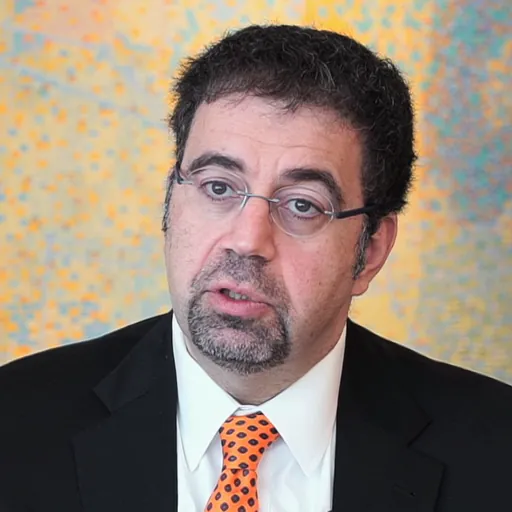
Daron Acemoğlu
Turkish-American economist and receiver of the 2024 Nobel Prize in economic sciences (born 1967)
About Daron Acemoğlu
Born 1967. Daron Acemoğlu is a Turkish and American economist, university teacher and author.
Kamer Daron Acemoğlu (born September 3, 1967) is a Turkish-American economist of Armenian descent who has been at the Massachusetts Institute of Technology since 1993, where he is currently the Elizabeth and James Killian Professor of Economics. He was named an Institute Professor at MIT in 2019. His primary research fields include political economy, development economics, and labor economics. He received the John Bates Clark Medal in 2005, and the Nobel Memorial Prize in Economic Sciences in 2024.
Acemoglu ranked third, behind Paul Krugman and Greg Mankiw, in the list of "Favorite Living Economists Under Age 60" in a 2011 survey among American economists. In 2015, he was named the most cited economist of the past 10 years per Research Papers in Economics (RePEc) data. According to the Open Syllabus Project, Acemoglu is the third most frequently cited author on college syllabi for economics courses after Mankiw and Krugman.
In 2024, Acemoglu, Simon Johnson, and James A. Robinson were awarded the Nobel Memorial Prize in Economic Sciences for their comparative studies in prosperity between states and empires. He is regarded as a centrist with a focus on institutions, poverty and econometrics.
Early and personal life Kamer Daron Acemoğlu Acemoğlu is the Turkified version of the Armenian last name Ajemian (Աճէմեան). Its root derives from the Arabic term ajam, used for non-Arabs, especially Persians. Most of Turkey's Armenians changed their last names due to the 1934 Surname Law. His first name is the Western Armenian version of Taron, a male given name from a historic region. was born in Istanbul to Armenian parents on September 3, 1967. He became interested in politics and economics as a teenager.
Acemoglu is a naturalized US citizen. and speaks some Armenian. He is married to Asuman "Asu" Ozdağlar, a professor of electrical engineering and computer science at MIT, who is the daughter of İsmail Özdağlar, a former Turkish government minister. Together, they have authored several articles. , they live in Newton, Massachusetts, with their two sons, Arda and Aras.
Academic career
Acemoglu was a lecturer in economics at the London School of Economics from 1992 to 1993.
, he has mentored over 60 PhD students.
Acemoglu is a research associate at the National Bureau of Economic Research (NBER), and was elected a Fellow of the Econometric Society in 2005. He was elected to the American Academy of Arts and Sciences in 2006, and to the National Academy of Sciences in 2014. He is also a Senior Fellow at the Canadian Institute for Advanced Research, and a member of several other learned societies. He edited Econometrica, an academic journal published by the Econometric Society, from 2011 to 2015.
Acemoglu has authored hundreds of academic papers. He noted in 2011 that most his research of the past 15 years concerned with what can be broadly called political economy. His influences include Joel Mokyr, Kenneth Sokoloff, Seymour Martin Lipset, The book's title is derived from Social Origins of Dictatorship and Democracy, a 1966 book by Barrington Moore Jr.
Romain Wacziarg praised the book and argued that its substantive contribution is the theoretical fusion of the Marxist dialectical materialism ("institutional change results from distributional struggles between two distinct social groups, a rich ruling class and a poor majority, each of whose interests are shaped primarily by economic forces") and the ideas of Barry Weingast and Douglass North, who argued that "institutional reform can be a way for the elite to credibly commit to future policies by delegating their enactment to interests that will not wish to reverse them." William Easterly called it "one of the most important contributions to the literature on the economics of democracy in a long time." Edward Glaeser described it as "enormously significant" work and a "great contribution to the field."
Why Nations Fail Why Nations Fail was included in the Shortlist of the 2012 Financial Times Business Book of the Year Award.
In their 2012 book, Why Nations Fail, Acemoglu and Robinson argue that economic growth at the forefront of technology requires political stability, which the Mayan civilization (to name only one) did not have, and creative destruction. The latter cannot occur without institutional restraints on the granting of monopoly and oligopoly rights. They say that the Industrial Revolution began in Great Britain, because the English Bill of Rights 1689 created such restraints.
Acemoglu and Robinson insist that "development differences across countries are exclusively due to differences in political and economic institutions, and reject other theories that attribute some of the differences to culture, weather, geography or lack of knowledge about the best policies and practices." For example, "Soviet Russia generated rapid growth as it caught up rapidly with some of the advanced technologies in the world [but] was running out of steam by the 1970s" because of a lack of creative destruction.
The book was written for a general audience. Warren Bass wrote of it in The Washington Post: "bracing, garrulous, wildly ambitious and ultimately hopeful. It may, in fact, be a bit of a masterpiece."
Clive Crook wrote in Bloomberg News that the book deserves most of the "lavish praise" it received. In his review in Foreign Affairs Jeffrey Sachs criticized Acemoglu and Robinson for systematically ignoring factors such as domestic politics, geopolitics, technological discoveries, and natural resources. He also argued that the book's appeal was based on readers' desire to hear that "Western democracy pays off not only politically but also economically." Bill Gates called the book a "major disappointment" and characterized the authors' analysis as "vague and simplistic." Ryan Avent, an editor at The Economist, responded that "Acemoglu and Robinson might not be entirely right about why nations succeed or fail. But at least they're engaged with the right problem."
The Narrow Corridor In The Narrow Corridor. States, Societies, and the Fate of Liberty (2019), Acemoglu and Robinson argue that a free society is attained when the power of the state and of society evolved in rough balance. The book introduces the concept of the "red queen effect," which suggests that liberty is maintained only when both the state and society continually evolve to keep each other in check.
Power and Progress Published in 2023, Power and Progress: Our Thousand-Year Struggle Over Technology and Prosperity is a book by Acemoglu and Simon Johnson on the historical development of technology and the social and political consequences of technology. The book addresses three questions, on the relationship between new machines and production techniques and wages, on the way in which technology could be harnessed for social goods, and on the reason for the enthusiasm around artificial intelligence.
Power and Progress argues that technologies do not automatically yield social goods, their benefits going to a narrow elite. It offers a rather critical view of artificial intelligence (AI), stressing its largely negative impact on jobs and wages and on democracy.
Acemoglu and Johnson also provide a vision of how new technologies could be harnessed for social good. They see the Progressive Era as offering a model. They also discuss a list of policy proposals for the redirection of technology that includes: (1) market incentives, (2) the break up of big tech, (3) tax reform, (4) investing in workers, (5) privacy protection and data ownership, and (6) a digital advertising tax.
Papers Social programs and policies In a 2001 article, Acemoglu argued that the minimum wage and unemployment benefits "shift the composition of employment toward high-wage jobs. Because the composition of jobs in the laissez-faire equilibrium is inefficiently biased toward low-wage jobs, these labor market regulations increase average labor productivity and may improve welfare." Furthermore, he has argued that "minimum wages can increase training of affected workers, by inducing firms to train their unskilled employees."
Democracy and economy Acemoglu et al. found that "democracy has a significant and robust positive effect on GDP" and suggested that "democratizations increase GDP per capita by about 20% in the long run." In another paper, Acemoglu et al. found that "there is a significant and robust effect of democracy on tax revenues as a fraction of GDP, but no robust impact on inequality.". The authors argue that democratic institutions contribute to economic growth by expanding education, improving public capacity, and encouraging investment.
Social democracy and unions Acemoglu and Philippe Aghion argued in 2001 that although deunionization in the US and UK since the 1980s is not the "underlying cause of the increase in inequality", it "amplifies the direct effect of skill-biased technical change by removing the wage compression imposed by unions."
According to Acemoglu and Robinson, unions historically had a significant role in creating democracy, especially in western Europe, and in maintaining a balance of political power between established business interests and political elites.
Nordic model In a 2012 paper titled "Can't We All Be More Like Scandinavians?", co-written with Robinson and Verdier, he suggests that "it may be precisely the more 'cutthroat' American society that makes possible the more 'cuddly' Scandinavian societies based on a comprehensive social safety net, the welfare state and more limited inequality." They concluded that "all countries may want to be like the 'Scandinavians' with a more extensive safety net and a more egalitarian structure," however, if the United States shifted from being a "cutthroat [capitalism] leader", the economic growth of the entire world would be reduced. He argued against the US adopting the Nordic model in a 2015 op-ed for The New York Times. He again argued: "If the US increased taxation to Denmark levels, it would reduce rewards for entrepreneurship, with negative consequences for growth and prosperity." He praised the Scandinavian experience in poverty reduction, creation of a level playing field for its citizens, and higher social mobility. This was critiqued by Lane Kenworthy, who argues that, empirically, the US's economic growth preceded the divergence in 'cutthroat' and 'cuddly' policies, and there is no relationship between inequality and innovation for developed countries.
Colonialism "The Colonial Origins of Comparative Development", co-written by Acemoglu, Robinson, and Simon Johnson in 2001, is by far his most cited work. Historical experience dominated by extractive institutions in these countries has created a vicious circle, which was exacerbated by European colonization. In "Non-Modernization" (2022), they further argue that modernization theory cannot account for various paths of political development "because it posits a link between economics and politics that is not conditional on institutions and culture and that presumes a definite endpoint—for example, an 'end of history'."
Automation and labor markets Beginning in the late 2010s, Acemoglu expanded his research to focus on the economic effects of automation and artificial intelligence on labor markets. In collaboration with Pascual Restrepo, he examined how industrial robots affected employment and wages in the United States. Their study "Robots and Jobs: Evidence from U.S. Labor Markets" (2020) found that regions with greater exposure to industrial robots experienced larger declines in employment and modest reductions in wages, suggesting that the economic benefits of automation were not evenly distributed. Acemoglu and Restrepo extended this analysis in "Tasks, Automation, and the Rise in U.S. Wage Inequality" (2022), arguing that automation has contributed to rising wage inequality in the United States by replacing many middle-skill tasks while increasing demand for higher-skill labor. This body of research has influenced broader discussions on the future of work, emphasizing that technological change does not automatically benefit workers and can lead to unequal outcomes if incentives favor labor-replacing technologies. Acemoglu has argued that policy and institutional frameworks play an important role in determining whether new technologies complement human labor or substitute for it.
Views Journalists and economists have described Acemoglu as a centrist. ("...the middle-of-the-roaders Daron Acemoglu and James Robinson..." "Daron Acemoglu, a more centrist economist at MIT..." "...Acemoglu, who aligns more with the center than with the populists." Acemoglu's and Robinson's long-time collaborator Simon Johnson suggests that their "point is not just about how things may become awful when the government goes off track (a right-leaning point).) They are also more deeply concerned about how powerful people fight to grab control of the state and otherwise compete to exert influence over the rest of society (a left-leaning perspective)." He argues that the market economy is the only system that creates prosperity, and believes in finding an appropriate balance between "incentivizing creativity, hard work and risk-taking and creating the essential public services, social safety nets and equality of opportunity." As the main cause of the 2008 financial crisis, he stated that policy makers were "lured by ideological notions derived from Ayn Rand's novels rather than economic theory" and opined: "In hindsight, we should not be surprised that unregulated profit-seeking individuals have taken risks from which they benefit and others lose."
Acemoglu believes that universal basic income is "expensive and not generous enough" and that a "more efficient and generous social safety net is needed." He further called it a "flawed idea" and a "poorly designed policy." He instead advocates for a "guaranteed-income program [that] would offer transfers only to individuals whose monthly income is below $1,000, thereby coming in at a mere fraction of a UBI's cost." He calls for "universal health care, more generous unemployment benefits, better-designed retraining programs, and an expanded earned income tax credit (EITC)." Acemoglu supports a negative income tax, calling it a "more sensible" alternative to UBI.
Acemoglu believes that nation-building by the West is no longer possible around the world because the West now lacks the resources and commitment that were present in post-World War II Germany and Japan, and because countries where progress is needed today, such as in the Muslim- and Arab-majority world, do not trust the West.
He views the US war on drugs as a "total and very costly failure", and supported the 2013 ballot referendum Colorado Amendment 64, a successful popular initiative that legalized the sale of recreational marijuana.
In a 2016 interview with National Public Radio, he opined that the US infrastructure is in a "pitiful state, with negative consequences for US economic growth."
Socialism, communism, and Marxism Acemoglu argues that socialist states have not been successful in creating prosperity. He wrote that socialist regimes "from Cuba to the eastern bloc have been disastrous both for economic prosperity and individual freedom."
Social democracy and unions In 2019, Acemoglu argued in favor of social democracy. He stated: "[Social democracy, when practiced by competent governments] is a phenomenal success. Everywhere in the west is to some degree social democratic, but the extent of this varies. We owe our prosperity and freedom to social democracy." However, he qualified this statement by arguing that social democracy "did not achieve these things by taxing and redistributing a lot. It achieved them by having labor institutions protecting workers, encouraging job creation and encouraging high wages."
Authoritarian countries According to Acemoglu, the three obstacles for economic growth under authoritarian regimes are the tendency of authoritarian regimes to become more authoritarian, their tendency to use power to halt "Schumpeterian creative destruction, which is key to sustaining growth" and the instability and uncertainty caused by internal conflicts.
He believes that China has managed to achieve significant economic growth because it "sort of picked up the low hanging fruit from the world technology frontier, but that sort of growth is not going to last until China goes to the next step, which is harnessing innovation," which he argues will be impossible "unless economic institutions become even more open and the extractive political institutions in China will be a barrier to that."
Turkey Acemoglu opined that the Republic of Turkey, formed in 1923 by Atatürk, "is very continuous with the Ottoman Empire." Although the shift from empire to republic brought some positive changes, he argues, the model was largely maintained by the reformers who took power, citing a persistent concentration of power and economic activity. He suggests that the Republican period has been characterized by an unwillingness to accept ethnic minorities. In 2014, Acemoglu condemned the widespread anti-Armenian rhetoric in Turkish textbooks, and demanded that the books be pulled from circulation. In a 2013 op-ed in The New York Times, following the crackdown of Gezi Park protests, Acemoglu wrote that "Even before the brutal suppression of the demonstrations, the belief that Turkey was on its way to becoming a mature democracy — a role model for the rest of the Middle East — had already become untenable." In a May 2014 op-ed in Foreign Affairs, Acemoglu wrote that the drift from democracy by Erdogan is lamentable, but an "almost predictable, stage of Turkey's democratic transition." In the late 2010s, Acemoglu often criticized Turkey's economic policies and consequently became popular with the opposition.
Armenia In a 2015 interview with the Armenian service of Voice of America, Acemoglu stated that he has always been interested in economic, political, and social developments in Armenia.
In a September 2016 conference in Toronto, Acemoglu criticized the Armenian diaspora for legitimizing the successive governments in Armenia, especially when the rights of its citizens are violated, and a wrong economic and political line is being followed in the country. In an April 2017 conference held by the USC Institute of Armenian Studies, Acemoglu stated that while "Armenia could have looked much more like the Czech Republic or Estonia and what we got instead is a country that looks much more like Azerbaijan or Uzbekistan, which is a real shame." He suggested that in the immediate post-Soviet years Armenia was "stronger and it's been getting worse and worse." He criticized the level of corruption of the government, which has systematically closed the political system.
Other countries In an op-ed for The Globe and Mail following the 2014 Ukrainian revolution, Acemoglu advocated Ukraine "to break with its past as quickly as possible. It needs to move away from Russia, politically and economically, even if that means an end to the natural-gas subsidies Russia has used to keep it in the position of a client state. Even more important is for Ukraine's leaders to spread political power and economic benefits to the maximum number of its people, including Russian speakers."
Acemoglu argued that the Greek government-debt crisis was caused by the "terrible state of Greek institutions, and the clientelistic nature of its politics", and stated that the country's problems are "political not just macroeconomic." He identified lack of political integration within the EU as Greece's problem, and said that "the only way forward for Europe is to have greater fiscal and banking integration or to abandon monetary integration."
Acemoglu met with Kemal Kılıçdaroğlu, leader of the opposition Republican People's Party (CHP) in October 2022. In December 2022 Kılıçdaroğlu appointed Acemoglu, among others, as his economic adviser. Pro-Erdogan circles criticized the move. One pro-government columnist said: "The Armenian Daron Acemoğlu, praised by FETÖ, prepared Kılıçdaroğlu's vision program (resembling his own roots)." In response, finance professor Özgür Demirtaş defended Acemoglu. "This tweet is both racist and presumptuous. The influence of Daron Acemoğlu on world's economy-finance professors is greater than the number of cells in your body. It's terrible that you talk like this about a professor who made us proud and is going for the Nobel prize." Yeni Şafak, a pro-government newspaper, ran the headline: "Daron Acemoğlu, one of the new economic advisors of the CHP, could not solve the economic crisis of Armenia."
Armenia Following the 2018 Armenian revolution, opposition leader-turned-Prime Minister Nikol Pashinyan wrote on his Facebook page that Acemoglu told him that he is ready to help Armenia to "restore and develop" its economy. Pashinyan and Acemoglu talked via the internet in June 2018. Acemoglu met with Deputy Prime Minister Tigran Avinyan in Boston in July 2019. In 2020, Acemoglu publicly emphasized the importance of institutional reforms for Armenia’s long-term economic development during interviews related to the country’s post-revolution economic strategy.
In October 2025, Acemoglu delivered a video message on Armenia's economic development to the meeting of Russian-Armenian billionaire Samvel Karapetyan's Our Way political movement, which was interpreted as joining or endorsing the future party. Acemoglu told Agos that he sent a message for their conference, but has "no connection with the party."
Recognition
According to data collected by Research Papers in Economics (RePEc), Acemoglu was the most cited economist of the decade leading to 2015.
He was listed 88th in Foreign Policy'''s 2010 list of Top 100 Global Thinkers "for showing that freedom is about more than markets." Acemoglu was voted by the readers of Prospect Magazine as the world's top thinker for 2024. He was elected a fellow of the American Academy of Arts and Sciences in 2006.
Francis Fukuyama has described Acemoglu and his long-time collaborator James A. Robinson as "two of the world's leading experts on development." Clement Douglas wrote in the Federal Reserve Bank of Minneapolis publication that the "scope, depth and sheer volume of [his] scholarship are nothing short of breathtaking, verging on implausible."
Awards Economics awards John Bates Clark Medal (2005) by the American Economic Association Erwin Plein Nemmers Prize in Economics (2012) by Northwestern University "for fundamental contributions to the understanding of political institutions, technical change and economic growth" BBVA Foundation Frontiers of Knowledge Award (2016) "for proving the influence of institutions over economic development" Jean-Jacques Laffont Prize, Toulouse School of Economics (2018) Global Economy Prize, Kiel Institute for the World Economy (2019) Omicron Delta Epsilon Distinguished Economist Award (2026)
State orders and awards Presidential Culture and Arts Grand Award in Social Sciences (2013) by Turkish President Abdullah Gül
Honorary degrees Acemoglu has been awarded honorary degrees from the following universities: Utrecht University (2008), University of Bath (2017), ENS Paris-Saclay (2017), London Business School (2018), the University of Glasgow (2024), and the University of Oxford (2026).
Other Carnegie Fellow (2017)
Nobel Prize Acemoglu was long considered a prospective Nobel laureate. In 2024, Acemoglu, jointly with James A. Robinson and Simon Johnson, were awarded the Nobel Memorial Prize in Economic Sciences for their comparative studies in prosperity among nations. The trio was recognized for their studies on how political and economic institutions impact a nation's development, highlighting the distinction between inclusive institutions, which promote widespread economic participation and growth, and extractive institutions, which concentrate power and wealth in the hands of a few. Acemoglu became the second ethnic Armenian (after Ardem Patapoutian) and third Turkish national (after Orhan Pamuk and Aziz Sancar) to become a Nobel laureate.
Selected bibliography
Acemoglu, Daron; Laibson, David and List, John (2014). Principles of Economics, Pearson, New York. Description, arrow-searchable preview, & reviewers' comments (at bottom). Acemoglu, Daron, and Simon Johnson (2023). Power and Progress: Our Thousand-Year Struggle Over Technology and Prosperity.'' New York: PublicAffairs.
Don’t just read it —
keep it.
Full-length biographies made to live with: read them, listen on the way to work, watch them tonight.
- E-book
- Audio
- Video
Instant download · yours to keep · every purchase keeps this site free
Important facts
People in Daron Acemoğlu's life
Named in this biography and alive at the same time






Related people
Same field, nearest in time


Contemporaries
People whose lives overlapped Daron Acemoğlu's


Frequently asked questions
Who is Daron Acemoğlu?
Turkish-American economist and receiver of the 2024 Nobel Prize in economic sciences (born 1967)
When was Daron Acemoğlu born?
Daron Acemoğlu was born on 3 September 1967 in Istanbul.
What is Daron Acemoğlu's occupation?
Daron Acemoğlu is an economist, university teacher and author.
What nationality is Daron Acemoğlu?
Daron Acemoğlu is Turkish and American.
Sources & further reading
Cite this page
APA: Biography.guide. (2026). Daron Acemoğlu. https://biography.guide/daron-acemoglu/
MLA: "Daron Acemoğlu." Biography.guide, https://biography.guide/daron-acemoglu/.
Chicago: "Daron Acemoğlu." Biography.guide. https://biography.guide/daron-acemoglu/.
Data last updated: 2026-09-20 · Spot an error? Report a correction.
Page generated 2026-09-27 05:10 UTC