
About Dariush Mehrjui
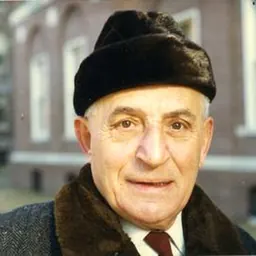
Lived 1939 – 2023 (aged 83). Dariush Mehrjui was an Iranian film director, screenwriter, translator and director.
Dariush Mehrjui (; 8 December 1939 – 14 October 2023) was an Iranian filmmaker, screenwriter, and a member of the Iranian Academy of the Arts.
Mehrjui was a founding member of the Iranian New Wave movement of the early 1970s, which also included directors Masoud Kimiai and Nasser Taqvai. His second film, The Cow (1969), is considered to be the first film of this movement. Most of his films are inspired by literature and adapted from Iranian and foreign novels and plays.
On 14 October 2023, Mehrjui and his wife, Vahideh Mohammadifar, were found stabbed to death in their home in the city of Karaj, near Tehran.
Early life and education Dariush Mehrjui was born on 8 December 1939 to a middle-class family in Tehran. He showed interest in painting miniatures, music, and playing santoor and piano. He spent a lot of time going to the movies, particularly American films which were un-dubbed and inter-spliced with explanatory title cards that explained the plot throughout the films. At this time Mehrjui started to learn English so as to better enjoy the films. The film that had the strongest impact on him as a child was Vittorio De Sica's Bicycle Thieves. At the age of 12, Mehrjui built a 35 mm projector, rented two-reel films and began selling tickets to his neighborhood friends. Although raised in a religious household, Mehrjui said that, at the age of 15, "The face of God gradually became a little hazy for me, and I lost my faith."
Mehrjui started his own literary magazine in 1964, Pars Review. The magazine's intention was to bring contemporary Persian literature to western readers. During this time he wrote his first script with the intention of filming it in Iran. He moved back to Tehran in 1965, and found employment as a journalist and screenwriter.
The film is adapted from a short story by renowned Iranian literary figure Gholamhossein Sa'edi. Sa'edi was a friend of Mehrjui and suggested the idea to him when Mehrjui was looking for a suitable second film, and they collaborated on the script. Through Sa'edi, Mehrjui met the actors Ezzatolah Entezami and Ali Nassirian, who were performing in one of Sa'edi's plays. Mehrjui would work with Entezami and Nassirian throughout his career. The film was completed in 1969.
In the film, Entezami stars as Masht Hassan, a peasant in an isolated village in southern Iran. Hassan has a close relationship with his cow, which is his only possession (Mehrjui said that Entezami even resembled a cow in the film). It won the International Critics Award at Venice, and later that year, Entezami won the Best Actor Award at the Chicago International Film Festival.
While waiting for Gaav to be released and gaining international recognition, Mehrjui was busy directing two more films. In 1970 he shot Agha-ye Hallou (Mr. Naive), a comedy which starred and was written by Ali Nassirian. Mehrjui had said that, "After all the censorship problems with Gaav, [he] wanted to do a no-problem film." It was a commercial success in Iran. Mehrjui got the idea for the film when a friend suggest that he investigate the black market and illicit blood traffic in Iran. Horrified with what he found, Mehrjui took the idea to Gholamhossein Sa'edi, who had written a play on the subject, "Aashghaal-duni". The play became the basis for the script, which then had to be approved by the Ministry of Culture before production could begin. With pressure from the Iranian medical community, approval was delayed for a year until Mehrjui began shooting the film in 1974.
During this time, Iran was going through great political changes. The events leading up to the Iranian Revolution of 1979 were causing a gradual loosening of strict censorship laws, which Mehrjui and other artists had great hopes for. and to approve a new theocratic constitution whereby Khomeini became Supreme Leader of the country, in December 1979.
Mehrjui stated that he, "enthusiastically took part in the revolution, shooting miles of reels of its daily events".
In 1995, Mehrjui made Pari, an unauthorized loose film adaptation of J. D. Salinger's book Franny and Zooey. Though the film could be distributed legally in Iran since the country has no official copyright relations with the United States, Salinger had his lawyers block a planned screening of the film at Lincoln Center in 1998. Mehrjui called Salinger's action "bewildering", explaining that he saw his film as "a kind of cultural exchange". His follow-up film, 1997's Leila, is a melodrama about an urban, upper-middle-class couple who learn that the wife is unable to bear children.
His last film, titled Laminor, was released in 2019.
Cinematic style and legacy Modern Iranian cinema begins with Mehrjui. Mehrjui introduced realism, symbolism, and the sensibilities of art cinema. His films have some resemblance with those of Rosselini, De Sica, and Satyajit Ray, but he also added something distinctively Iranian, in the process starting one of the greatest modern film waves.
The one constant in Mehrjui's work was his attention to the discontents of contemporary, primarily urban, Iran. His film The Pear Tree (1999) has been hailed as the apotheosis of the director's examination of the Iranian bourgeoisie.
Murder and aftermath
Daryoush Mehrjui and his wife, Vahideh Mohammadifar, were found stabbed to death on 14 October 2023, in their villa in Meshkin Dasht, Karaj. Prior to this incident, Vahideh had posted on her social media page about anonymous personal threats, including threats from a non-Iranian individual with a knife.
On 17 October, Iranian police arrested ten individuals suspected of being involved in the murders, including "the main killer". Four people were arrested by police days after the killing for their alleged involvement. One of them later confessed to being the killer, saying that he was a former employee of Mehrjui who harbored a grudge against him "due to financial issues". He was subsequently sentenced to death in February 2024 while the three others received prison terms ranging from eight to 36 years for being accomplices to the crime.
Their funeral was held at Roudaki Performance Hall in Tehran, with tributes from Jafar Panahi, Masoud Kimiai, Mohammad Rasoulof and Bahman Farmanara.
Filmography Diamond 33 (1967) The Cow (1969) Mr. Naive (1970) The Postman (1971) The Cycle (1975) The Wild Bafti (1988) Hamoun (1990) Leila (1997) The Pear Tree (1998) Beloved Sky (2010) The Orange Suit (2012) Good To Be Back (2013) Ghosts (2014) La minor (2020)
Awards Mehrjui has received 49 national and international awards, including: Golden Seashell, San Sebastián International Film Festival 1993 Silver Hugo, Chicago International Film Festival 1998 Crystal Simorgh, Fajr Film Festival 2004 Lifetime Achievement Award, 1st Diorama International Film Festival & Market (2019)
Literature Hamid Dabashi, Masters & Masterpieces of Iranian Cinema, 451 p. (Mage Publishers, Washington, DC, 2007); Chapter IV, pp. 107–134: Dariush Mehrjui; The Cow.
Don’t just read it —
keep it.
Full-length biographies made to live with: read them, listen on the way to work, watch them tonight.
- E-book
- Audio
- Video
Instant download · yours to keep · every purchase keeps this site free
Important facts
People in Dariush Mehrjui's life
Named in this biography and alive at the same time



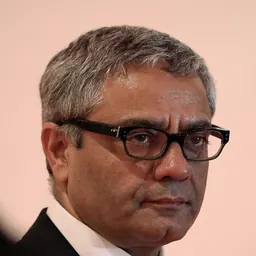


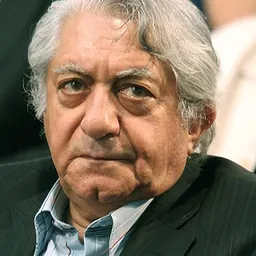

Related people
Same field, nearest in time
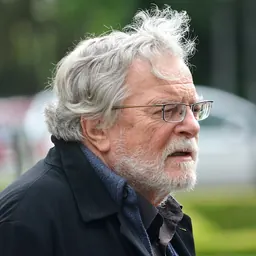
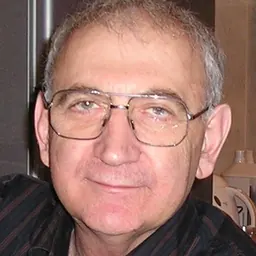
Contemporaries
People whose lives overlapped Dariush Mehrjui's



Frequently asked questions
Who was Dariush Mehrjui?
Iranian filmmaker (1939–2023)
When was Dariush Mehrjui born?
Dariush Mehrjui was born on 8 December 1939 in Tehran.
When did Dariush Mehrjui die?
Dariush Mehrjui died on 14 October 2023 in Karaj.
What was Dariush Mehrjui's occupation?
Dariush Mehrjui was a film director, screenwriter, translator and director.
What nationality was Dariush Mehrjui?
Dariush Mehrjui was Iranian.
Sources & further reading
Cite this page
APA: Biography.guide. (2026). Dariush Mehrjui. https://biography.guide/dariush-mehrjui/
MLA: "Dariush Mehrjui." Biography.guide, https://biography.guide/dariush-mehrjui/.
Chicago: "Dariush Mehrjui." Biography.guide. https://biography.guide/dariush-mehrjui/.
Data last updated: 2026-09-22 · Spot an error? Report a correction.
Page generated 2026-09-27 05:26 UTC