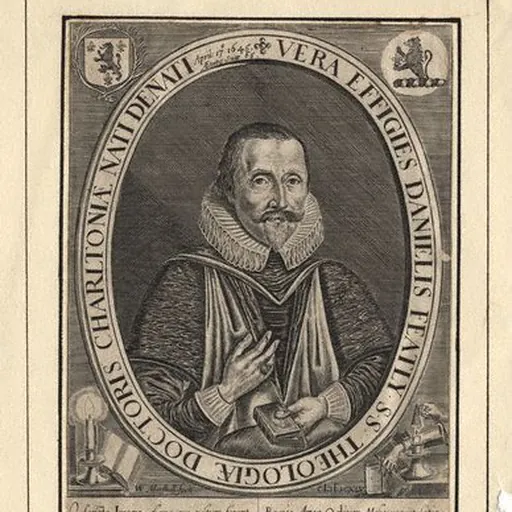
About Daniel Featley
Lived 1582 – 1645 (aged 63). Daniel Featley was a translator, theologian and bible translator.
Daniel Featley, also called Fairclough and sometimes called Richard Fairclough/Featley (15 March 158217 April 1645), was an English theologian and controversialist. He fell into difficulties with Parliament due to his loyalty to Charles I of England in the 1640s, and he was harshly treated and imprisoned at the end of his life.
Early life Daniel Featley was born at Charlton-upon-Otmoor, Oxfordshire, on 15 March 1582, the second son of John Fairclough. by his wife Marian Thrift. His father was cook to Laurence Humphrey, President of Magdalen College, Oxford, and afterwards to Corpus Christi College in the same university. Featley was the first of his family to adopt the surname.
Featley was educated as a chorister of Magdalen College. John Rainolds, President of Corpus, was his godfather and benefactor, and Featley is noted as a protégé of Rainolds, a leading Puritan spokesman. He was admitted scholar of Corpus Christi College 13 December 1594, and probationer fellow 20 September 1602, having taken his B.A. degree on 13 February 1601. He proceeded M.A. on 17 April 1606, and became noted as a disputant and preacher. In 1607 he delivered an oration at Rainolds' funeral.
In 1610 and for the two following years he was chaplain to Sir Thomas Edmondes, the English ambassador at Paris, and was noticed for his attacks on Catholic doctrine and his disputations with Jesuits. Twenty-one of the sermons preached by him in the ambassador's chapel are printed. Featley commenced BD on 8 July 1613, and was the preacher at the act of that year. He seems to have given offence by his plain speaking, even in consecration sermons. The king, James I, himself asked to engage with him in a disputation, which Featley afterwards published. Some time before 1625 Abbot gave him the rectory of All Hallows, Bread Street, which Featley was afterwards allowed to exchange for the rectory of Acton, Middlesex, to which he was instituted on 30 January 1627. While writing it, says his nephew, he was allowed three books at a time from his library. In January 1644 he published as the third section of The Gentle Lash his 'Challenge' against the puritan divines of the day, in which he offered to vindicate the articles, discipline, and liturgy of the Church of England. Another controversy was with a fellow-prisoner, the Baptist minister, Henry Denne. Featley had on 17 October 1643 held fierce argument in Southwark with William Kiffin and three other Baptists, the substance of which he embodied in his best-known work entitled The Dippers Dipt Denne, hurt by the tone of Featley's diatribe, offered to dispute the ten arguments with him face to face; and then drew up his Antichrist Unmasked, which appeared by 1 April 1645, when Featley was already a dying man; another reply by Samuel Richardson, entitled Some brief Considerations, followed soon afterwards.
His works include:
Life of John Jewel prefixed to the bishop's collected works in 1609, and again in 1611, mostly an abridgment of the life by Laurence Humphrey. It was reproduced, together with his lives of Rainolds, Robert Abbot, bishop of Salisbury, and others, in Thomas Fuller's Abel Redevivus, 1651. Parallelismus nov-antiqui erroris Pelagiarminiani, London, 1630, anonymous tract against Richard Montagu. Pelagius Redivivus, or Pelagius raked out of the ashes by Arminius and his schollers, London, 1620, anonymous, containing a translation of the preceding tract. A Second Parallel together with a Writ of Error [by Dr. Featley] sued against the Appealer (i.e. Bishop Montagu), London, 1620. The grand sacrilege of the Church of Rome in taking away the sacred cup from the Laiety in the Lord's Table . . . Together with two conferences, the former at Paris with D. Smith ... the later at London with Mr. Everard, London, 1630. Hexalexium : or, six Cordials to strengthen the Heart of every faithful Christian against the Terrors of Death, London, 1637. Transubstantiation exploded; or an encounter with Richard [Smith] the Titularie Bishop of Chalcedon, concerning Christ his presence at his holy Table. . . . Whereunto is annexed a . . . Disputation [touching the same point] held at Paris with C. Bagshaw, London, 1638. Θρήνοικος. The House of Mourning; furnished with directions for the houre of death. Delivered in 47 sermons, preached at the funeralls of . . . divers Servants of Christ. By Dr. D. Featly and other. divines. London, 1640; another edition, London, 1660. The Gentle Lash, or the Vindication of Dr. Featley, a knowne Champion of the Protestant Religion; also Seven Articles exhibited against him. With his Answer thereunto. Together with the said Doctor his Manifesto and Challenge, 2 parts (Oxford), 1644; another edition the same year. Sacra Nemesis, the Levites Scourge; or, Mercurius Britain. Civicus, disciplin'd. Also diverse remarkable Disputes and Resolves in the Assembly of Divines related, Episcopacy asserted. Truth righted, Innocency vindicated against detraction (anon.). Oxford, 1644. Pedum Pastorale et Methodus Concionandi, Utrecht, 1657. Featlei Παλιγγενεσία; or, Dr. Daniel Featley revived: proving that the Protestant Church (and not the Romish) is the onely Catholick and true Church. . ., With a succinct History of his Life and Death. Published by John Featley, 2 parts, London, 1660. The League illegal: wherein the late solemn league is … examined … and confuted; … written long since in prison by Daniel Featley. … Published by John Faireclough, vulgo Featley. (D. F. his speech before the assembly of divines, concerning the new league and covenant. Dr. Featley's sixteen reasons for Episcopal government, which he intended to have delivered in the assembly . . . but was not permitted, London, 1660.
Featley also published, London, 1638, Sir Humphrey Lynde's posthumous reply to the Jesuit Robert Jenison, entitled A Case for the Spectacle, or a Defence of Via Tuta, together with a treatise of his own called Strictura in Lyndomasttigem, by way of supplement to the Knight's Answer, and a Sermon [on Numb. xxiii, 10] preached at his Funerall at Cobham, June the 14th, 1636 reprinted in the supplement to Edmund Gibson's Preservative from Popery (vol. v. ed. 1849). A set of Latin verses, written by him in 1606, giving an exposition of Jesuitical amphibology, was prefixed to Henry Mason's New Art of Lying, London, 1634.
Don’t just read it —
keep it.
Full-length biographies made to live with: read them, listen on the way to work, watch them tonight.
- E-book
- Audio
- Video
Instant download · yours to keep · every purchase keeps this site free
Important facts
People in Daniel Featley's life
Named in this biography and alive at the same time



Related people
Same field, nearest in time



Contemporaries
People whose lives overlapped Daniel Featley's


Frequently asked questions
Who was Daniel Featley?
English translator (1582-1645)
When was Daniel Featley born?
Daniel Featley was born on 15 March 1582.
When did Daniel Featley die?
Daniel Featley died on 17 April 1645 in Chelsea.
What was Daniel Featley's occupation?
Daniel Featley was a translator, theologian and bible translator.
Sources & further reading
Cite this page
APA: Biography.guide. (2026). Daniel Featley. https://biography.guide/daniel-featley/
MLA: "Daniel Featley." Biography.guide, https://biography.guide/daniel-featley/.
Chicago: "Daniel Featley." Biography.guide. https://biography.guide/daniel-featley/.
Data last updated: 2026-09-24 · Spot an error? Report a correction.
Portrait: Wikimedia Commons · author & licence
Page generated 2026-09-27 05:08 UTC