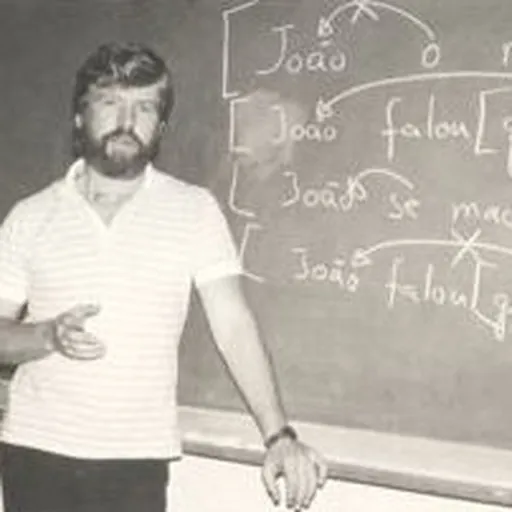
About Daniel Everett
Born 1951. Daniel Everett is an American linguist, university teacher, writer, missionary and anthropologist.
Daniel Leonard Everett (born July 26, 1951) is an American linguist and author best known for his study of the Amazon basin's Pirahã people and their language.
In 2025, Everett is Trustee Professor of Cognitive Sciences at Bentley University in Waltham, Massachusetts. From July 1, 2010, to June 30, 2018, Everett served as Dean of Arts and Sciences at Bentley. Prior to Bentley University, Everett was chair of the Department of Languages, Literatures and Cultures at Illinois State University in Normal, Illinois. He has taught at the University of Manchester and is former chair of the Linguistics Department of the University of Pittsburgh.
Early life Everett was raised near the Mexican border in Holtville, California. His father was an occasional cowboy, mechanic, and construction worker. His mother was a waitress at a local restaurant. Everett played in rock bands from the time he was 11 years old until converting to Christianity at age 17, after meeting missionaries Al and Sue Graham in San Diego, California.
At age 18, Everett married the daughter of these missionaries, Keren Graham. He completed a diploma in Foreign Missions from the Moody Bible Institute of Chicago in 1975. Daniel and Keren Everett subsequently enrolled in the Summer Institute of Linguistics (now SIL International), which trains missionaries in field linguistics so that they can translate the Bible into various world languages.
Because Everett, by his own account, quickly demonstrated a gift for language, he was invited to study Pirahã, which previous SIL missionaries had, according to Everett, failed to learn in 20 years of study. In 1977, after four months of jungle training and three semesters of courses in linguistic analysis, translation principles, and literacy development, the couple and their three children moved to Brazil, where they studied Portuguese for a year before moving to a Pirahã village at the mouth of the Maici River in the Lowland Amazonia region. Since 1999, Everett's stays in the jungle have included a generator-powered freezer, and a large video and DVD collection. Regarding the topic, Everett said that "After twenty years of living like a Pirahã, I'd had it with roughing it."
Education in linguistics Everett had some initial success learning the language, but when SIL lost their contract with the Brazilian government, he enrolled in the fall of 1978 at the University of Campinas in Brazil, under the auspices of which he could continue to study Pirahã. Everett focused on the theories of Noam Chomsky. His master's thesis, "Aspectos da Fonologia do Pirahã," was written under the direction of Aryon Rodrigues, one of the leading experts on Amazonian languages. It was completed in 1980. His PhD dissertation, "A Lingua Pirahã e Teoria da Sintaxe," completed in 1983, was written under the direction of . This dissertation provided a detailed Chomskyan analysis of Pirahã.
Wari': The Pacaas-Novos Language of Western Brazil This 540-page grammar of the Wari' language was a ten-year project that was undertaken by Everett and the New Tribes Missionary Barbara Kern, who has worked among the Wari' since 1962 and is perhaps the most fluent non-Wari' speaker of the language.
Universal grammar Everett eventually concluded that Chomsky's ideas about universal grammar, and the universality of recursion in particular (at least understood in terms of self-embedded structures), are falsified by Pirahã. His 2005 article in Current Anthropology, entitled "Cultural Constraints on Grammar and Cognition in Pirahã", has caused a controversy in the field of linguistics. Chomsky called Everett a "charlatan", and said that even if Pirahã had all the properties described by Everett, there would be no implications for universal grammar. "Everett hopes that readers will not understand the difference between UG in the technical sense (the theory of the genetic component of human language) and in the informal sense, which concerns properties common to all languages". The June 2009 issue of the Journal of the Linguistic Society of America, Language, contains a nearly 100-page debate between Everett and some of his principal critics.
Don't Sleep, There Are Snakes: Life and Language in the Amazonian Jungle In November 2008, Everett's book on the culture and language of the Pirahã people, and what it was like to live among them, was published in the United Kingdom by Profile Books and in the United States by Pantheon Books. Blackwell's booksellers in the UK selected this as one of the best books of 2009 in the UK. National Public Radio selected it as one of the best books of 2009 in the US. Translations have appeared in German, French, and Korean, and others are due to appear in 2010 in Thai, and Mandarin. It is mainly about doing scientific field research and the discoveries that this has led to about the grammar and culture of the Pirahã people.
Don't Sleep, There Are Snakes was runner-up for the 2008 award for adult non-fiction from the Society of Midland Authors.
Language: The Cultural Tool This book develops an alternative to the view that language is innate. It argues that language is, like the bow and arrow, a tool to solve a common human problem, the need to communicate efficiently and effectively.
Dark Matter of the Mind: The Culturally Articulated Unconscious In this book, published by the University of Chicago Press, Everett reviews a great deal of philosophy, anthropology, linguistics, and cognitive science to argue that humans are molded by culture and that the idea of human nature is not a very good fit with the facts. He reiterates and supports Aristotle's claim that the mind is a blank slate and makes the case that the notion of the human self most compatible with the facts is the Buddhist concept of anātman.
How Language Began: The Story of Humanity's Greatest Invention In this work, Everett makes the case that Homo erectus invented language nearly two million years ago and that the subsequent species Homo neanderthalensis and Homo sapiens were born into a linguistic world.
Personal life Influenced by the Pirahã's concept of truth, Everett's belief in Christianity slowly diminished and he became an atheist. He says that he was having serious doubts by 1982 and had abandoned all faith by 1985. He kept this atheism to himself until the late 1990s; when he finally opened up, his wife divorced him and two of his three children found it very hard to understand and accept; his wife also told their children to cut off all contacts with him. Later he married Linda Ann Everett and reconciled with his children.
He is the father of Caleb Everett.
Selected publications Everett is a prolific author and his CV lists nearly 130 published articles. He completed his masters thesis in 1979 and his doctoral thesis in 1983; both in Portuguese.
Books and monographs
Edited books, volumes, and journal issues
Theses and dissertations
Journal articles, scholarly responses, and working papers
Discussed In 2016 Tom Wolfe published a book, The Kingdom of Speech, in which he discusses work of four major figures in the history of the sciences of evolution and language, Charles Darwin, Noam Chomsky, Alfred Wallace, and Daniel Everett.
Don’t just read it —
keep it.
Full-length biographies made to live with: read them, listen on the way to work, watch them tonight.
- E-book
- Audio
- Video
Instant download · yours to keep · every purchase keeps this site free
Important facts
People in Daniel Everett's life
Named in this biography and alive at the same time




Related people
Same field, nearest in time




Contemporaries
People whose lives overlapped Daniel Everett's


Frequently asked questions
Who is Daniel Everett?
American linguist (born 1951)
When was Daniel Everett born?
Daniel Everett was born on 26 July 1951 in Holtville.
What is Daniel Everett's occupation?
Daniel Everett is a linguist, university teacher, writer, missionary and anthropologist.
What nationality is Daniel Everett?
Daniel Everett is American.
Sources & further reading
Cite this page
APA: Biography.guide. (2026). Daniel Everett. https://biography.guide/daniel-everett/
MLA: "Daniel Everett." Biography.guide, https://biography.guide/daniel-everett/.
Chicago: "Daniel Everett." Biography.guide. https://biography.guide/daniel-everett/.
Data last updated: 2026-09-21 · Spot an error? Report a correction.
Portrait: Wikimedia Commons · author & licence
Page generated 2026-09-27 04:58 UTC