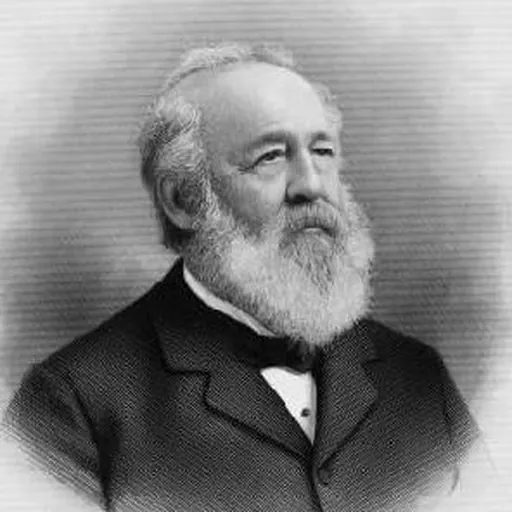
About Daniel B. Wesson
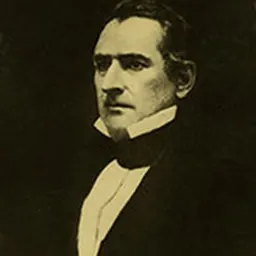
Lived 1825 – 1906 (aged 81). Daniel B. Wesson was an American inventor, entrepreneur and design engineer, known for Smith & Wesson.
Daniel Baird Wesson (May 18, 1825 – August 4, 1906) was an American inventor and firearms designer. He helped develop several influential firearm designs over the course of his life; he and Horace Smith were the co-founders of two companies named "Smith & Wesson", the first of which was eventually reorganized into the Winchester Repeating Arms Company and the latter of which became the modern Smith & Wesson.
Early years Daniel Baird Wesson was the son of Rufus and Betsey (Baird) Wesson. Daniel's father was a farmer and manufacturer of wooden plows and Daniel worked on his father's farm and attended public school until the age of eighteen, when he apprenticed himself to his brother Edwin Wesson (a leading manufacturer of target rifles and pistols in the 1840s) in Northborough, Massachusetts.
Wesson was married to Cynthia Maria Hawes, May 26, 1847, in Thompson, Connecticut. Hawes' father objected to the couple's engagement fearing that Wesson was a "mere gunsmith" with no future, forcing the couple to elope. Wesson's salary at Smith & Wesson amounted to over $160,000 a year by 1865.
The couple had one daughter and three sons: Sarah Jeannette Wesson (1848–1927); Walter Herbert Wesson (1850–1921); Frank Luther Wesson (1853–1887); and Joseph Hawes Wesson (1859–1920). Frank died in a train accident on the Central Vermont Railway.
In 1856, Smith & Wesson began to produce a small revolver designed to fire the rimfire cartridge they had patented in August 1854. This revolver was the first successful fully self-contained cartridge revolver available in the world. Smith & Wesson secured patents for the revolver to prevent other manufacturers from producing a cartridge revolver – giving the young company a very lucrative business.
At the age of 65, Smith retired from the company and sold his share of the business to Wesson, making him the sole owner of the firm. In the late 1800s, the company introduced its line of hammerless revolvers, a style that is still produced.
In 1899, Smith & Wesson introduced what is arguably the most famous revolver in the world, the .38 Military & Police (renamed the Model 10 in 1957). This revolver has been in continual production since that year and has been used by virtually every police agency and military force around the world.
Death and legacy Wesson remained active in the firm until his death. Wesson died at his home in Springfield, Massachusetts, on August 4, 1906—following a four-year illness, he succumbed to "...heart failure, superinduced by neuritis." The Wessons are buried in Oak Grove Cemetery in Springfield.
Wesson, a strong advocate of homeopathy, had funded a new building for the Hampden Homeopathic Hospital in Springfield through a donation of $100,000 in 1904. The hospital, later known as Wesson Memorial Hospital, switched from homeopathy to modern-day medicine in 1923, and became part of Baystate Medical Center through a merger in 1976.
Grandson Douglas B. Wesson worked in the family business and helped create the .357 Magnum in the 1930s. Great-grandson Daniel B. Wesson II followed the family tradition, working in the family business for 30 years and then founding his own company, which later became known as Dan Wesson Firearms.
Residences Wesson was involved in the construction of 13 houses. Wesson also helped fund construction of the French Congregational Church and South Congregational Church, both in Springfield, Massachusetts.
Springfield, Massachusetts
Wesson lived and worked in the city of Springfield, Massachusetts, building hospitals and a home there. Wesson’s primary home was located at 50 Maple Street in Springfield and was the city’s most extravagant mansion. Wesson hired New York architect Bruce Price to design his residence in the early 1890s. The design was published in The American Architect and Building News in 1893. The house was three and a half stories in height and constructed of pink granite with a red slate roof and bronze cresting and finials. Stylistically, it was adapted from the French chateaux of the Renaissance. Completed in 1898, which they were unable to do. In 1915, it became the clubhouse for the Colony Club of Springfield, remaining as such until fire destroyed the building on February 20, 1966.
Northborough, Massachusetts
Wesson had apprenticed in Northborough, Massachusetts, at his brother Edwin's gunsmith shop, and met his future wife there. Later, Wesson built a summer home in Northborough on land partially belonging to his wife's family, which was completed in 1886 a cost of approximately $300,000. It is an example of shingle style architecture. The house had 17 fireplaces and 32 rooms, along with elaborate carvings, stained glass windows, and gas-lit chandeliers.
After Wesson's death in 1906, the house stayed in the family for a few years then was sold in 1910, and subsequently went through multiple owners. It was again put up for sale in January 2014,
Due to lack of a buyer, it was scheduled to be demolished in 2016. The town approved funds to purchase the property at 167 Main Street for $1.75 million, plus additional funding for future development, with a total allocation of $2.4 million. , the building and its grounds remained unused.
The house is known locally, and was operated as a restaurant and function hall, under the name "White Cliffs". The origin of the name has been attributed to the White Cliffs of Dover area in England. Either due to Wesson having a painting of those chalk cliffs that he placed over the mantle that faced the house's main entrance, or due to an Irish waitress who worked at the restaurant in its early years singing "The White Cliffs of Dover" while doing her prep work.
Don’t just read it —
keep it.
Full-length biographies made to live with: read them, listen on the way to work, watch them tonight.
- E-book
- Audio
- Video
Instant download · yours to keep · every purchase keeps this site free
Important facts
People in Daniel B. Wesson's life
Named in this biography and alive at the same time




Related people
Same field, nearest in time


Contemporaries
People whose lives overlapped Daniel B. Wesson's





Frequently asked questions
Who was Daniel B. Wesson?
American gunsmith (1825–1906)
When was Daniel B. Wesson born?
Daniel B. Wesson was born on 18 May 1825 in Worcester.
When did Daniel B. Wesson die?
Daniel B. Wesson died on 4 August 1906 in Springfield.
What was Daniel B. Wesson's occupation?
Daniel B. Wesson was an inventor, entrepreneur and design engineer.
What was Daniel B. Wesson known for?
Daniel B. Wesson was known for Smith & Wesson.
What nationality was Daniel B. Wesson?
Daniel B. Wesson was American.
Sources & further reading
Cite this page
APA: Biography.guide. (2026). Daniel B. Wesson. https://biography.guide/daniel-b-wesson/
MLA: "Daniel B. Wesson." Biography.guide, https://biography.guide/daniel-b-wesson/.
Chicago: "Daniel B. Wesson." Biography.guide. https://biography.guide/daniel-b-wesson/.
Data last updated: 2026-09-23 · Spot an error? Report a correction.
Portrait: Wikimedia Commons · author & licence
Page generated 2026-09-27 05:06 UTC