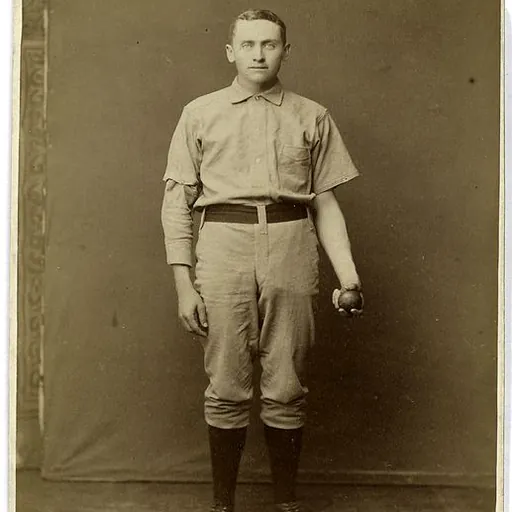
About Dan Casey
Lived 1862 – 1943 (aged 80). Dan Casey was an American baseball player.
Daniel Maurice Casey (November 20, 1862 – February 8, 1943) was an American professional baseball player whose career spanned from 1884 to 1894 and 1899. He played in Major League Baseball, principally as a pitcher, over parts of seven seasons for four major league clubs. He saw his most extensive playing time with the Philadelphia Quakers, appearing in 142 games for that team from 1886 to 1889. He also appeared in 46 games for the Syracuse Stars in 1890.
Casey led the National League with a 2.86 earned run average (ERA) and four shutouts in 1887 while playing for Philadelphia. Over the course of his seven seasons in the major leagues, he compiled a 96–90 win–loss record in 201 appearances, with a 3.18 ERA and 743 strikeouts.
In his later years, Casey claimed to be the Casey about whom Ernest L. Thayer wrote his famous poem, "Casey at the Bat." Casey was given a parade honoring him as the famed "Casey", was featured on a national radio broadcast, and participated in a "re-enactment" of "Casey at the Bat" when he was age 78. The poem's author denied that his work was based on any real player, and several sources have called Casey's claim into doubt. Casey had a career batting average of .162 and one home run.
Professional baseball career
Wilmington In 1884, Casey began his professional baseball career at age 21 with the Wilmington Quicksteps. He began playing for Wilmington while the team was part of the Eastern League and compiled a 10–2 win–loss record and 1.91 ERA in Eastern League play. Casey continued to play for the Quicksteps after the team joined the Union Association in August 1884, compiling a 1–1 record and 1.00 ERA in two games. Casey was the winning pitcher in one of the two victories in the club's brief major league history; a player known as The Only Nolan was the winning pitcher in the Quicksteps' other victory.
Indianapolis and Detroit In 1885, Casey played with two different teams. He began the season with the Indianapolis Hoosiers of the newly formed Western League and compiled a 10–2 win–loss record and a 0.50 ERA in 12 games. Casey claimed that the poem was based on an August 1887 game in which he played for Philadelphia. He asserted that he had hit a "lucky" home run against Boston a week earlier and that Philadelphia trailed, 4–3, when he came to bat and struck out. Casey claimed the area drew the name "Mudville" because the site was a vast mudhole before the ballpark was built.
Over the years, a number of sources accepted Casey's claim. As early as 1900, after Casey was "scalped" in a streetcar accident, a newspaper account noted that there was "no end" to the persons claiming to be "Casey", but cited Dan Casey as the one true "Casey" who had been immortalized by Thayer. In July 1915, a local Binghamton baseball club, the Bingos, sponsored a "Casey Day" that included a parade honoring Dan Casey as the famed "Casey." In March 1938, Casey appeared on Gabriel Heatter's radio program, broadcast on the Columbia network, to make his claim to being the famous "Casey." During the broadcast, Casey stated: I've been waiting 50 years to tell you folks that Mighty Casey was just old Dan Casey, a pretty good ball player, but no home run king. But I guess if I hadn't struck out that day I never would have become famous.
After Casey's radio broadcast, The Sporting News published a lengthy profile, complete with a photograph of the 75-year-old Casey with a bat on his shoulder, touting him as the "Inspiration of Thayer's Poem." In approximately 1940, a supposed re-enactment of "Casey at the Bat" was played out prior to a Baltimore Orioles game; Rogers Hornsby threw two called strikes to the 78-year-old Dan Casey, and Casey then swung and missed on the third pitch, just as Thayer had written in the poem. though Thayer himself reportedly denied that the poem was based on any real player. Another writer examining the claim concluded that the game cited by Casey as the inspiration for Thayer did not end in a 4–3 defeat of Philadelphia. Rather, Casey got a hit in the ninth inning, driving in two runs, and the game was called due to darkness in a 5–5 tie.
Family and later years Casey was married in December 1889 to Minnie E. Cahill (sometimes later listed as Mary E. Casey) at a ceremony at St. Patrick's Church in Binghamton, New York. Casey and his wife had a daughter, Mable, in 1891.
After retiring from baseball, Casey lived in Binghamton, where he worked from at least 1895 to 1920 as a trolley car operator for the Binghamton Railway Company. By 1930, Casey remained living in Binghamton with his wife, though he was not employed.
After 1935, Casey and his wife later moved to Silver Spring, Maryland, a suburb of Washington, D.C. Casey died in 1943 at age 80 in a hospital in Washington, D.C.
Don’t just read it —
keep it.
Full-length biographies made to live with: read them, listen on the way to work, watch them tonight.
- E-book
- Audio
- Video
Instant download · yours to keep · every purchase keeps this site free
Important facts
People in Dan Casey's life
Named in this biography and alive at the same time




Related people
Same field, nearest in time



Contemporaries
People whose lives overlapped Dan Casey's



Frequently asked questions
Who was Dan Casey?
American baseball player (1862–1943)
When was Dan Casey born?
Dan Casey was born on 20 November 1862 in Binghamton.
When did Dan Casey die?
Dan Casey died on 8 February 1943 in Washington, D.C..
What was Dan Casey's occupation?
Dan Casey was a baseball player.
What nationality was Dan Casey?
Dan Casey was American.
Sources & further reading
· DBpedia: Dan Casey (baseball)
Cite this page
APA: Biography.guide. (2026). Dan Casey. https://biography.guide/dan-casey/
MLA: "Dan Casey." Biography.guide, https://biography.guide/dan-casey/.
Chicago: "Dan Casey." Biography.guide. https://biography.guide/dan-casey/.
Data last updated: 2026-09-21 · Spot an error? Report a correction.
Portrait: Wikimedia Commons · author & licence
Page generated 2026-09-27 05:00 UTC