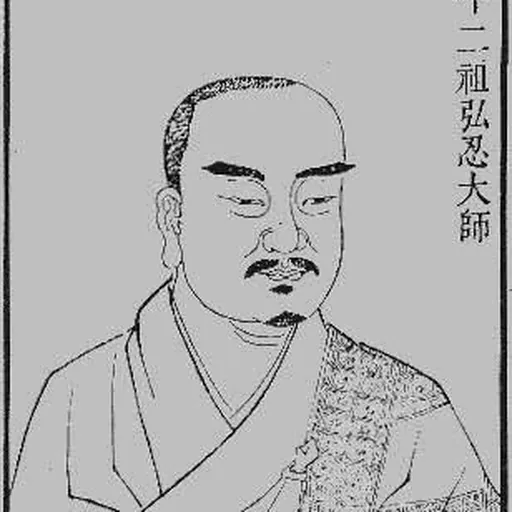
About Daman Hongren
Lived 601 – 674 (aged 72–73). Daman Hongren was a Chinese buddhist monk.
Hongren (, 601–674), posthumous name Daman, was the 5th Patriarch of Chan Buddhism (Chinese: 禪宗五祖).
Hongren is said to have received Dharma transmission from Dayi Daoxin and passed on the symbolic bowl and robe of transmission to Huineng, the Sixth and last Chan Patriarch.
Biography As with all the early Chan patriarchs, many of the details of Hongren’s life are uncertain and much of his biography is layered with legend added well after his death. The following biography is based on Chan traditional sources.
Childhood Hongren was born in Huangmei with the family name Chou. His father abandoned the family but Hongren displayed exemplary filial duty in supporting his mother.
Although the Records of the Teachers and Disciples of the Lankavatara claim that Hongren’s father abandoned the family, Chan scholar John McRae points out that Hongren’s residence was converted to a monastery, implying that Hongren’s family was probably wealthy and prominent locally. Furthermore, mention of Hongren doing menial labour would only be of significance if this were unusual, indicating that Hongren was of upper-class birth.
Chán-studies under Daoxin At the age of either seven or twelve, Hongren left home to become a monk and began his studies under Daoxin, who, according to tradition, immediately recognized his insight: Daoxin met Hongren on a road in Huangmei. Daoxin asked his name. Hongren replied, “I have essence but it is not a common name.” The Chan master asked, “What name is it?” Hongren said, “It is the essence of Buddhahood.” Daoxin replied, “Have you no name?” Hongren said, “None, because essence is empty.” With this, Daoxin passed on the teaching and the robe (making Hongren the next Patriarch of Chan).
The Ch’üan fa pao chi (Annals of the Transmission of the Dharma-treasure), written approximately 712, says that Hongren was quiet and withdrawn, diligent in his menial labors, and sat in meditation throughout the night. He “never looked at the Buddhist scriptures” but understood everything he heard. After some ten years of teaching, the record claims that “eight or nine of every ten ordained and lay aspirants in the country had studied under him.” According to the Treatise on the Essentials of Cultivating the Mind, Hongren's basic teaching was that the Pure Mind was obscured by “discriminating thinking, false thoughts, and ascriptive views.” Eliminating false thoughts and maintaining a constant awareness of one’s natural enlightenment ensures Nirvana naturally arises.
Two meditation techniques are specifically mentioned in the Treatise. Hongren is said to have instructed, "Look to where the horizon disappears beyond the sky and behold the figure one. … It is good for those beginning to sit in meditation, when they find their mind distracted, to focus their mind on the figure one." The Chinese character for "one" is a single horizontal line, resembling a horizon, and metaphorically represents the unity of the mind and Buddha nature.
He also taught that the meditator should observe the mental processes within: "View your own consciousness tranquilly and attentively, so that you can see how it is always moving, like flowing water or a glittering mirage. …until its fluctuations dissolve into peaceful stability. This flowing consciousness will disappear like a gust of wind. When this consciousness disappears, all one’s illusions will disappear along with it."
Influence Hongren was held in high esteem by later Chan-adepts in the ancient capital cities of Chang'an and Luoyang in the early eighth century, when Chan moved from a rural base to the centre of Chinese power, in the major urban areas and the imperial court.
Don’t just read it —
keep it.
Full-length biographies made to live with: read them, listen on the way to work, watch them tonight.
- E-book
- Audio
- Video
Instant download · yours to keep · every purchase keeps this site free
Important facts
People in Daman Hongren's life
Named in this biography and alive at the same time
Related people
Same field, nearest in time


Contemporaries
People whose lives overlapped Daman Hongren's




Frequently asked questions
Who was Daman Hongren?
Chinese Buddhist patriarch
When was Daman Hongren born?
Daman Hongren was born in 601 in Henan.
When did Daman Hongren die?
Daman Hongren died in 674.
What was Daman Hongren's occupation?
Daman Hongren was a buddhist monk.
What nationality was Daman Hongren?
Daman Hongren was Chinese.
Sources & further reading
Cite this page
APA: Biography.guide. (2026). Daman Hongren. https://biography.guide/daman-hongren/
MLA: "Daman Hongren." Biography.guide, https://biography.guide/daman-hongren/.
Chicago: "Daman Hongren." Biography.guide. https://biography.guide/daman-hongren/.
Data last updated: 2026-09-21 · Spot an error? Report a correction.
Portrait: Wikimedia Commons · author & licence
Page generated 2026-09-27 04:59 UTC