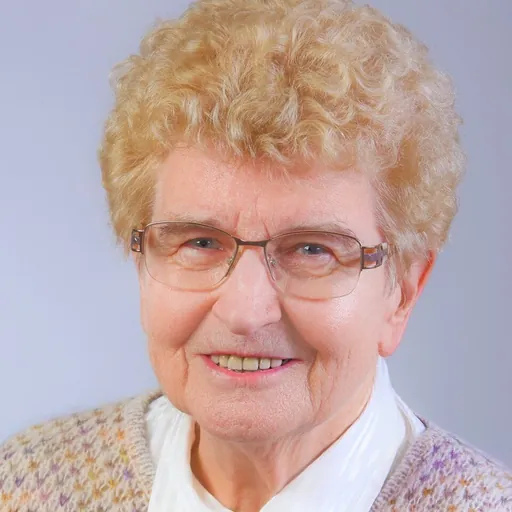
Dagmar Hülsenberg
German materials scientist
About Dagmar Hülsenberg
Born 1940. Dagmar Hülsenberg is a German materials scientist, university teacher, technician, materials science and professor.
Dagmar Hülsenberg ( Hinz; born 2 December 1940, in Sonneberg) is a German materials scientist and university professor.
In 1975, at age 34, she became the youngest full professor in the German Democratic Republic. By that time she had already distinguished herself by obtaining doctorates in two barely related disciplines: Economics/Cost accounting (1969) and Engineering/Materials science (1970).
Life Dagmar Hinz was born soon after the start of the Second World War in Sonneberg, a small town in the centre of southern Germany, located between Würzburg and Leipzig. Before she was 3 her father had been killed in the fighting. Her mother worked as a milliner. Just a year later, in 1970, she received a second doctorate, this time in Material Sciences: her dissertation on this occasion was entitled "High-temperature deformation of heterogeneous materials, illustrated using fire-resistant chamotte (fire clay)"
In 1970, she moved to the (Ministry of light industry) and later to the (Ministry for the glass and ceramics industries) where she was involved in preparing the national plan for science and technology . Looking back, she recalled that she had not much enjoyed work at the ministries: five years had been enough.
In 1975 she switched again, back to the academic world, accepting the newly created professorship of "Glass and Ceramics Materials and Technology" at the Ilmenau Technical Academy, back in Thuringia. At the time she was the youngest professor in the country, and her tenure would comfortably outlast the German Democratic Republic itself, ending only in 2007.
From 1984 until 1990 Dagmar Hülsenberg served as a member of the National Research Council. Between 1976 and 1987 she chaired the Silicates Technology Expert Committee of the FDGB Chamber of Technology, and from 1987 until 1992 she served as (the last) president of the Chamber of Technology, in succession to Manfred Schubert who had died young. She became a corresponding member of the national German Academy of Sciences in 1989. and has been a member of the Saxony Academy of Sciences, based in Leipzig since 1986: she became a member of the presidium in 2004. She is a member of the German Ceramics Society, the German Glass Technology Society and of the German Academy of Science and Engineering.
Don’t just read it —
keep it.
Full-length biographies made to live with: read them, listen on the way to work, watch them tonight.
- E-book
- Audio
- Video
Instant download · yours to keep · every purchase keeps this site free
Important facts
People in Dagmar Hülsenberg's life
Named in this biography and alive at the same time

Related people
Same field, nearest in time

Contemporaries
People whose lives overlapped Dagmar Hülsenberg's


Frequently asked questions
Who is Dagmar Hülsenberg?
German materials scientist
When was Dagmar Hülsenberg born?
Dagmar Hülsenberg was born on 2 December 1940 in Sonneberg.
What is Dagmar Hülsenberg's occupation?
Dagmar Hülsenberg is a materials scientist, university teacher, technician, materials science and professor.
What nationality is Dagmar Hülsenberg?
Dagmar Hülsenberg is German.
Sources & further reading
· Wikipedia: Dagmar Hülsenberg
Cite this page
APA: Biography.guide. (2026). Dagmar Hülsenberg. https://biography.guide/dagmar-hulsenberg/
MLA: "Dagmar Hülsenberg." Biography.guide, https://biography.guide/dagmar-hulsenberg/.
Chicago: "Dagmar Hülsenberg." Biography.guide. https://biography.guide/dagmar-hulsenberg/.
Data last updated: 2026-09-23 · Spot an error? Report a correction.
Portrait: Wikimedia Commons · author & licence
Page generated 2026-09-27 05:08 UTC