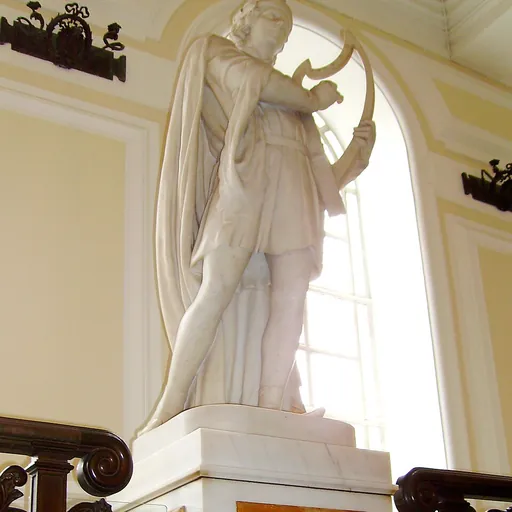
About Dafydd ap Gwilym
Lived 1320 – 1380 (aged 59–60). Dafydd ap Gwilym was a Welsh poet, writer and bard.
Dafydd ap Gwilym ( 1315/1320 – 1350/1370) is regarded as one of the leading Welsh poets and among the great poets of Europe in the Middle Ages. Dafydd's poetry also offers a window into the cultural practices of the period and preservation of culture in the face of occupation.
Life R. Geraint Gruffydd suggests 1315- 1350 as the poet's dates; others place him a little later from 1320–40 1370–80.
Later tradition has it that Dafydd was born at Brogynin, Penrhyn-coch (at the time Llanbadarn Fawr parish), Ceredigion. Although he doesn't mention this village in his poems, in his poem (Love's Journey) he mentions a number of places which are close by, showing that he was familiar with the region.
His father, Gwilym Gam, and mother, Ardudfyl, were both from noble families. As one of noble birth it seems Dafydd did not belong to the guild of professional poets in medieval Wales, and yet the poetic tradition had been strong in his family for generations.
According to R. Geraint Gruffydd, he died in 1350, a possible victim of the Black Death. Tradition says that he was buried within the precinct of the Cistercian Strata Florida Abbey, Ceredigion. This burial location is disputed by supporters of the Talley Abbey theory who contend that burial took place in the Talley Abbey Churchyard: On Saturday 15 September 1984 a memorial stone was unveiled by a Prifardd to mark the site in the churchyard at Talley where a deeply-rooted tradition asserts that the poet Dafydd ap Gwilym lies buried. For many centuries the rival claims of Talley and Ystrad Fflur have been debated as the burialplace of Wales’ foremost poet. While it may be difficult to trace the exact years Dafydd was active, it is clear he wrote after the Edwardian conquests of Wales. Despite living under English authority, Dafydd's poetry presents ways in which Welsh culture continued to distinguish itself and prevail. Some of Dafydd's poetry outright reflects rejection of the standards of English authority, like in one poem where he draws attention to the state of housing after English subjugation of Wales.
The first recorded observation that Dafydd ap Gwilym was buried in Talley was made in the sixteenth century. Elements of courtly love have been noted in Welsh literature well before the Dafydd's active days, suggesting that courtly love grew as a culturally connected phenomenon across European literature.
Dafydd's poetry reflected the individuality of his own personal as well as Welsh cultural expression through his unique expression of common literary practices, as well as his individual voice in his poetry. One aspect that differed from conventional poetry in Dafydd's works was the use of himself as the subject. Traditional contemporary poetry traditionally kept the poet far removed from the scene. Dafydd's work, in contrast, is full of his own feelings and experiences, and he is a key figure in this transition from a primarily social poetic tradition into one in which the poet's own vision and art is given precedence. Dafydd's poetry was also unique in its expressions of religion and nature. In “Praise of Summer,” Dafydd praises both the divine and the changing of summer as connected and benevolent. Reference to the divine in prior and contemporary literature usually depicted strong themes of judgement and virtue. With Dafydd's poetry, we see these forces as a gift worth celebrating.
Dafydd's poetry also differs from the conventions of other love poetry in its use of sexual metaphor. Some of Dafydd's poems, such as “A Poem in Praise of the Penis”, display explicit connection to sexual desire. Yet, Dafydd was also well adept at keeping his metaphors subtle. In “The Lady Goldsmith,” Dafydd praises his devotion to a woman who creates attire out of her hair and nature's bristle. In the poem, the woman crafts a belt for Dafydd. In this poem, the metaphor of sexual desire is drawn from the proximity of the woman's hair to Dafydd's waist. The belt itself stands as the sexual connection between this woman and Dafydd. In contrast, traditional courtly love literature tended to shy away from praising sexual desire in favour of patience and virtuous romance.
He was an innovative poet who was responsible for popularising the metre known as the and first to use it for praise. Dafydd also has been credited for popularising the exacting rules of alliteration and rhyme known as . The continued use of and by Welsh poets after Dafydd's active years is a testament to the effect Dafydd had on shaping Welsh literary culture. Dafydd's poetry provided a framework for which Welsh literary culture could grow its own unique traditions.
Love poetry Although Dafydd wrote comparatively conventional praise poetry, he also wrote love poetry and poetry expressing a personal wonderment at nature; Dafydd's poetry on the latter subject in particular is largely without precedent in Welsh or European literature in terms of its depth and complexity. His popularity during his own historic period is testified by the fact that so many of his poems were selected for preservation in texts, despite a relatively short career compared to some of his contemporaries.
Many of Dafydd's poems are addressed to women or humorously describe his unsuccessful attempts to seduce them. His best-known works include the following poems:
(The Girls of Llanbadarn), in which he speaks of going to church on Sunday in order to ogle the local girls; (May), a celebration of the coming of summer, love's season; (Trouble at a Tavern), in which he comically recounts the difficulties he faces trying to meet his lover in a tavern; (The Seagull), a poem in which Dafydd asks a seagull to carry a message to his love; (The Rattle Bag), in which Dafydd's intercourse with a young girl is cruelly interrupted; (A Poem in Praise of the Penis), in which complains that his penis has often got him into trouble, while at the same time boasting about it. Until recently it was not included in editions of Dafydd's works.
Morfudd
The woman most often mentioned in Dafydd's poems is Morfudd . She was apparently the wife of an Aberystwyth merchant and she seems to have had a long affair with Dafydd. She features in at least 28 poems including the following:
(Morfudd Like the Sun). Dafydd describes Morfudd's beauty and her complexion, comparing it to snow or foam. He admits: "Her deceit and trickery is enormous, worse than anything, and (yet) she is my darling." He compares her to the sun, which shines brightly during the day, but disappears at night, when Morfudd goes to join her husband. (The Wave on the River Dyfi) Travelling back from North Wales, Dafydd is frustrated to find the River Dyfi (or Dovey) in full spate, preventing him from seeing Morfudd. (Morfudd's Mockery): Dafydd addresses Morfudd's declaration that she does not want a lover with a monk's tonsure. He denies that he has ever been a monk, flatters her, and reminds her how they had once made love in her bed. (The Wind): Dafydd describes the wind and begs it to go to Morfudd to tell her how wretched he is without her.
Dyddgu Another girl repeatedly mentioned in his poems is the aristocratic Dyddgu , who appears in seven poems: The poem starts by praising a nobleman, Ieuan ap Gruffudd, who was recently Dafydd's host; then Dafydd reveals that he has fallen in love with Ieuan's daughter. He retells the tale of the knight Peredur, who was reminded of his dark-haired beloved when he saw a dead blackbird. (To Dyddgu): Dafydd speaks of the hopelessness of his love for Dyddgu, using various images such as an archer shooting arrows at a difficult target to illustrate that it is just possible that he might one day win her. (Dyddgu's invitation) Dafydd invites Dyddgu to a tryst in the countryside, describing the heavenly beauty of the birch grove where they will meet. (Love's tears). Dafydd praises Dyddgu's beauty and tells how much he is suffering for her love. (The Pedigree of Longing): A dialogue poem where personified Hiraeth (Longing) arrives as a messenger sent by Dyddgu to torment the sleepless poet. (Dyddgu and Morfudd): Dafydd compares Dyddgu's dark, aristocratic refinement with Morfudd's golden brilliance. (The Tune). Dafydd sings a new tune to the harp. Alas that Dyddgu, if she is still living, cannot hear it!
Praise poems Ifor Hael
Another theme of several of Dafydd's poems is his praise for his patron Ifor ap Llywelyn (Ifor Hael), a nobleman of Bassaleg near Newport in Gwent. Although Dafydd does not explicity call Ifor "" ("generous"), it seems that because of his comparison of Ifor to Rhydderch Hael in two poems, Ifor became known as Ifor Hael to poets of the 15th century and later. (Ode to Ifor Hael): This poem is a tribute to Ifor’s status as a Chieftain. The poem is written partly in stanzas and partly in highly elaborate stanzas of the metre, with the same rhyme "-or" continuing throughout the poem. The name Ifor comes at the end of all twelve stanzas. (Verses Addressed to Ifor Hael): A collection of four-line stanzas that list ten of his patron's noble qualities, one in each stanza. (Thanking for a Pair of Gloves): Dafydd warmly thanks Ifor for gifting him a pair of gloves. Dafydd sends a messenger from Glamorgan (to Anglesey with a message that he cannot leave Bassaleg in South Wales because of his love for Ifor. He describes his patron's character and the activities they enjoy together. (Taking Leave of Ifor Hael): Dafydd excuses himself to Ifor saying that he is about to depart to Gwynedd. He praises Ifor, comparing him to the famously generous ancient king Rhydderch Hael. (Elegy for Ifor and Nest): An elegy mourning the death of Ifor and his wife, Nest. (Scholars believe, however, that this is a pseudo-elegy, since Ifor outlived Dafydd.)
In the poem Dafydd describes some of the activities he enjoyed in Ifor's company. They include hunting with hounds, shooting stags (with arrows), hunting with hawks, drinking wine, singing poems, and playing backgammon and chess.
Religious poems Despite the irreverent attitude to church-going and religious preaching which Dafydd displays in poems such as The Girls of Llanbadarn and The Poet and the Grey Friar, Dafydd also wrote at least three devotional Christian poems. These include the following: (Stanzas on the Mass): It consists of a Latin prayer, the , split into separate lines. After each line there follows a stanza in Welsh in the metre meditating on the prayer. (Pictures of Christ and His Apostles): This poem in metre is a meditation on a new painting of Christ and his disciples. It appears that the painting depicted Christ flanked by his apostles, six on either side.
The following, however, have been suspected by some scholars not to be by Dafydd: (The Trinity): A short poem of 6 couplets in the metre praising God the Father, Saint Anne, Saint Mary, and Jesus. Although all the manuscripts attribute it to Dafydd, some scholars doubt its authenticity because of its very simple style. (Ode to Jesus Christ): A poem describing Christ's life, the betrayal by Judas, the crucifixion, and the grief of the Virgin Mary. But the authenticity of this ode has been suspected on stylistic and other grounds. The poem is unusual in being written mostly in the metre.
Metre of the poems Six different metres are used in Dafydd's poems, as follows:
The great majority of Dafydd's extant poems are written in the ("long couplet ") metre, often just called , which he may have invented or at any rate greatly popularised. This consists of rhyming couplets of seven-syllable lines ornamented with particular patterns of internal rhyme and consonance known as . In any couplet, one line must have a stressed rhyme and the other an unstressed one, in either order, for example or .
The next most frequently used metre in Dafydd's poems is the , a four-line stanza of 10, 6, 7 and 7 syllables (the first two lines being a , and the last two lines being a couplet). Stanzas in this metre are found in (To the Rood of Carmarthen), , and , as well as those listed below under and one of the poems in . The ("A Poet's Verses to his Hair"), if (as argued by Ann Parry Owen) it is by Dafydd ap Gwilym, is also in this metre.
The poem (Elegy of Llywelyn ap Gwilym, Dafydd's uncle, who was murdered), among its 35 stanzas, contains three in a different metre. This is a stanza of 7, 7, 7 and 7 syllables, which is rhymed by assonance instead of rhyme .
Five poems are made using the metre. (Another poem, , also uses but for various reasons is thought not be authentic).
Two poems use , the metre is used alone; in the other, (Praise of Hywel, Dean of Bangor) three stanzas of begin the poem, before the metre changes to .
One poem, The Poet and the Grey Friar, is written in . This metre is very similar to the in having rhyming couplets of 7-syllable lines, except that it has almost no ornamentation, and the rules for rhyme are less strict. It is thought to have been a popular precursor to the which developed into it by adding strict rules of rhyme and ornamentation. Three other poems of the same kind are known, but some scholars consider them inauthentic. This view has a favourable outlook if you take Wales in the time of Dafydd. The Welsh had become predominantly subservient to the English after the Edwardian conquests. Bartlett might argue that the cultural developments that came in the period of peace after the conquests is evidence for this principle of assimilation.
Some contend still that cultures developed as a product of their internal audiences. In the case of Dafydd, Helen Fulton argues that his poetry reflected the values admired by Welsh audiences and reflected values of the culture's uniqueness. In this context, Welsh culture is formed outside of outside influences of other cultures.
Others place their arguments somewhere on a spectrum of these two extremes. Andrew Breeze has noted that from even the earliest evidence of Welsh literature, there are many similarities between works of cultures from close and far proximity to the Welsh. While some of these similarities are directly attributed to warfare, there is also an apparent spread of cultural traditions peacefully. The argument is taken further by Carol Lloyd Wood, who demonstrates how intermarriage and architectural similarity among various regions also support an idea of passive cultural diffusion. Although, when looking at architecture from after the Edwardian conquests, the narratives of the polarised views tend to be amplified. Architecture tended to reflect the cultures of either the Welsh or English based on the level of authority of either group in the region.
Dafydd's poetry reflects the multiple avenues in which cultural exchange manifested in medieval Europe. Dafydd had clear influences by traditions of foreign origin that became used often in his poetry. Some of Dafydd's poetry also reflects the assimilation and domination present by the Edwardian conquests. Yet, Dafydd also displays poetic structure that would become part of the Welsh literary identity. Scratching the surface of Dafydd's poetry reveals that culture was defined and controlled by many aspects, and not just one major force.
When looking at a successor of Dafydd, Guto'r Glyn, one is able see to how these forces that control culture interact in a different context. Like Dafydd, Glyn used cywydd meter and referenced himself in his poetry; however, in Glyn's “Moliant i Syr Rhisiart Gethin ap Rhys Gethin o Fuellt, capten Mantes yn Ffrainc,” one can see other influences in Welsh literary culture. The poem praises an English lord in the same manner of classic heroes such as Arthur. God is also mentioned as an omnipotent protector. Glyn's poem demonstrates a much more traditional approach of gallantry and chivalry popular in continental European literature. Glyn also demonstrates the principle of assimilation in the sense that the English are viewed as equals or interchangeable with the Welsh. Despite taking influence from a previous Welsh figure in Dafydd, Glyn also demonstrates the effect outside influences had in shaping Welsh literary culture.
It is fair to say Dafydd was important in establishing certain customs that would become popular among Welsh literary culture. Although literary culture was very prevalent in the identities of medieval cultures, it often gets overlooked in larger debates about the spread of culture. By looking at Dafydd ap Gwilym, literary culture appears as just as an important part of Welsh cultural identity as resistance to occupation was.
Ancestry
Beethoven's Welsh Songs The lyrics to the Lied 'Der Traum' in Ludwig van Beethoven's 1810 collection 26 Welsh Songs are a German translation and adaption of a dream-vision poem supposedly by Dafydd, though not to be found among his works or in his apocrypha.
Don’t just read it —
keep it.
Full-length biographies made to live with: read them, listen on the way to work, watch them tonight.
- E-book
- Audio
- Video
Instant download · yours to keep · every purchase keeps this site free
Important facts
People in Dafydd ap Gwilym's life
Named in this biography and alive at the same time

Related people
Same field, nearest in time



Contemporaries
People whose lives overlapped Dafydd ap Gwilym's
Frequently asked questions
Who was Dafydd ap Gwilym?
14th-century Welsh poet
When was Dafydd ap Gwilym born?
Dafydd ap Gwilym was born in 1320 in Ceredigion, Brogynin Fawr.
When did Dafydd ap Gwilym die?
Dafydd ap Gwilym died in 1380.
What was Dafydd ap Gwilym's occupation?
Dafydd ap Gwilym was a poet, writer and bard.
What nationality was Dafydd ap Gwilym?
Dafydd ap Gwilym was Welsh.
Sources & further reading
Cite this page
APA: Biography.guide. (2026). Dafydd ap Gwilym. https://biography.guide/dafydd-ap-gwilym/
MLA: "Dafydd ap Gwilym." Biography.guide, https://biography.guide/dafydd-ap-gwilym/.
Chicago: "Dafydd ap Gwilym." Biography.guide. https://biography.guide/dafydd-ap-gwilym/.
Data last updated: 2026-09-22 · Spot an error? Report a correction.
Portrait: Wikimedia Commons · author & licence
Page generated 2026-09-27 05:04 UTC