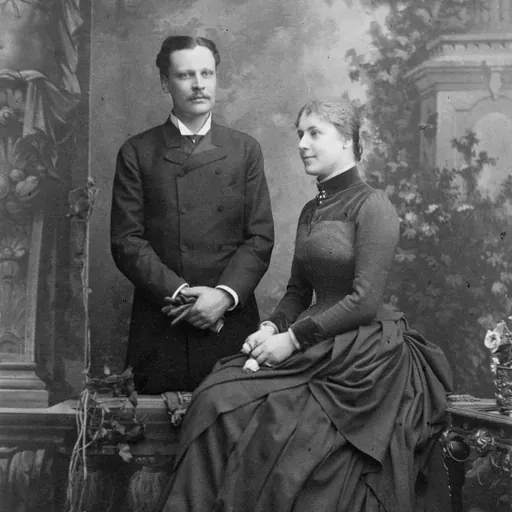
About Count Manfred von Clary-Aldringen
Lived 1852 – 1928 (aged 75). Count Manfred von Clary-Aldringen was an Austrian politician.
Count Manfred von Clary-Aldringen (30 May 1852 Palais Mollard-Clary, Vienna12 February 1928 Castle Herrnau, Salzburg) was an Austro-Hungarian nobleman and statesman. He served as the 16th Minister-President of Cisleithania (therefore the 28th Minister-President of Austria overall).
Biography
Family He was born into a prominent Austro-Hungarian princely family of Bohemian origin (the Clary-Aldringens), the son of Fürst (prince) Edmund Moritz and Fürstin (princess) Elisabeth-Alexandrine von Clary-und-Aldringen (born countess de Ficquelmont). He was the younger brother of Fürst Siegfried (1848–1929), a prominent Austro-Hungarian diplomat, and the grandson of Count Charles-Louis de Ficquelmont (1777–1857), 2nd Minister-President of the Austrian Empire.
In 1884, in Vienna, he married Gräfin (countess) Franziska Pejácsevich von Veröcze. She was the heiress of one of the most powerful families of the Croatian nobility, descending from the princes Esterházy von Galántha. The couple had two children.
Political career Count Clary-und-Aldringen studied law at the University of Vienna before starting his political career. The Austro-Hungarian Empire was dominated by a small circle of high nobility families that had great power and enormous riches and thus played a major role in politics and diplomacy. Count Manfred is an example of such an influence.
On 22 February 1896, he became Governor of the Länd of Austrian Silesia, a key office in a strategic region for the Empire: not only was the Länd rich in natural resource, it also lay at the border with both the German and Russian Empires. Austrian Silesia was involved in the long power struggle between these three empires and a subject of central European irredentisms.
In 1898, Count Manfred became Governor of the Länd of Styria and its representative in the Reischrat ("Imperial Council"). This was office of major importance, which he held until the fall of the Empire in 1918. Styria was one of the powerhouses of the Austro-Hungarian economy: the Länd was a centre of industry and agriculture, and its capital Graz was one of the Empire's most populous cities.
From 2 October to 21 December 1899, Count Clary-und-Aldringen served as Minister-President of Austria, following in the steps of his grandfather, Count Charles-Louis de Ficquelmont.
Later life
After the fall of the Austro-Hungarian Empire following the defeat of the Central Powers during the autumn of 1918, Count Manfred resigned from all his official offices and spent his remaining years on his estates in Austria and Czechia (Teplice).
On 12 February 1928, Count Manfred von Clary-und-Aldringen died in his Salzburg residence of Schoss Herrnau (Herrnau Castle).
Count Clary und Aldringen is widely seen as a modernizer and has been regarded as both one of the most prominent statesmen of the end of the Austro-Hungarian Empire and a symbol of the influence of the Austro-Hungarian high nobility in politics at the turn of the 19th century.
He is also well known for having successfully fought tuberculosis when he was president of the Austrian Red Cross in Cisleithania.
Honours Knight of the Order of Franz Joseph, 1890 Knight of the Iron Crown, 1st Class, 1905 Grand Cross of the Imperial Order of Leopold, 1915 War Cross for Civil Merits, 1st Class Merit Star of the Decoration for Services to the Red Cross, with War Decoration Jubilee Cross for Civil State Officials Bronze Jubilee Medal for the Armed Forces Jubilee Medal for Civil State Officials Knight of the Order of Charles III
Don’t just read it —
keep it.
Full-length biographies made to live with: read them, listen on the way to work, watch them tonight.
- E-book
- Audio
- Video
Instant download · yours to keep · every purchase keeps this site free
Important facts
Family & relationships
People in Count Manfred von Clary-Aldringen's life
Named in this biography and alive at the same time

Related people
Same field, nearest in time




Contemporaries
People whose lives overlapped Count Manfred von Clary-Aldringen's

Frequently asked questions
Who was Count Manfred von Clary-Aldringen?
Austrian politician (1852-1928)
When was Count Manfred von Clary-Aldringen born?
Count Manfred von Clary-Aldringen was born on 30 May 1852 in Vienna.
When did Count Manfred von Clary-Aldringen die?
Count Manfred von Clary-Aldringen died on 12 February 1928 in Schloss Herrnau.
What was Count Manfred von Clary-Aldringen's occupation?
Count Manfred von Clary-Aldringen was a politician.
What nationality was Count Manfred von Clary-Aldringen?
Count Manfred von Clary-Aldringen was Austrian.
Sources & further reading
· Wikipedia: Count Manfred von Clary-Aldringen
· DBpedia: Count Manfred von Clary-Aldringen
Cite this page
APA: Biography.guide. (2026). Count Manfred von Clary-Aldringen. https://biography.guide/count-manfred-von-clary-aldringen/
MLA: "Count Manfred von Clary-Aldringen." Biography.guide, https://biography.guide/count-manfred-von-clary-aldringen/.
Chicago: "Count Manfred von Clary-Aldringen." Biography.guide. https://biography.guide/count-manfred-von-clary-aldringen/.
Data last updated: 2026-09-22 · Spot an error? Report a correction.
Portrait: Wikimedia Commons · author & licence
Page generated 2026-09-27 05:02 UTC