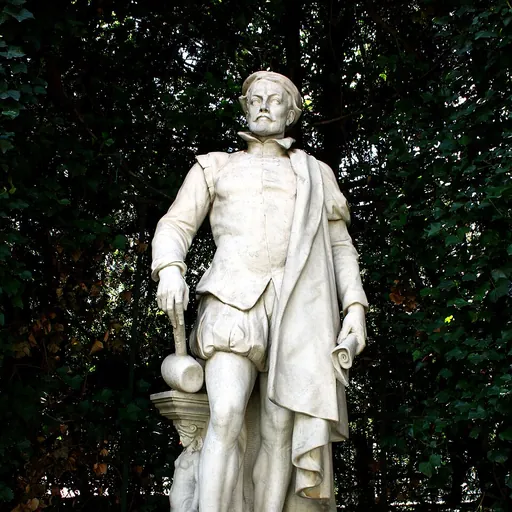
About Cornelis Floris II
Lived 1514 – 1575 (aged 60–61). Cornelis Floris II was an architect, sculptor, medalist, designer and visual artist.
Cornelis Floris or Cornelis (II) Floris De Vriendt (c. 1514 – 20 October 1575) was a Flemish sculptor, architect, draughtsman, medallist and designer of prints and luxury. He operated a large workshop in Antwerp from which he worked on many large construction projects in Flanders, Germany and Denmark. He was one of the designers of the Antwerp City Hall. He developed a new style, which was informed by Flemish traditions, the 16th century Italian Renaissance and possibly the School of Fontainebleau. His innovations spread throughout Northern Europe where they had a major influence on the development of sculpture and architecture in the 16th and early 17th centuries.
Life Cornelis Floris II was born around the year 1514 as the eldest of the four sons of Cornelis the Elder and Margarita Goos. The earliest known ancestors of the Floris de Vriendt family, then still called only 'de Vriendt', were residents of Brussels where they practiced the craft of stonemason and stonecutter which was passed on from father to son. One of Cornelis' ancestors became in 1406 a master of the Brussels stonemasons guild. A family member, Jan Florisz. (abbreviation of Floriszoon, meaning son of Floris) de Vriendt, left his native Brussels and settled in Antwerp in the mid 15th century. The patronymic name 'Floris' became the common family name of the subsequent generations. The original form 'de Vriendt' can, however, still be found in official documents until the late 16th century. He served as the dean of the Guild in 1547 and 1559.
A hypothesis put forward in 2021 and explained in 2024 stating that the famous Roman drawings in the two Berlin scrapbooks were not executed by the Dutch painter Maarten van Heemskerck and the Anonimi A and B, but with a few exceptions entirely by Floris and dated between 1535/36 and 1538, was not taken up by archaeological and art-historical research and was refuted by several contributions to the Berlin exhibition catalog “The Allure of Rome. Maarten van Heemskerck draws the city."
In 1550, Floris married Elisabeth Machiels and bought a house in Antwerp that he renovated in his own style. This was the beginning of many commissions for sepulchral monuments for members of the Danish royal family. These included the tomb of Albert, Duke in Prussia in Königsberg Cathedral, the mausoleum of King Christian III of Denmark and the Cenotaph of Frederick I in Schleswig Cathedral. The monuments were typically made in marble with the statue of the deceased executed in alabaster.
In his home country, he created in 1522 for the St. Leonard's Church in Zoutleeuw a stone tabernacle in the form of an 18-meter-high, nine-level tower. The tower made of white Avesnes stone was shipped in parts from Floris’ workshop in Antwerp to the church. This work still incorporates gothic elements. He created another tabernacle for the St. Catherina Church in Zuurbeemde (now part of Glabbeek) in 1555-1557 which is in a pure renaissance style. He also made the rood screen for the Notre-Dame Cathedral in Tournai and the tomb monument of Jean II de Mérode in the Saint Dymphna Church in Gheel.
Architecture
From the late 1550s, Cornelis Floris was additionally active as a designer of buildings. He is listed among others as architect of the Antwerp City Hall. There are divergent views on the precise role of Cornelis Floris in the design of the building and its construction, as it was a collaborative effort which involved a great number of architects and sculptors including, amongst others, Willem van den Broeck, Hans Hendrik van Paesschen and Jan Daems. His contribution was not restricted to collaboration in the design. It is certain that he also had an important role in the practical execution.
Hans Liefrinck printed in 1555 in Antwerp a set of 18 prints after designs by Floris under the title Pourtraicture ingenieuse de plusieurs facons de Masques (Ingenious depiction of various forms of masks). The prints were cut by Frans Huys and show 'grotesques' style derived from ancient Roman prototypes. The grotesque decoration originated from ancient Roman designs rediscovered in the late 15th century in the underground rooms, or grottoes, of the Golden House of Emperor Nero in Rome. Grotesque ornaments took inspiration from fish and animal forms or from vegetation.were used to decorate a wide range of objects, such as ceramics. Floris is credited with inventing a Flemish version of the grotesque style in about 1541.
Hieronymus Cock published in 1556 in Antwerp a suite of six strapwork cartouches with philosophical quotes in Latin. The engravings were cut by Joannes van Doetecum the Elder or Lucas van Doetecum. Hieronymus Cock published Veelderleij Veranderinghe van grotissen ende Compertimenten ghemaeckt tot dienste van alle die Conste beminne ende ghebruiken (Many variations of grottoes and compartments made to serve all who love and use art) in 1556 in Antwerp. The plates for this publication were cut by Joannes or Lucas van Doetecum after designs of Floris. The publication contained ornamental designs for the use by other artisans in the creation of furniture, vases, textiles etc. Many of the designs used grotesques, which were popular at the time. Hieronymus Cock published in 1557 a book with Floris' designs for tomb monuments and ornaments entitled the Veelderley niewe inuentien van antycksche sepultueren ('The many new designs of antique grave tombs'). The 14 plates were engraved by Joannes or Lucas van Doetecum.
These publications contributed to the spread of Floris' inventions and style throughout Northern Europe.
Don’t just read it —
keep it.
Full-length biographies made to live with: read them, listen on the way to work, watch them tonight.
- E-book
- Audio
- Video
Instant download · yours to keep · every purchase keeps this site free
Important facts
People in Cornelis Floris II's life
Named in this biography and alive at the same time

Related people
Same field, nearest in time

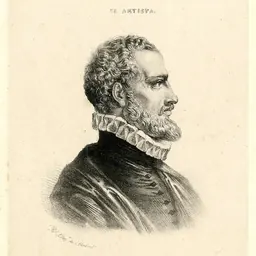
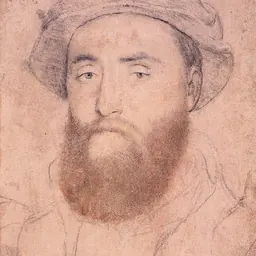


Contemporaries
People whose lives overlapped Cornelis Floris II's





Frequently asked questions
Who was Cornelis Floris II?
Flemish architect, sculptor and print artist (1514–1575)
When was Cornelis Floris II born?
Cornelis Floris II was born in 1514 in Antwerp.
When did Cornelis Floris II die?
Cornelis Floris II died on 20 October 1575 in Antwerp.
What was Cornelis Floris II's occupation?
Cornelis Floris II was an architect, sculptor, medalist, designer and visual artist.
What nationality was Cornelis Floris II?
Cornelis Floris II's recorded nationality: Flanders.
Sources & further reading
· Wikipedia: Cornelis Floris II
· DBpedia: Cornelis Floris de Vriendt
Cite this page
APA: Biography.guide. (2026). Cornelis Floris II. https://biography.guide/cornelis-floris-ii/
MLA: "Cornelis Floris II." Biography.guide, https://biography.guide/cornelis-floris-ii/.
Chicago: "Cornelis Floris II." Biography.guide. https://biography.guide/cornelis-floris-ii/.
Data last updated: 2026-09-22 · Spot an error? Report a correction.
Portrait: Wikimedia Commons · author & licence
Page generated 2026-09-27 05:03 UTC