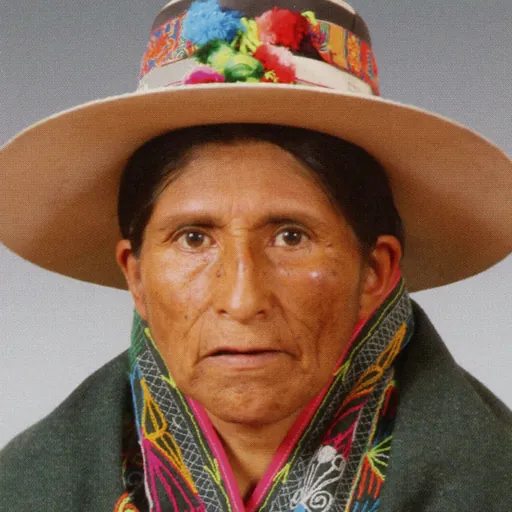
About Cornelia Flores
Born 1962. Cornelia Flores is a politician and trade unionist.
Cornelia Flores Choque (born 16 September 1962) is a Bolivian politician and trade unionist who represented Oruro's 34th constituency in the Constituent Assembly from 2006 to 2007 and as a substitute in the Chamber of Deputies from 2010 to 2015. Flores was raised in rural Cercado Province and headed her local branch of the Bartolina Sisa Federation. In 2006 and 2009, she was elected through the organization's alliance with the Movement Toward Socialism.
Early life and trade unionism Cornelia Flores was born on 16 September 1962 in Micayani, a small community in the Cercado Province of Oruro Department. She is the daughter of Miguel Flores Colque and Ascencia Choque Mamani, and is of indigenous Quechua origin. Flores attended school only through the fifth grade, receiving instruction in Aymara and Quechua; she has indicated that Spanish was not her first language.
Raised in rural poverty, Flores worked in agriculture and tended livestock. She emerged as a trade union leader in Micayani and was also active in women's social movement organizations. Prior to 2007, she spent eight years leading provincial women's organizations, including as local general secretary of the Bartolina Sisa Federation, the national peasant women's union, in Paria Municipality.
Constituent Assembly
Election
In politics, the Bartolinas affiliated with the Movement Toward Socialism (MAS) and received from it a share of representation in government and the legislature. In the run-up to the Constituent Assembly, the federation lobbied for and secured a gender quota in candidate lists; as a result, the Bartolinas attained a small bench of roughly eighteen seats within the MAS majority. Flores was elected to represent Oruro's 34th constituency.
Tenure Like other assembly members, Flores took office on 3 August 2006, and her term was extended from 6 August to 14 December 2007 due to delays in drafting the new constitution. She became a member of the Education and Interculturality Commission on 19 January 2007, after a lengthy period of deadlock. In that role, she promoted the recognition of indigenous cultures and languages and advocated the adoption of intercultural bilingual education. "We must defend both languages; it cannot be just Aymara and Quechua alone. Native languages must come first [in their regions], followed by Spanish", she stated.
Commission assignments Education and Interculturality Commission Culture and Sports Committee (2007)
Chamber of Deputies
Election
Entering 2009, the Bartolinas had difficulty pressuring for gender parity on the MAS candidate slate, as mandated by law. Particularly in single-member districts, male candidates took up most principal seats. In the 34th constituency, the party nominated Ever Moya, with Flores as his substitute. The MAS swept the vote in Oruro, and their ticket was elected to the Chamber of Deputies.
Tenure Flores was sworn in alongside other substitutes on 25 January 2010, and shared commission and committee assignments with Moya. During her term, she served as vice president of Oruro's legislative delegation, and sat on its Land, Territory, and Environment Commission. In legislation, she performed oversight on regional public works, and presented projects for rural electrification, potable water, and the conservation of Paria's colonial church, a historic sixteenth-century building on the verge of collapse.
Commission assignments Plural Justice, Prosecutor's Office, and Legal Defense of the State Commission Ordinary Jurisdiction and Magistracy Council Committee (2010–2011) Indigenous Native Peasant Jurisdiction Committee (2014–2015) Human Rights Commission (President: 2013–2014) Human Rights and Equal Opportunities Committee (Secretary: 2011–2012) Constitution, Legislation, and Electoral System Commission Constitutional Review and Legislative Harmonization Committee (2012–2013)
Electoral history + Year Office Party Votes Result . Total % . 2006 Constituent Movement Toward Socialism 23,906 66.12 1st 2009 Deputies Movement Toward Socialism 33,774 75.33 1st Source: Plurinational Electoral Organ Electoral Atlas
Don’t just read it —
keep it.
Full-length biographies made to live with: read them, listen on the way to work, watch them tonight.
- E-book
- Audio
- Video
Instant download · yours to keep · every purchase keeps this site free
Important facts
People in Cornelia Flores's life
Named in this biography and alive at the same time
Related people
Same field, nearest in time




Contemporaries
People whose lives overlapped Cornelia Flores's




Frequently asked questions
Who is Cornelia Flores?
Bolivian politician (born 1962)
When was Cornelia Flores born?
Cornelia Flores was born on 16 September 1962 in Paria.
What is Cornelia Flores's occupation?
Cornelia Flores is a politician and trade unionist.
Sources & further reading
Cite this page
APA: Biography.guide. (2026). Cornelia Flores. https://biography.guide/cornelia-flores/
MLA: "Cornelia Flores." Biography.guide, https://biography.guide/cornelia-flores/.
Chicago: "Cornelia Flores." Biography.guide. https://biography.guide/cornelia-flores/.
Data last updated: 2026-09-23 · Spot an error? Report a correction.
Portrait: Wikimedia Commons · author & licence
Page generated 2026-09-27 05:07 UTC