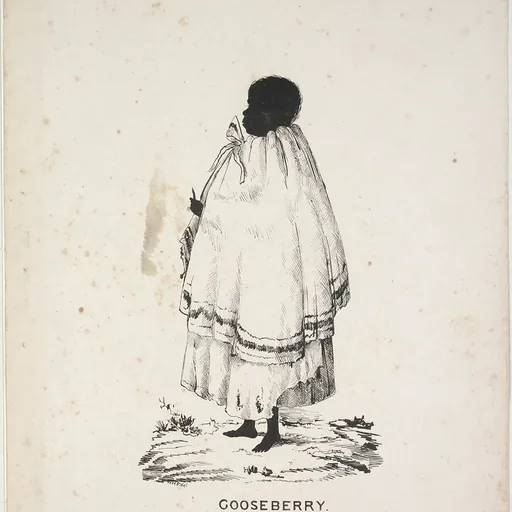
Cora Gooseberry
Indigenous Australian leader
About Cora Gooseberry
Lived 1777 – 1852 (aged 74–75).
Cora Gooseberry (also known as Queen Gooseberry and Lady Bungaree; – 30 July 1852) was an Indigenous Australian woman and cultural knowledge keeper of the Murro-ore-dial clan of the Eora nation. In popular culture, she is often depicted smoking a pipe and wearing a scarf on her head. She received two breastplates, one of which was inscribed "Cora Gooseberry/ Freeman/ Bungaree / Queen of Sydney and Botany". It is held by the Mitchell Library. her given Aboriginal Australian name, circa 1777. She was the daughter of Moorooboora (also known as Maroubra; circa 1758–1798), an important man of the Murro-ore-dial (Pathway Place) clan from what is now the Maroubra area of eastern Sydney, Australia.
Personal life
Cora was one of the two known wives of the notable Aboriginal explorer and celebrity Bungaree. After Bungaree's first wife, Matora, died in the mid-1820s, Cora became Bungaree's principal wife and the couple were readily identified in Sydney as the "king" and "queen" of the local Aboriginal population.
Bungaree and Cora were associated with a group of surviving Indigenous people from a number of coastal clans of the Sydney, Central Coast and Newcastle regions. They camped at various places along the eastern harbour, such as Georges Head, Rose Bay, Camp Cove, The Domain and Elizabeth Bay. Camp Cove in particular was a favourite place of residence, attracting up to a few hundred Indigenous people at any one time due to its fishing and cultural importance. Cora was widowed after Bungaree's death in 1830. After the death of her husband Bungaree in 1830, Cora Gooseberry became a leader among a regrouped band.
Cora continued living with other Aboriginal people at places such as Camp Cove into her older years, retaining cultural knowledge of the coastal Sydney area, only some of which she guardedly shared with enquiring British people.
In the last few years of her life, she moved into the city, where she became a resident at the hotels owned by her ex-convict friend named Edward Borton. According to her coroner's verdict, she had died of natural causes. She was buried in the Presbyterian section of the Sandhills cemetery, but her tombstone was relocated shortly afterwards. It is now located in Pioneers Cemetery, Botany.
Don’t just read it —
keep it.
Full-length biographies made to live with: read them, listen on the way to work, watch them tonight.
- E-book
- Audio
- Video
Instant download · yours to keep · every purchase keeps this site free
Important facts
Family & relationships
Contemporaries
People whose lives overlapped Cora Gooseberry's




Frequently asked questions
Who was Cora Gooseberry?
Indigenous Australian leader
When was Cora Gooseberry born?
Cora Gooseberry was born in 1777.
When did Cora Gooseberry die?
Cora Gooseberry died on 30 July 1852 in Australia, New South Wales, Sydney.
Sources & further reading
Cite this page
APA: Biography.guide. (2026). Cora Gooseberry. https://biography.guide/cora-gooseberry/
MLA: "Cora Gooseberry." Biography.guide, https://biography.guide/cora-gooseberry/.
Chicago: "Cora Gooseberry." Biography.guide. https://biography.guide/cora-gooseberry/.
Data last updated: 2026-09-22 · Spot an error? Report a correction.
Portrait: Wikimedia Commons · author & licence
Page generated 2026-09-27 05:01 UTC