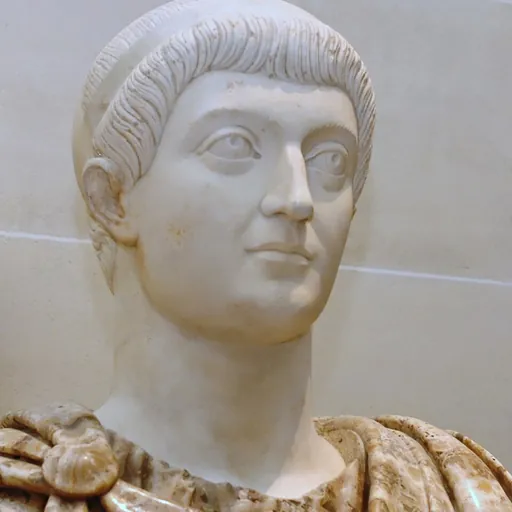
About Constans
Lived 320 – 350 (aged 29–30). Constans was a Roman and Byzantine politician.
Flavius Julius Constans ( 323 – 350), also called Constans I, was Roman emperor from 337 to 350. He held the imperial rank of caesar from 333, and was the youngest son of Constantine the Great.
After his father's death, he was made augustus alongside his brothers in September 337. Constans was given the administration of the praetorian prefectures of Italy, Illyricum, and Africa. He defeated the Sarmatians in a campaign shortly afterwards. In the following years he campaigned against the Franks, and in 343 he visited Roman Britain, Magnentius overthrew and killed Constans. According to the works of both Ausonius and Libanius, he was educated at Constantinople under the tutelage of the poet Aemilius Magnus Arborius, who instructed him in Latin.
On 25 December 333, Constans was elevated to the imperial rank of caesar at Constantinople by his father. Prior to 337, Constans became engaged to Olympias, the daughter of the praetorian prefect Ablabius, although the marriage did not actually happen.
After Constantine's death, Constans and his two brothers, Constantine II and Constantius II were proclaimed augusti and divided the Roman empire among themselves on 9 September 337. Constans was left with Italy, Africa and Illyricum. In 338, he campaigned against the Sarmatians.
Meanwhile, Constans came into conflict with his eldest brother Constantine II over the latter's presumed authority over Constans' territory. After attempting to issue legislation to Africa in 339, which was part of Constans' realm, Constantine led his army into an invasion of Italy only a year later. However, he was ambushed and killed by Constans' troops, and Constans then took control of his brother's territories.
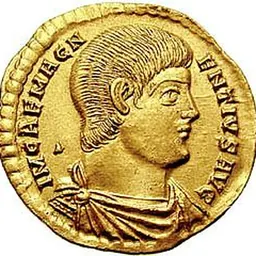
Gold medallion of Constans, equivalent to 9 solidi. Aquileia, 342 AD – Bode Museum
Constans began his reign in an energetic fashion. From 341 to 342, he led a campaign against the Franks where, after an initial setback, the military operation concluded with a victory and a favorable peace treaty. Eutropius wrote that he "had performed many gallant actions in the field, and had made himself feared by the army through the whole course of his life, though without exercising any extraordinary severity," while Ammianus Marcellinus remarked that Julian was the only person the Alamanni feared after the death of Constans.
In the early months of 343, he visited Britain, an event celebrated enough for Libanius to dedicate several sections of his panegyric to explaining it. Although the reasons for the visit remain unclear, the ancient writers were primarily interested in Constans' precarious journey to the province, rather than his actions within it. One theory considers it to have involved the northern frontier, based on Ammianus' remark that he had discussed the Areani in his now-lost coverage of Constans' reign. Additionally, after recording attacks "near the frontiers" in 360, the historian wrote that the Alamanni were too much of a threat for Julian to confront the problem, in contrast to what Constans was able to do.
Constans was accused of employing corrupt ministers during his reign, due to his purported personal greed. One example included the magister officiorum (master of the offices) Flavius Eugenius, who remained in his position throughout most of the 340s. Despite Eugenius being alleged to have misused his power to seize property, the emperor continued to support him, his trust going as far as to honor him with a statue in the Forum of Trajan in Rome.
Religion Constans issued an edict banning superstition and pagan sacrifices in 341, his justification being that he was following the precedent set by his father. Only a short while later though, he tried to moderate his stance by legislating against the destruction of temple buildings.
Constans' support of Nicene orthodoxy and the bishop Athanasius of Alexandria brought him into conflict with his brother Constantius. Although the two emperors called the Council of Serdica in 343 to settle the conflict, it was a complete failure, and by 345 Constans was outright threatening civil war against his brother. Eventually, Constantius agreed to allow Athanasius to return to his position, as the bishop's replacement had recently died. Constans also used the military to suppress Donatism in Africa, where the church was split between Donatists and Catholics.
Alleged homosexuality Constans was targeted with gossip over his personal life. Numerous ancient writers suspected him of homosexuality, perhaps because he never married. Aurelius Victor charged the emperor with "rabid" pederasty towards young barbarian hostages, and asserted it was a contributing factor to his unpopularity. Modern scholars have generally doubted the veracity of these claims, with some of them pointing to Constans' legislation against homosexuality in 342.
Death
On 18 January 350, the general Magnentius declared himself emperor at Augustodunum (Autun) with the support of a number of court officials such as Marcellinus, Constans' comes rerum privatarum, as well as Fabius Titianus, who had previously served as the praetorian prefect of Gaul. At the time, Constans was distracted by a hunting trip. As he was trying to reach Hispania, supporters of Magnentius cornered him in a fortification in Helena (Elne) in the eastern Pyrenees of southwestern Gaul, where he was killed after seeking sanctuary in a temple. An alleged prophecy at his birth had said Constans would die "in the arms of his grandmother". His place of death happens to have been named after Helena, mother of Constantine and his own grandmother, thus realizing the prophecy. Constans' name would later be erased from inscriptions in places that recognized Magnentius as emperor.
Ancient sources agree that Constans was overthrown due to his own failings, which caused him to become widely unpopular. Along with the accusation of corruption and homosexuality, he is also accused of neglecting portions of the empire and treating his soldiers with contempt. Ammianus lamented the emperor's failure to listen to wise counsel, referencing one man he believed could have saved Constans from his own faults.
However, some modern scholars have questioned this portrayal. According to historian Jill Harries, "The detail that Constans was in the habit of making journeys with only a small escort may account for his vulnerability in 350." Based on several factors - the small number of people behind the plot, how the setting for Magnentius' coup was not a military centre, Vetranio's proclamation as emperor in opposition to Magnentius, and Julian's report that the usurper had to murder several of Constans' generals to take control of the Gallic army – she concluded that Magnentius' revolt was "the result of a private grudge on the part of an apprehensive official and not the outcome of widespread discontent among the military or the wider population." This view is supported by Peter Crawford, who considered the explanation from the ancient sources to be a misconception caused by the rapid success of the coup.
Nonetheless, Harries does acknowledge a few factors that indicate Constans faced significant opposition from the military. The Gallic army accepted Magnentius seemingly without difficulty, and according to Zosimus, Constantius' official Philippus emphasized Constantine, rather than Constans, when addressing Magnentius' troops. On speculating the basis for Constans' downfall, she suggested that one reason may have been regarding financial difficulties in Gaul by the end of his reign, which could have been related to the finance officer Marcellinus' support of him. After Magnentius took power, he levied taxes, sold imperial estates in Gaul and debased the coinage. Nicholas Baker-Brian also observed how Magnentius sent his brother Decentius to defend the region after Constans had neglected it, writing that, "it is apparent that among the reasons for Magnentius' rebellion was a desire to remedy Constans' governmental failings in Gaul."
Family tree
Emperors are shown with a rounded-corner border with their dates as Augusti, names with a thicker border appear in both sections
1: Constantine's parents and half-siblings
2: Constantine's children
Don’t just read it —
keep it.
Full-length biographies made to live with: read them, listen on the way to work, watch them tonight.
- E-book
- Audio
- Video
Instant download · yours to keep · every purchase keeps this site free
Important facts
Family & relationships
People in Constans's life
Named in this biography and alive at the same time


Related people
Same field, nearest in time

Contemporaries
People whose lives overlapped Constans's




Frequently asked questions
Who was Constans?
Roman emperor from 337 to 350
When was Constans born?
Constans was born in 320 in Italy.
When did Constans die?
Constans died on 18 January 350 in Elne.
What was Constans's occupation?
Constans was a politician.
What nationality was Constans?
Constans was Roman and Byzantine.
Sources & further reading
Cite this page
APA: Biography.guide. (2026). Constans. https://biography.guide/constans-politician/
MLA: "Constans." Biography.guide, https://biography.guide/constans-politician/.
Chicago: "Constans." Biography.guide. https://biography.guide/constans-politician/.
Data last updated: 2026-09-21 · Spot an error? Report a correction.
Portrait: Wikimedia Commons · author & licence
Page generated 2026-09-27 04:59 UTC