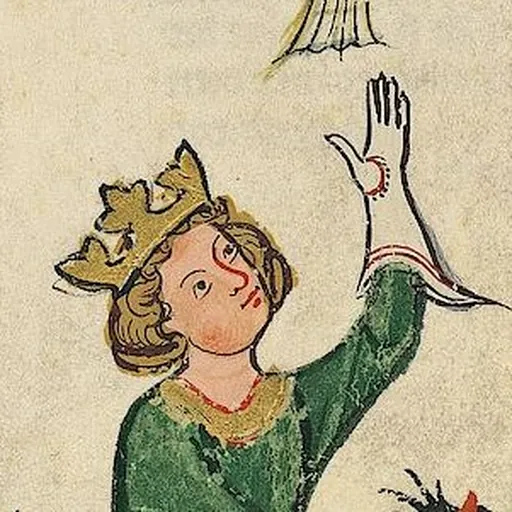
About Conradin
Lived 1252 – 1268 (aged 16). Conradin was a minnesänger, composer and writer.
Conrad III (25 March 1252 – 29 October 1268), called the Younger or the Boy, but usually known by the diminutive Conradin (, ), was the last direct heir of the House of Hohenstaufen. He was Duke of Swabia (1254–1268) and nominal King of Jerusalem (1254–1268) and Sicily (1254–1258). After his attempt to reclaim the Kingdom of Sicily for the Hohenstaufen dynasty failed, he was captured and beheaded.
With the death of Conradin, the House of Hohenstaufen ceased to exist. Although many emperors continued to have some Hohenstaufen heritage.
Early childhood Conradin was born in Wolfstein, Bavaria, to Conrad IV of Germany and Elisabeth of Bavaria. Though he never succeeded his father as Roman-German king, he was recognized as king of Sicily and Jerusalem by supporters of the Hohenstaufens in 1254.
Having lost his father in 1254, he grew up at the court of his uncle and guardian, Louis II, Duke of Bavaria. His guardians were able to hold Swabia for him. Jerusalem was held by a relative from the royal house of Cyprus as regent. In Sicily, his father's half-brother Manfred continued as regent, but began to develop plans to usurp the kingship.
Little is known of his appearance and character except that he was as "beautiful as Absalom, and spoke good Latin".
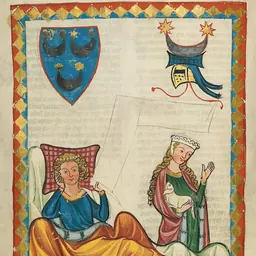
Political and military career Having assumed the title of King of Jerusalem and Sicily, Conradin took possession of the Duchy of Swabia in 1262, and remained for some time in his duchy. His remains, with those of Frederick of Baden, lie in the church of the monastery of Our Lady of Mt. Carmel at Naples, founded by his mother for the good of his soul; and here in 1847 Maximilian, crown prince of Bavaria, erected a marble statue by Bertel Thorvaldsen to his memory. In the 14th-century Codex Manesse, a collection of medieval German lyrics, preserved at Heidelberg, there appear two songs written by Conradin, and his fate has formed the subject of several dramas. Conradin : a philosophical ballad was written by C. R. Ashbee, dedicated to his patron and friend Colonel Shaw Hellier, and published in 1908 by Essex House Press, "one of the most significant private presses at work during the Arts and Crafts movement"
The novel Põlev lipp (The Burning Banner) by Karl Ristikivi (1961; in Estonian) depicts Conradin's Italian campaign. A translation into the French by L'étendard en flammes, was published in Paris in 2005.
Don’t just read it —
keep it.
Full-length biographies made to live with: read them, listen on the way to work, watch them tonight.
- E-book
- Audio
- Video
Instant download · yours to keep · every purchase keeps this site free
Important facts
Family & relationships
Related people
Same field, nearest in time


Frequently asked questions
Who was Conradin?
Duke of Swabia, King of Jerusalem and King of Sicily (1252–1268)
When was Conradin born?
Conradin was born on 25 March 1252 in Burgruine Wolfstein.
When did Conradin die?
Conradin died on 29 October 1268 in Naples.
What was Conradin's occupation?
Conradin was a minnesänger, composer and writer.
What nationality was Conradin?
Conradin's recorded nationality: Kingdom of Jerusalem.
Sources & further reading
Cite this page
APA: Biography.guide. (2026). Conradin. https://biography.guide/conradin/
MLA: "Conradin." Biography.guide, https://biography.guide/conradin/.
Chicago: "Conradin." Biography.guide. https://biography.guide/conradin/.
Data last updated: 2026-09-23 · Spot an error? Report a correction.
Portrait: Wikimedia Commons · author & licence
Page generated 2026-09-27 05:05 UTC