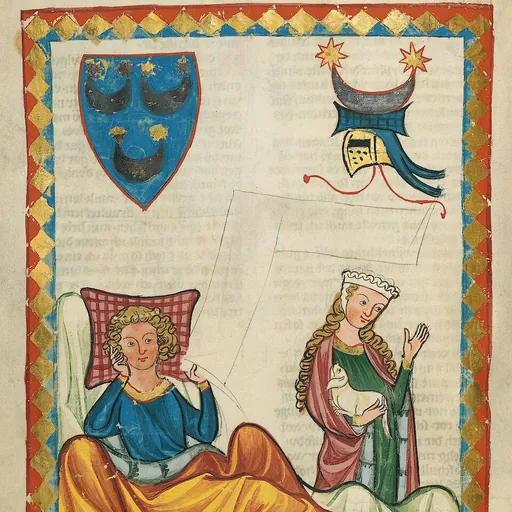
About Heinrich von Morungen
Lived 1200 – 1222. Heinrich von Morungen was a German minnesänger, composer, writer and poet.
Heinrich von Morungen (died 1222) was a Minnesinger, whose 35 surviving Middle High German songs are dated on both literary and biographical grounds to around the period 1190–1200. Alongside Walter von der Vogelweide and Reinmar, he is regarded as one of the most important Minnesänger: he was "the most colourful, passionate, tender and musical of the Minnesänger" and his work "marks a new and brilliantly effective stage in the development of the German lyric."
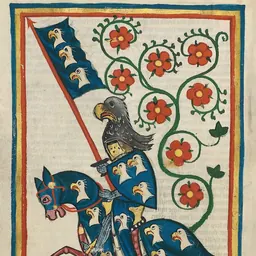
Life Memorial for Heinrich von Morungen in the grounds of St Thomas's Church, Leipzig. Morungen is identified with the Hendricus de Morungen who is mentioned in two charters of Dietrich I, Margrave of Meissen. This Hendricus presumably originated from the castle of Morungen near Sangerhausen in Saxony-Anhalt, a location consistent with the language of the songs. As a "retired knight" (miles emeritus) he received from his patron Dietrich, also a patron of Walter von der Vogelweide, a pension for his "high personal merits" (alta suae vitae merita). In 1213 he transferred this to the monastery of St Thomas in Leipzig, which he entered himself in 1217. According to a 16th century source based on the records of the monastery, he died there in 1222. The same source reports a certainly apocryphal story of a visit to India.
In the Late Middle Ages, there was extant a ballad of Der edele Möringer ("The Noble Moringer"), which transferred to Heinrich von Morungen the stock theme of the return of a husband believed lost.
Works Manuscript tradition The manuscript tradition preserves 115 strophes of Morungen's, constituting 35 songs. He is represented in the three main Minnesang manuscripts:. MS A (the Kleine Heidelberger Liederhandschrift, 1270-1280) has 29 strophes under Morungen's name, though three of these are ascribed to Ulrich von Singenberg in MS C. MS B (the Weingarten Manuscript, first quarter of the 14th Century) has 25 strophes under Morungen's name and three under Dietmar von Aist's. MS C (the Große Heidelberger Liederhandschrift, the Manesse Codex, c. 1304) has by far the largest collection, with 104 strophes under Morungen's name. Of these 43 appear in the "Tross Fragment" (MS Ca), which is based on C.
Four other manuscripts have small amounts of additional material:
MS E (the Würzburg Manuscript (LMU Munich, Universitätsbibliothek, 2° Cod. Ms. 731c., the Housebook of Michael de Leone, 1345-1354) has eight strophes (two songs) of Morungen's under the names of Walther von der Vogelweide and Reinmar. MS M (the Carmina Burana MS, Munich, Staatsbibliothek, clm 4660) has a single anonymous strophe matching one in C. It is the only Morungen text with neumes. MS p (Berne, Burgerbibliothek, Cod. 260) has four strophes of Morungen's. MS S (the Kremsmünster fragment, CC248) has three strophes of the song "Sîn hiez mir nie widersagen" (MF 130,9), including one strophe not in any other MS. At the end of this song on folio 78r of MS C a space large enough for a single strophe has been left, which may have been intended for the additional strophe.
Themes
An essential theme in Morungen's work is the demonic nature of Minne, the Middle High German word for this type of love, which for the mediaeval writers was embodied by the ancient classical goddess of love, Venus. Minne is experienced partly as a magical, pathological, even fatal power, but also as a religious and mystical experience.
Morungen is a very graphic lyricist: he particularly often makes use of images of shining (sun, moon, evening star, gold, jewels, mirror) as comparisons by which to describe the lady who is being sung and praised.
In form and content the poems are influenced by the Provençal troubadour lyric: dactylic rhythms and through-rhymes (Durchreimung) occur frequently. Motifs in the content have also been taken over from the same source: for example, the motif, otherwise rare in German Minnesang, of the "notice of termination of the service of love" (Lied XXVII), the roots of which are to be found in classical literature (for example Ovid).
Legacy Although Morungen is explicitly named in the works of later poets more rarely than Walther or Reinmar, his surviving corpus of 35 songs is larger than that of any contemporary Minnesänger other than these two, and his influence on the Minnesang tradition was considerable.
The Songs
Don’t just read it —
keep it.
Full-length biographies made to live with: read them, listen on the way to work, watch them tonight.
- E-book
- Audio
- Video
Instant download · yours to keep · every purchase keeps this site free
Important facts
People in Heinrich von Morungen's life
Named in this biography and alive at the same time
Related people
Same field, nearest in time



Contemporaries
People whose lives overlapped Heinrich von Morungen's



Frequently asked questions
Who was Heinrich von Morungen?
German minnesinger
When was Heinrich von Morungen born?
Heinrich von Morungen was born in 1200 in Sangerhausen.
When did Heinrich von Morungen die?
Heinrich von Morungen died in 1222 in Leipzig.
What was Heinrich von Morungen's occupation?
Heinrich von Morungen was a minnesänger, composer, writer and poet.
What nationality was Heinrich von Morungen?
Heinrich von Morungen was German.
Sources & further reading
· Wikipedia: Heinrich von Morungen
· DBpedia: Heinrich von Morungen
Cite this page
APA: Biography.guide. (2026). Heinrich von Morungen. https://biography.guide/heinrich-von-morungen/
MLA: "Heinrich von Morungen." Biography.guide, https://biography.guide/heinrich-von-morungen/.
Chicago: "Heinrich von Morungen." Biography.guide. https://biography.guide/heinrich-von-morungen/.
Data last updated: 2026-09-20 · Spot an error? Report a correction.
Portrait: Wikimedia Commons · author & licence
Page generated 2026-09-27 04:57 UTC